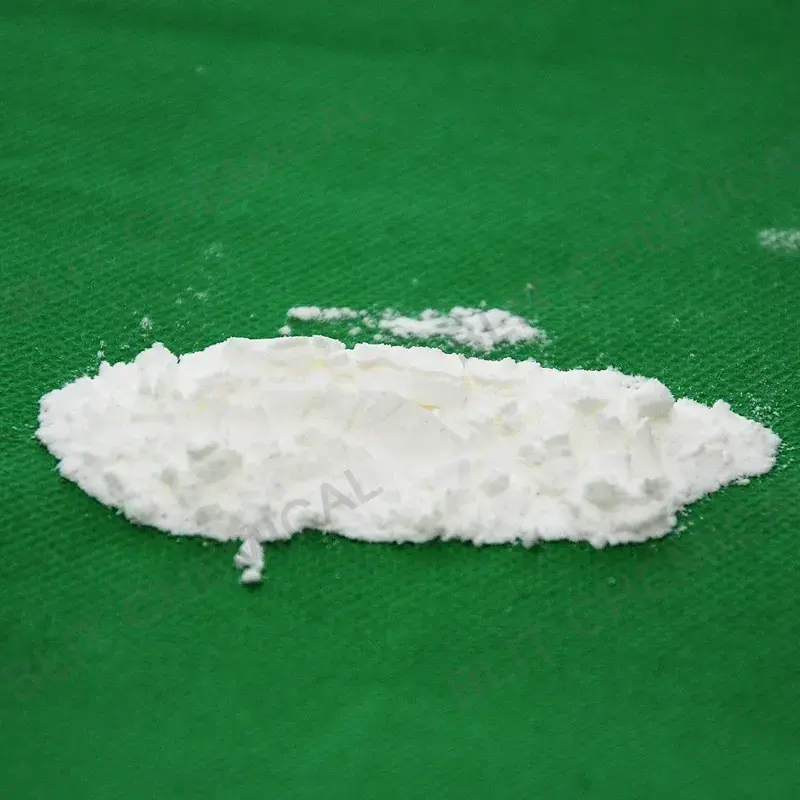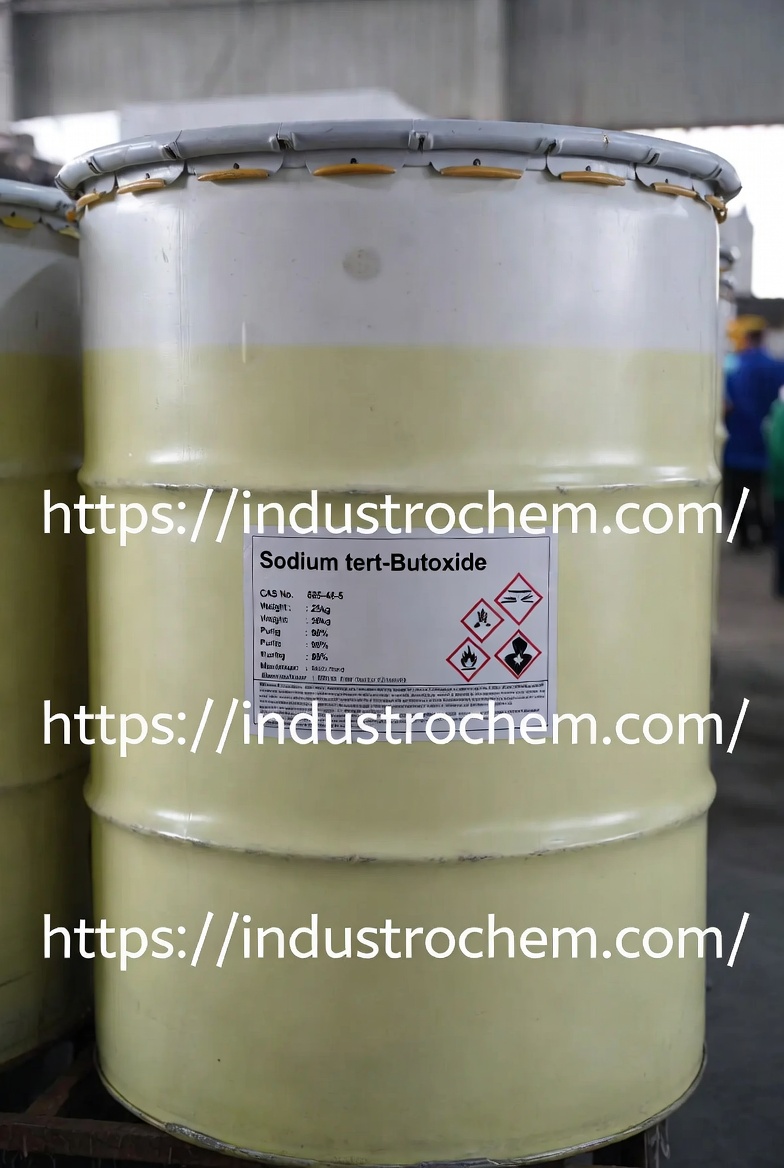
Sodium tert-Butoxide, also called sodium tert-butylate or NaOtBu, CAS 865-48-5, is a strong, sterically hindered alkoxide base supplied as a white to off-white hygroscopic powder or a solution in compatible solvents, positioned for organic synthesis and pharmaceutical intermediate production. Confirm the required form, then request a quotation with COA/TDS/SDS for bulk supply.
Sodium tert-Butoxide (NaOtBu) CAS 865-48-5
- CAS: 865-48-5
- Synonyms: Sodium tert-butylate; Sodium t-butoxide; NaOtBu
- Einecs: 212-741-9
- Molecular Formula: C₄H₉NaO
- Grade: Industrial synthesis / reagent grade
- Package: Sealed, moisture-protected packaging
Product Description
Sodium tert-Butoxide (NaOtBu) CAS 865-48-5 is a strong, sterically hindered alkoxide base with EC 212-741-9 and molecular formula C4H9NaO.
Synonyms: Sodium tert-butylate; Sodium t-butoxide; NaOtBu.
CAS: 865-48-5.
Molecular formula: C4H9NaO.
It is supplied as a white to off-white hygroscopic powder or as a solution in compatible solvents such as tert-butanol.
It has a molecular weight of about 96.10 g/mol.
It is positioned as a highly reactive alkoxide base for deprotonation, condensation and elimination reactions.
It is used in organic synthesis, fine chemical and pharmaceutical intermediate production.
It is used in palladium-catalyzed C-N or C-C coupling such as Buchwald-Hartwig amination.
Its bulky tert-butoxide group provides strong basicity with relatively low nucleophilicity for selective transformations.
It is hygroscopic and reacts vigorously with water and acids to form tert-butanol and sodium hydroxide.
Confirm the required solid or solution form, assay, appearance, and related specifications for the chosen grade.
Check compatibility with the target solvent system, substrate, and reaction or catalytic cycle.
Store in tightly sealed, moisture-resistant containers in a cool, dry, well-ventilated area, away from water, acids, oxidizers, heat and open flames.
Use appropriate PPE and handle under dry or inert-gas conditions, keeping the material away from humidity.
Confirm packaging suitable for the solid or solution form and order quantity, and follow the current SDS.
Confirm grade, packaging, and specification as required.
The page is an RFQ entry point and does not state stock, price, MOQ, or fixed lead time.
For an RFQ, state the intended application, required form and grade, quantity, packaging, destination, and document needs.
FAQ - Technical & Supply Chain
-
Q:
What is Sodium tert-Butoxide CAS 865-48-5?
A: Sodium tert-Butoxide, also called sodium tert-butylate or NaOtBu, is a strong, sterically hindered alkoxide base with the formula C4H9NaO, molecular weight 96.10 g/mol, and EC number 212-741-9. It is supplied as a white to off-white hygroscopic powder or as a solution in compatible solvents, and it is widely used in organic synthesis. -
Q:
Why is Sodium tert-Butoxide preferred over sodium hydride in some pharmaceutical reactions?
A: Sodium tert-Butoxide is a strong base with bulky tert-butoxide groups, so it can promote deprotonation and coupling steps while being less likely to participate as a nucleophile. In selected pharmaceutical oxygen alkylation or palladium-catalyzed reactions, it can offer a more controlled and safer alternative to sodium hydride because the base is available as a stable powder or solution and can avoid the vigorous hydrogen evolution associated with hydride reagents. -
Q:
Can NaOtBu be freely substituted by potassium or lithium tert-butoxide?
A: No. Sodium, potassium, and lithium tert-butoxides are not freely interchangeable because the alkali-metal counterion affects aggregation, solubility, base strength, and reaction selectivity. The correct tert-butoxide should be chosen for the specific solvent system, substrate, and catalytic cycle rather than replacing NaOtBu on a molar basis. -
Q:
What are the main applications of Sodium tert-Butoxide?
A: Sodium tert-Butoxide is used for deprotonation, elimination, condensation, rearrangement, and ring-opening reactions. It is especially important in pharmaceutical and fine chemical synthesis, agrochemical intermediates, polymerization or isomerization catalysis, and palladium-catalyzed C-N or C-C coupling such as Buchwald-Hartwig amination. -
Q:
Why does Sodium tert-Butoxide require dry, air-sensitive handling?
A: NaOtBu is hygroscopic and reacts vigorously with water, acids, and moisture to form tert-butanol and sodium hydroxide. It should therefore be handled under dry conditions or inert gas, kept away from humidity, and used promptly after opening sealed containers. -
Q:
How should Sodium tert-Butoxide be stored and supplied?
A: Store it in tightly sealed, moisture-resistant containers in a cool, dry, well-ventilated area, away from water, acids, oxidizers, heat, and open flames. Solid grades are commonly supplied in sealed drums or air-sensitive containers, while solution grades may be supplied in THF, tert-butanol, or another compatible solvent system to maintain stability during transport and storage.
Ordering & Documentation
Key information for document requests, quotations, and supply planning.
Documents
Tell us which documents your procurement team needs. Before an order, we will check whether the quoted source can provide them for the offered lot.
Quotation
Send the CAS number, grade, quantity, packing preference and destination.
Sample & Supply
Ask whether samples, trial quantities or repeat orders are possible. We will check each request against the sourced product and current offer.
Storage & Shipping
Product-specific conditions are confirmed before order.