










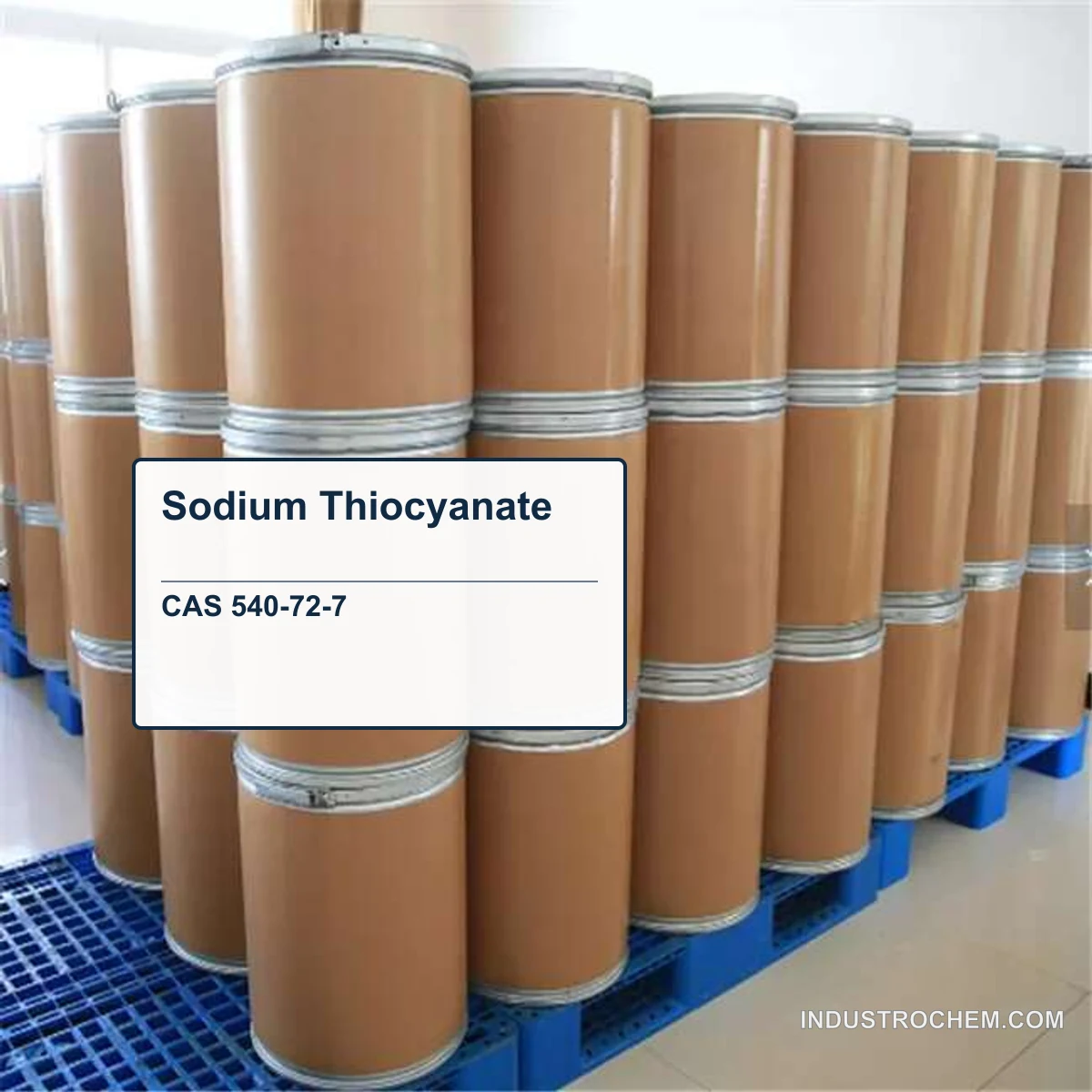
Sodium Thiocyanate, CAS 540-72-7, is also known as sodium rhodanide. It is an inorganic sodium salt containing the thiocyanate anion. Confirm whether an anhydrous or hydrate form is required, the required analytical limits and intended industrial process, quantity, packaging, destination and document availability before ordering.
Sodium Thiocyanate CAS 540-72-7
- CAS: 540-72-7
- Synonyms: Sodium Thiocyanate; Sodium Rhodanide; Thiocyanic Acid Sodium Salt
- Einecs: 208-754-4
- Molecular Formula: NaSCN
- Grade: Solid or solution grade; assay, concentration and impurity limits per offered specification.
- Package: Moisture-resistant bag or drum for solid, or compatible IBC or tank for solution; confirm form and net quantity.
Product Description
Identity and procurement review
Sodium Thiocyanate, CAS 540-72-7, is an inorganic sodium salt containing the thiocyanate anion. Before an RFQ, confirm: whether an anhydrous or hydrate form is required, the required analytical limits, and the intended industrial process; quantity, packaging, destination and document availability.
| Field | Current product-specific specification |
| Chemical identity | Sodium Thiocyanate; CAS 540-72-7 |
| Molecular formula | NaSCN |
| Molar mass | 81.07 g/mol |
| Offered physical form | Confirm the offered physical form in the current product-specific specification. |
| Grade and assay | Confirm the required value in the current product-specific specification. |
| Impurity limits | Confirm the required value in the current product-specific specification. |
| Physical data | Confirm the required value in the current product-specific specification. |
| Packaging | Confirm packaging compatible with the offered form and destination requirements. |
| Documents | Request current product-specific specifications, packaging details and document availability. |
Application boundary
Sodium Thiocyanate is an inorganic sodium salt containing the thiocyanate anion. CAS 540-72-7 identifies Sodium Thiocyanate. If a hydrate is required, specify that form separately in the RFQ.
- Sodium Thiocyanate is an inorganic sodium salt containing the thiocyanate anion. CAS 540-72-7 identifies Sodium Thiocyanate. If a hydrate is required, specify that form separately in the RFQ.
- Confirm the offered physical form in the current product-specific specification.
- Confirm the required value in the current product-specific specification.
- In the RFQ, state: whether an anhydrous or hydrate form is required, the required analytical limits, and the intended industrial process; quantity, packaging, destination and required documents.
- Request current product-specific specifications, packaging details and document availability.
Procurement information
In the RFQ, state: whether an anhydrous or hydrate form is required, the required analytical limits, and the intended industrial process; quantity, packaging, destination and required documents.
- Request current product-specific specifications, packaging details and document availability.
- Confirm packaging compatible with the offered form and destination requirements.
- State the required form, quantity, intended use, packaging, destination and document needs in the RFQ.
Handling and safety review
Storage review
Use the current product-specific SDS and specification to review handling, storage and local regulatory suitability.
Safety review
- Use the current product-specific SDS and specification to review handling, storage and local regulatory suitability.
- Request current product-specific specifications, packaging details and document availability.
- State the required form, quantity, intended use, packaging, destination and document needs in the RFQ.
- Confirm the required value in the current product-specific specification.
FAQ - Technical & Supply Chain
-
Q:
Does CAS 540-72-7 cover both solid Sodium Thiocyanate and commercial aqueous solution?
A: CAS 540-72-7 identifies sodium thiocyanate, NaSCN, but the quotation must still distinguish dry crystals or powder from an aqueous solution and state the solution concentration. Do not substitute ammonium, potassium or calcium thiocyanate. Specify the required form and concentration. -
Q:
What is Sodium Thiocyanate used for?
A: It is used in acrylic-fiber spinning and solvent systems, metal treatment, photochemical and electroplating processes, and as a chemical intermediate or analytical reagent. The required purity and cyanide-related impurity profile depend on the process and whether it is supplied as solid or solution. -
Q:
Which batch limits should be compared for Sodium Thiocyanate?
A: For solid material, compare NaSCN assay on the agreed basis, water or loss on drying, pH, color, iron, sulfate, sulfide, chloride and water-insoluble matter where relevant. For solution, add concentration, density and clarity. Put identical test methods and acceptance limits in the quotation and purchase order. -
Q:
What handling and safety points apply to Sodium Thiocyanate?
A: Keep thiocyanate materials away from strong acids, strong bases and oxidizing agents because harmful decomposition gases can form. Store solid material dry and avoid dust generation, and confirm local exposure, waste and transport controls before transfer or blending. -
Q:
What should be confirmed before bulk or packaged Sodium Thiocyanate delivery?
A: Confirm moisture-resistant bags or drums for solid material, or compatible IBC or tank construction for solution, together with net quantity, seal condition, sampling and unloading arrangements. State intended use and the required solid form or solution concentration.
Ordering & Documentation
Key information for document requests, quotations, and supply planning.
Documents
Tell us which documents your procurement team needs. Before an order, we will check whether the quoted source can provide them for the offered lot.
Quotation
Send the CAS number, grade, quantity, packing preference and destination.
Sample & Supply
Ask whether samples, trial quantities or repeat orders are possible. We will check each request against the sourced product and current offer.
Storage & Shipping
Product-specific conditions are confirmed before order.