










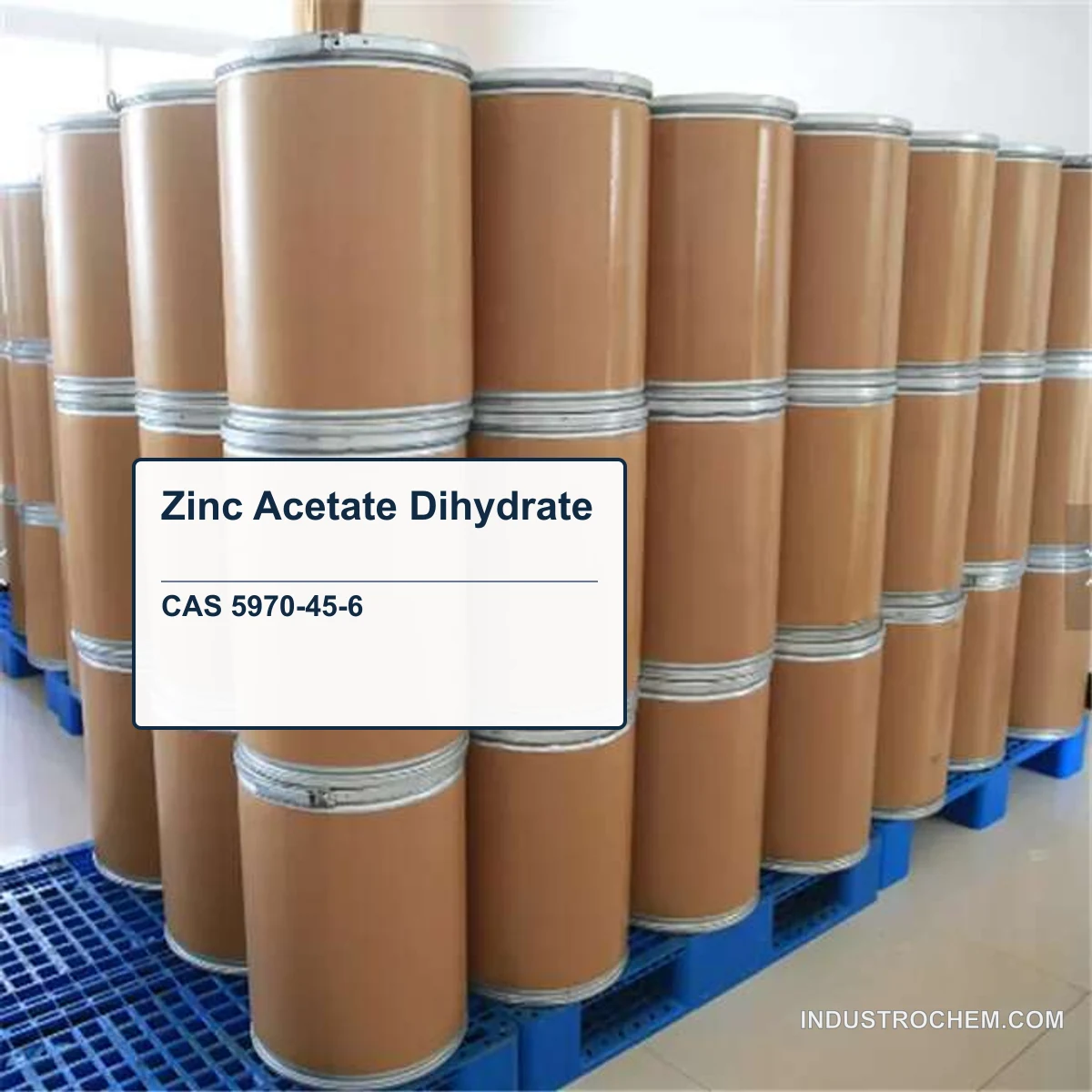
Zinc Acetate Dihydrate, CAS 5970-45-6, is the hydrated zinc salt of acetic acid with the formula Zn(CH₃COO)₂·2H₂O. Commercial grades are selected by assay method and limits for chloride, sulfate, insoluble matter, iron and other metals according to the intended industrial process. For purchasing, confirm the required grade, analytical basis, quantity and moisture-resistant packing; current COA, TDS and SDS can be provided for the offered specification.
Zinc Acetate Dihydrate CAS 5970-45-6
- CAS: 5970-45-6
- Synonyms: Zinc Acetate, Zinc Acetate Dihydrate, Zinc Ethanoate, Acetic Acid Zinc Salt
- Einecs: 209-170-2
- Molecular Formula: C₄H₁₀O₆Zn
- Grade: Assay and impurity limits to the agreed dihydrate specification
- Package: Moisture-resistant lined bag or fibre drum; confirm net weight and grade requirements
Product Description
Zinc Acetate Dihydrate
Zinc Acetate Dihydrate, CAS 5970-45-6, is supplied as a crystalline powder with a typical 99% assay.
Zinc Acetate Dihydrate is used in zinc salts and catalysts, textile dyeing as a mordant, photography and buffer systems, animal-feed applications, printing and dyeing, polymerization additives, polymer stabilizers and specialty chemical synthesis.
For related zinc-compound raw materials, see Zinc Oxide and Zinc Carbonate.
Packaging: two-layer plastic inner bag inside an outer plastic woven bag, 25 kg net.
Storage: Store sealed in a dry, cool and well-ventilated place.
FAQ - Technical & Supply Chain
-
Q:
Is Zinc Acetate Dihydrate CAS 5970-45-6 the same as anhydrous Zinc Acetate?
A: No. CAS 5970-45-6 identifies the dihydrate, Zn(CH₃COO)₂·2H₂O, while anhydrous Zinc Acetate is commonly listed under CAS 557-34-6. The hydration state changes molecular weight and assay calculations, so it must be explicit on the order and batch analysis. -
Q:
What is Zinc Acetate Dihydrate used for?
A: It is used in zinc salts and catalysts, textile dyeing as a mordant, photography and buffer systems, animal-feed applications, polymerization additives, polymer stabilizers and specialty chemical synthesis. The required purity and metal limits depend on whether it is technical, feed or pharmaceutical grade. -
Q:
How should Zinc Acetate Dihydrate assay be compared between suppliers?
A: Compare the stated formula, assay range, analytical method and reporting basis. Some grades use complexometric titration and may report a range around theoretical content, while application standards may use different limits. Do not compare percentages without matching the basis. -
Q:
Which impurity limits should be requested for Zinc Acetate Dihydrate?
A: Select limits according to the application, commonly including chloride, sulfate, insoluble matter, iron and metals such as lead or copper. State the required industrial, technical or compendial standard and review the batch analysis against that exact specification. -
Q:
What packaging and storage should be confirmed for Zinc Acetate Dihydrate?
A: Confirm moisture-resistant lined bags or fibre drums, net weight and grade requirements. Store sealed in a dry, cool, well-ventilated place, and state the required analytical specification and delivery form before ordering.
Ordering & Documentation
Key information for document requests, quotations, and supply planning.
Documents
COA, TDS, SDS/MSDS and packing details are available on request.
Quotation
Send the CAS number, grade, quantity, packing preference and destination.
Sample & Supply
Support is available for samples, trial orders, bulk and repeat supply.
Storage & Shipping
Product-specific conditions are confirmed before order.
