Chemical products
  • Sodium Bis(2-ethylhexyl) Sulfosuccinate (DOSS/AOT) CAS 577-11-7

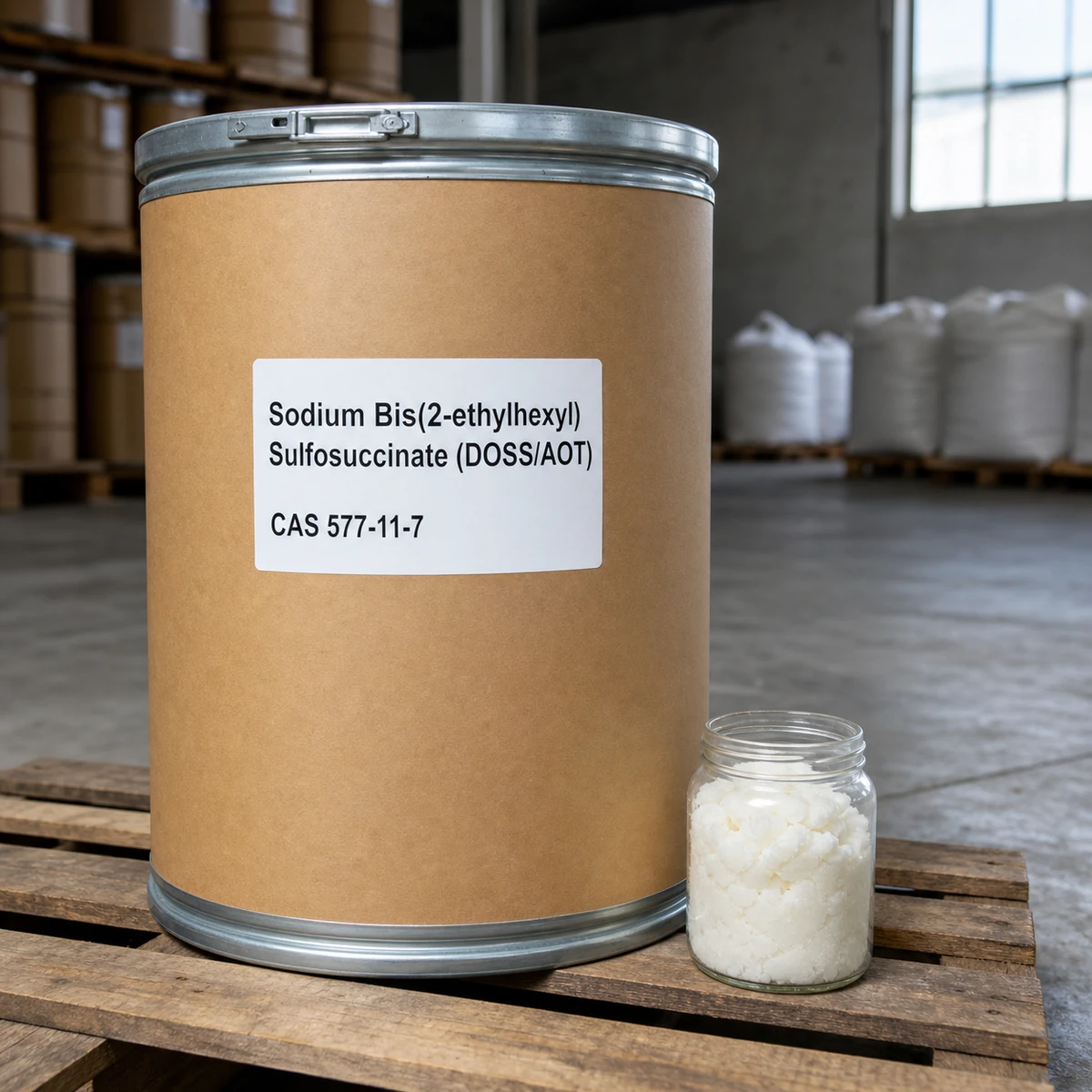
Sodium Bis(2-ethylhexyl) Sulfosuccinate (DOSS/AOT) CAS 577-11-7

Sodium bis(2-ethylhexyl) sulfosuccinate , commonly abbreviated DOSS or AOT , is an anionic sulfosuccinate surfactant identified by CAS No. 577-11-7 and EC No. 209-406-4 . It is used where rapid wetting, dispersion or emulsification is required. Commercial grades may be supplied at different active-matter levels and in different carriers, so concentration, water, acidity, color, physical form and wetting performance must be confirmed on the current TDS and COA. Industrial supply does not by itself establish suitability for pharmaceutical, food or other regulated applications.

  • CAS: 577-11-7
  • Synonyms: Sodium Bis(2-ethylhexyl) Sulfosuccinate, Sodium Diethylhexyl Sulfosuccinate, DOSS, AOT
  • Einecs: 209-406-4
  • Molecular Formula: C₂₀H₃₇NaO₇S
  • Grade: Confirm the commercial grade code, composition or active matter, key analytical values, physical form and intended-use documents against the current TDS and COA.
  • Package: State required quantity, physical form and destination; confirm the current bag or container, liner, net weight, temperature handling and transport requirements before quotation.
Request a quote
Share:

Product Description

Physicochemical profile

ItemTechnical guidance
Product identitySodium bis(2-ethylhexyl) sulfosuccinate, commonly abbreviated DOSS or AOT
CAS / EC577-11-7 / 209-406-4
Molecular formulaC₂₀H₃₇NaO₇S
Commercial formSolid active material or a formulated liquid at a stated active-matter level in a specified carrier
Key quality controlsActive matter, carrier composition, water, acidity or pH, color, physical form and supplier-defined wetting performance
Identity boundaryDo not confuse this substance with sodium di-n-octyl sulfosuccinate, which is a different chemical identity

Application and grade selection

DOSS/AOT is an anionic sulfosuccinate surfactant used where rapid wetting, dispersion or emulsification is required. Commercial products with the same abbreviation can differ materially in active matter, carrier, flash point, viscosity and dosage.

  • Textile and cleaning evaluations should use a defined wetting-time or dynamic-surface-tension method at the intended concentration, pH, hardness and temperature.
  • Coating, dispersion and agrochemical trials should check foam, clarity, phase stability and performance with the actual solvent, electrolyte and active ingredients.
  • Compatibility with strongly cationic materials must not be assumed; test the concentrate and use dilution for turbidity, precipitation and loss of performance.

Storage and handling

Store in the original closed package under the conditions stated in the SDS. Temperature limits, fire precautions and transport requirements depend strongly on whether the grade is a solid or a solution and on the identity and concentration of its carrier.

Safety and supply documentation

Avoid generalized statements that the material is non-flammable or compatible with every acid or alkali. Follow the exact-grade SDS for personal protection, spill response, incompatibilities, transport and disposal.

Before quotation, state the required active matter, carrier, wetting-test method, application, quantity, destination and package, and request the current specification, COA, TDS and SDS.

FAQ - Technical & Supply Chain

  • Q:

    What chemical identity is supplied as DOSS or AOT on this page?

    A: It is sodium bis(2-ethylhexyl) sulfosuccinate, identified by CAS 577-11-7 and EC 209-406-4. The purchase specification and SDS should repeat this identity so it is not confused with di-n-octyl sulfosuccinate.
  • Q:

    Can every commercial product called DOSS or AOT be treated as equivalent?

    A: No. Products may differ in active matter, carrier, water, color, acidity and physical form. Procurement should compare CAS, EC number, composition and the current supplier specification rather than approving material from an abbreviation alone.
  • Q:

    Why must active matter and carrier be stated for a sulfosuccinate grade?

    A: Commercial material may be supplied as a solid or formulated solution. Active matter, water, alcohol or other carrier affects flash point, transport, viscosity, dissolution and dosage, so prices cannot be compared by product name alone.
  • Q:

    Which performance tests matter for a fast-wetting sulfosuccinate?

    A: Measure wetting time or dynamic surface tension under defined concentration, pH, hardness, electrolyte and temperature conditions. Also compare foam, dispersion, clarity and formulation stability because neat-product surface-tension claims do not ensure process performance.
  • Q:

    Should compatibility with cationic surfactants be assumed?

    A: No. Anionic sulfosuccinates can form incompatibilities with strongly cationic materials, especially in concentrates. Test the complete formulation at intended concentration, pH and electrolyte level for precipitation, turbidity, viscosity and performance.
  • Q:

    What information is required before quoting this sulfosuccinate?

    A: Provide required active matter, carrier, wetting-test method, application, reference COA, quantity, destination and package. State any regulated-use requirement separately because an industrial DOSS grade is not automatically suitable for pharmaceutical or food use.

Ordering & Documentation

Key information for document requests, quotations, and supply planning.

Documents

COA, TDS, SDS/MSDS and packing details are available on request.

Quotation

Send the CAS number, grade, quantity, packing preference and destination.

Sample & Supply

Support is available for samples, trial orders, bulk and repeat supply.

Storage & Shipping

Product-specific conditions are confirmed before order.

Contact Form

Use our contact form to send us your questions, suggestions or comments. We will respond as soon as possible.