









Propylene Glycol is a diol compound supplied as an industrial ingredient, commonly referred to as PG, 1,2‑propanediol, or propylene alcohol in technical documentation. Identified by CAS 57‑55‑6, it contains two hydroxyl groups that provide good solvency, hygroscopic behavior, and compatibility with a wide range of formulation components. It is typically applied as a solvent carrier in industrial chemical systems where controlled viscosity, miscibility, and stability are required. From a supply perspective, the material is provided with competitive factory pricing, customized specifications, and complete documentation including MSDS, TDS, COA, suitable for regulated bulk supply for industrial use.
Propylene Glycol CAS 57-55-6
- CAS: 57-55-6
- Synonyms: Propylene glycol, 1,2-Propanediol, PG, Propane-1,2-diol
- Einecs: 200-338-0
- Molecular Formula: C₃H₈O₂
- Grade: Industrial grade 98%
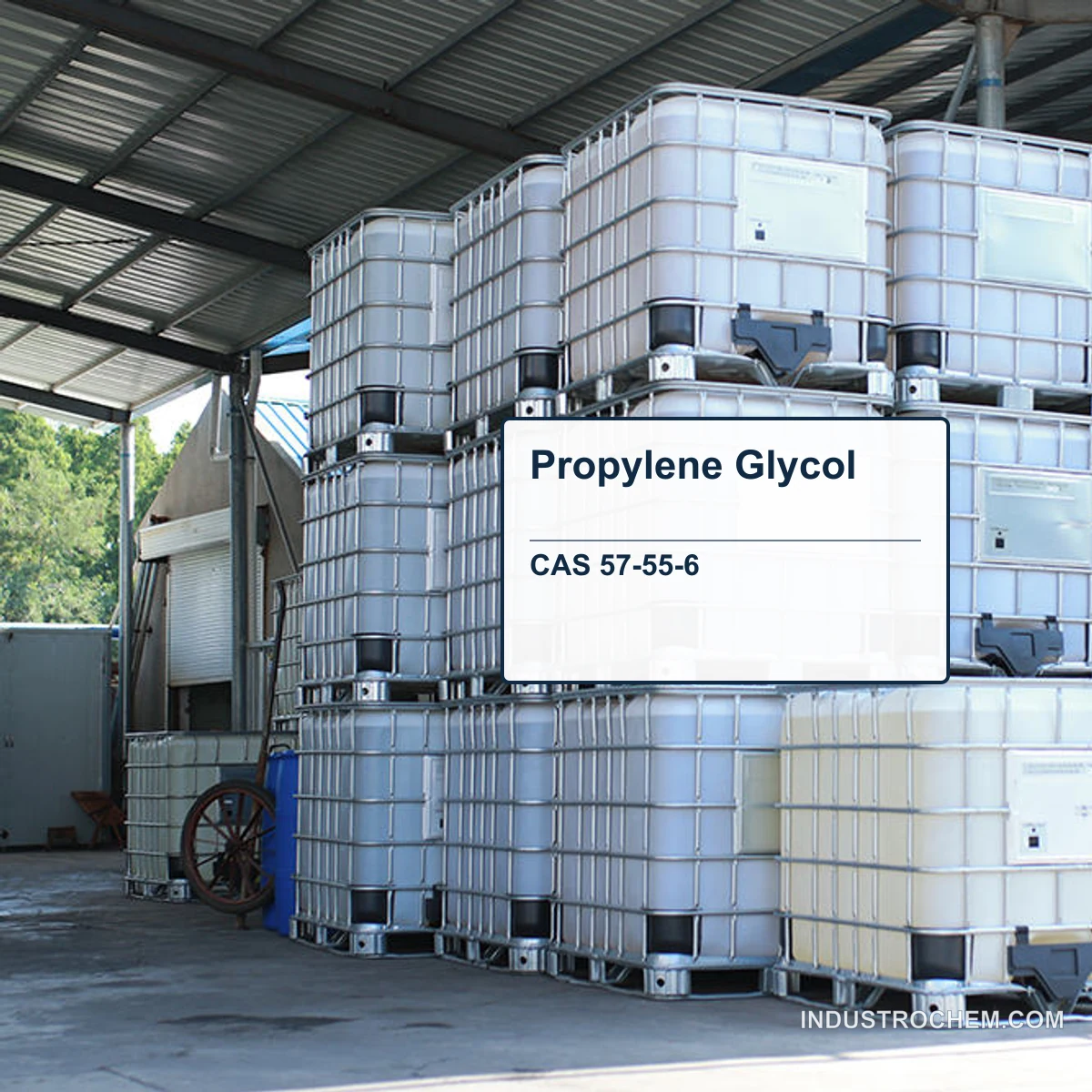
- Package: 200kg iron drum or 50kg plastic drum packaging
Product Description
Product Overview
Propylene Glycol (MPG), chemically known as 1,2-Propanediol, is a colorless, odorless, and viscous liquid with a faintly sweet taste. It is highly hygroscopic and miscible with water, acetone, and chloroform.
Due to its low toxicity and excellent solvent properties, it is a preferred alternative to ethylene glycol in applications requiring safety and environmental compliance. It serves as a critical raw material in the production of unsaturated polyester resins (UPR), non-toxic antifreeze, food additives, and pharmaceutical formulations.
Global Supplier of Glycols & Solvents.
📧 Email:info@industrochem.com
Contact us for USP/EP certification, COA, and competitive bulk pricing.
Physicochemical Properties
| Parameter | Specification (USP/Ind) | Test Method |
|---|---|---|
| Appearance | Clear, Colorless Viscous Liquid | Visual Inspection |
| Purity (GC) | ≥ 99.7% | Gas Chromatography |
| Color (Pt-Co) | ≤ 10 | ASTM D1209 |
| Density (20°C) | 1.035 – 1.037 g/cm³ | ASTM D4052 |
| Water Content | ≤ 0.20% | Karl Fischer |
| Acidity (as Acetic Acid) | ≤ 0.002% | Titration |
| Distillation Range | 185°C – 189°C | ASTM D1078 |
| Residue on Ignition | ≤ 0.007% | Gravimetric |
| Chlorides | ≤ 1 ppm | Ion Chromatography |
Applications
Polymers & Resins (Industrial Grade)
- Unsaturated Polyester Resins (UPR): The primary application for industrial MPG, used to produce high-performance reinforced plastics for construction, marine, and transportation sectors.
Functional Fluids
- Heat Transfer & Antifreeze: Acts as a non-toxic antifreeze and coolant in food processing plants and HVAC systems where incidental food contact may occur (unlike toxic ethylene glycol).
- De-icing: Used in aircraft de-icing fluids due to its freezing point depression capabilities.
Food, Pharma & Cosmetics (USP Grade)
- Humectant & Solvent: Retains moisture in cosmetics and serves as a solvent for food colorings, flavorings, and oral pharmaceutical solutions.
- Excipient: Used as a carrier in drug delivery systems and soft-gel capsules.
Quality Assurance
Our Propylene Glycol is manufactured in ISO 9001:2015 and FSSC 22000 certified facilities to ensure compliance with diverse regulatory standards.
- Grade Segregation: Strict separation between Industrial and USP production lines to prevent cross-contamination.
- Purity Testing: Each batch is analyzed via Gas Chromatography (GC) to guarantee a purity of $\ge$ 99.7%.
- Heavy Metals: For USP grades, we perform rigorous ICP-MS testing to ensure heavy metals (Pb, As, Cd, Hg) are below 5 ppm.
Storage & Safety
Storage Guidelines
- Hygroscopic: Store in tightly sealed containers (stainless steel, aluminum, or lined steel) to prevent moisture absorption.
- Environment: Keep in a cool, dry, and well-ventilated area, protected from direct sunlight and humidity.
- Shelf Life: 12 months for Industrial Grade; 24 months for USP Grade under proper storage.
Safety & PPE Recommendations
- Toxicity: Propylene Glycol is generally recognized as safe (GRAS) for food and cosmetic use.
- Handling: While low in toxicity, standard industrial hygiene is recommended. Wear safety glasses and gloves during bulk handling to prevent mild skin or eye irritation.
- Flammability: Combustible liquid at high temperatures. Keep away from open flames.
FAQ - Technical & Supply Chain
-
Q:
Does CAS 57-55-6 specifically identify the 1,2-propanediol isomer used in low-toxicity applications?
A: Yes. CAS 57-55-6 designates Propylene Glycol (specifically 1,2-Propanediol). It is chemically distinct from its toxic analog, Ethylene Glycol (CAS 107-21-1), and the isomeric 1,3-Propanediol. In industrial procurement, this CAS number confirms the material's identity as the standard aliphatic alcohol used where low toxicity and biodegradability are critical safety parameters. -
Q:
What is the primary technical function of CAS 57-55-6 in complex industrial dispersions?
A: CAS 57-55-6 functions primarily as a coupling agent and co-solvent. Its amphiphilic structure allows it to bridge the polarity gap between water and hydrophobic active ingredients (such as fragrances, resins, or dyes). In formulation chemistry, it is typically introduced to stabilize emulsions or clarify solutions that would otherwise phase-separate. -
Q:
What functional role does propylene glycol usually serve in industrial applications?
A: It is commonly used as a solvent carrier to dissolve, stabilize, or deliver other functional components within chemical formulations.
Documents and Product Support
For product review and sourcing evaluation, supporting documents can be coordinated according to the product type, inquiry stage, and order requirements.
- COA for batch-based quality reference
- TDS for key physical and chemical information
- SDS / MSDS for handling, storage, and safety reference
- Packing information for sample, trial, and bulk orders
- Technical communication based on application and specification requirements
Information to Confirm Before Quotation
Clear sourcing information helps reduce specification mismatch and allows a more accurate quotation before sample or bulk order discussion.
- Product name and CAS number
- Application or intended end use
- Required purity, grade, or specification
- Sample quantity, trial order, or bulk demand
- Preferred packing form or net weight
- Destination country or port
- Required documents or compliance expectations
Packaging, Storage, and Handling Notes
Packaging form, storage conditions, shelf life, and shipment arrangements should be confirmed according to the product characteristics, package size, and destination requirements.
Before order confirmation, buyers are advised to review the corresponding product documents and confirm whether any special storage, labeling, or handling requirements apply.
Sample, Bulk Order and Repeat Supply Support
Support can be arranged for sample discussion, bulk supply planning, packaging confirmation, and routine sourcing communication based on the actual product and order requirements.
For repeat-use formulations or long-term procurement plans, buyers may discuss specification consistency, packaging preferences, delivery expectations, and document coordination in advance.