










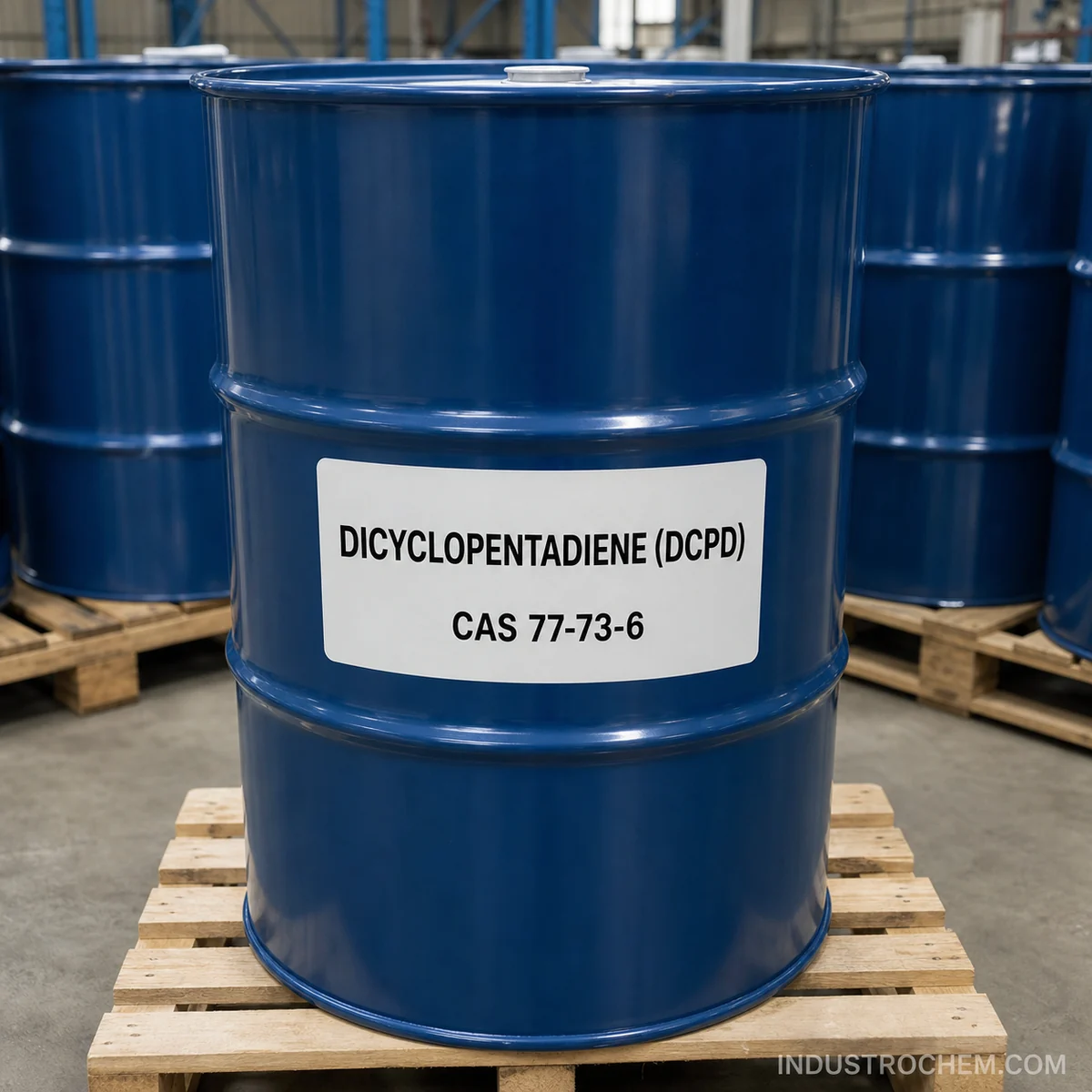
Dicyclopentadiene (DCPD) is a bicyclic unsaturated hydrocarbon supplied as a chemical raw material, commonly derived from the dimerization of cyclopentadiene in petrochemical processing. Identified by CAS 77‑73‑6, its strained ring structure and reactive double bonds enable ring‑opening metathesis polymerization and other controlled polymerization pathways. It is typically applied as a high‑performance monomer in industrial polymer and resin manufacturing processes where mechanical strength, thermal resistance, and dimensional stability are required. From a supply perspective, the material is available with competitive factory pricing, customized specifications, and supporting documentation including MSDS, TDS, COA, suitable for regulated bulk supply for industrial use.
Dicyclopentadiene (DCPD) CAS 77‑73‑6
- CAS: 77-73-6
- Synonyms: Dicyclopentadiene, DCPD monomer, Tricyclo[5.2.1.0]decadiene, Cyclopentadiene dimer
- Einecs: 201-052-9
- Molecular Formula: C10H12
- Grade: Industrial grade 99%
- Package: 200kg iron drum or 50kg plastic drum packaging
Product Description
bicyclopentadiene
Aliases dimer cyclopentadiene, 4,7-methylene-4,7,8,9-tetrahydroinden;
Chemical formula C10H12
Molecular Weight 132.202
CAS accession number 77-73-6
EINECS accession number 201-052-9
The melting point is 33.6 °C
Boiling point 170 °C
Density 0.982 g/cm³
Flash point 26 °C
Industrial Use:
1. It is used as the third component of ethylene-propylene binary copolymer (EPDM);
2. It is used as a raw material for the synthesis of ethylene bornoidene (ENB);
3. Reaction with maleic anhydride to obtain bornalene anhydride, which is used as a raw material for epoxy resin curing agent, polyester resin, alkyd resin and pesticide.
4. The hexachloride of cyclopentadiene – hexachlorocyclopentadiene, the hydrogenated phthalic anhydride of the hexachloride endomethylene obtained by reacting with maleic anhydride, is used as a flame retardant for synthetic resins;
5. It is used for the modification of tung oil, linseed oil, soybean oil, fish oil, etc., which can speed up drying and improve water and alkali resistance;
6. Dimercyclopentadiene resin can be used as rubber adhesives, pressure-sensitive adhesives, hot-soluble adhesives, inks, coatings, etc.
FAQ - Technical & Supply Chain
-
Q:
Is dicyclopentadiene different from cyclopentadiene?
A: Yes. Dicyclopentadiene is the dimerized form of cyclopentadiene and has different physical properties and industrial applications. -
Q:
Is DCPD mainly supplied as a monomer for polymer production?
A: It is commonly supplied as a monomer or intermediate for industrial polymer and resin synthesis rather than as a finished end‑use product.
Documents and Product Support
For product review and sourcing evaluation, supporting documents can be coordinated according to the product type, inquiry stage, and order requirements.
- COA for batch-based quality reference
- TDS for key physical and chemical information
- SDS / MSDS for handling, storage, and safety reference
- Packing information for sample, trial, and bulk orders
- Technical communication based on application and specification requirements
Information to Confirm Before Quotation
Clear sourcing information helps reduce specification mismatch and allows a more accurate quotation before sample or bulk order discussion.
- Product name and CAS number
- Application or intended end use
- Required purity, grade, or specification
- Sample quantity, trial order, or bulk demand
- Preferred packing form or net weight
- Destination country or port
- Required documents or compliance expectations
Packaging, Storage, and Handling Notes
Packaging form, storage conditions, shelf life, and shipment arrangements should be confirmed according to the product characteristics, package size, and destination requirements.
Before order confirmation, buyers are advised to review the corresponding product documents and confirm whether any special storage, labeling, or handling requirements apply.
Sample, Bulk Order and Repeat Supply Support
Support can be arranged for sample discussion, bulk supply planning, packaging confirmation, and routine sourcing communication based on the actual product and order requirements.
For repeat-use formulations or long-term procurement plans, buyers may discuss specification consistency, packaging preferences, delivery expectations, and document coordination in advance.
Contact Form
Use our contact form to send us your questions, suggestions or comments. We will respond as soon as possible.
Product Categories
Related Products
-
Sodium Methoxide CAS 124-41-4 -
Sodium Fluoride CAS 7681-49-4 -
GPE 3000 CAS 9082-00-2 -
Polypropylene Glycol 1000 CAS 25322-69-4 -
Polypropylene Glycol 2000 CAS 25322-69-4 -
AEO-9 / MOA-9 (Fatty Alcohol Ethoxylate 9EO) – CAS 9002‑92‑0 -
Polypropylene Glycol 200 (PPG-200) CAS 25322-69-4 -
PPG 2000 (Polyether Polyol 220) CAS 25322-69-4

