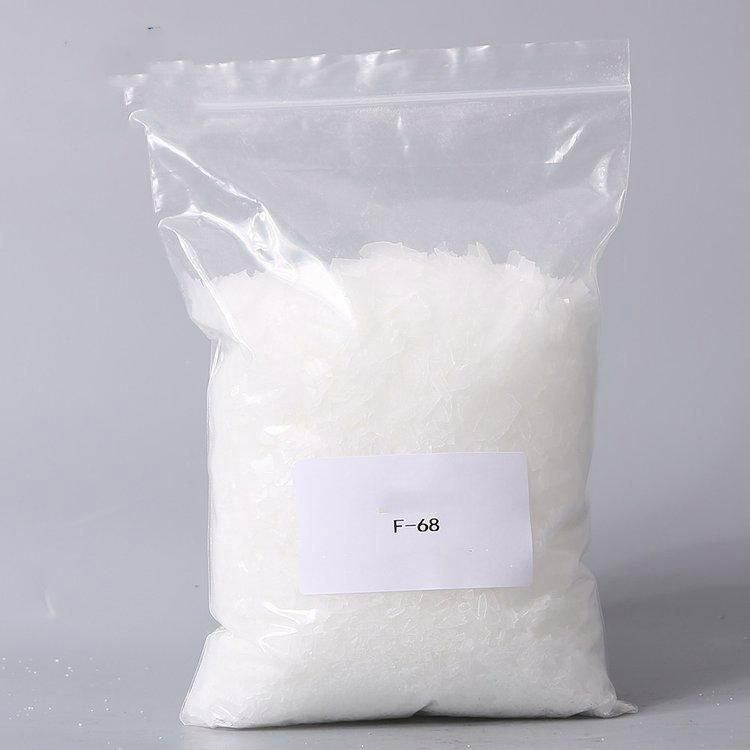
Propylene Glycol Block Polyether F68 CAS 9003-11-6, also known as Poloxamer 188, Pluronic F68, or Polyether F68, is a nonionic EO/PO block copolymer supplied as a surfactant, emulsifier, dispersant, and solubilizer for pharmaceutical, cosmetic, bioprocessing, and industrial formulation systems. It is supplied in 99% grade with 200 kg iron drum and 50 kg plastic drum packaging options. COA, TDS, and SDS can be provided according to grade and order requirements.
Propylene Glycol Block Polyether F68 CAS 9003‑11‑6
- CAS: 9003-11-6
- Synonyms: Polyether F68, Poloxamer 188, Pluronic F68, EO PO Block Copolymer
- Einecs: 500-039-7
- Molecular Formula: EO/PO block copolymer (variable average)
- Grade: 99%
- Package: 200kg iron drum, 50kg plastic drum packaging.
Product Description
Poloxamer 188 is supplied as a nonionic triblock polyether composed of polyethylene oxide and polypropylene oxide segments. It is commonly used as a formulation ingredient and processing aid where surface activity, water solubility, dispersion support, and system stability are required.
This material is suitable for pharmaceutical excipient applications as well as selected industrial surfactant systems. Technical documents such as COA, TDS, and SDS may be provided according to the supplied grade.
| Product Name | Poloxamer 188 |
| Synonyms | Polyether F68; Pluronic F68; EO-PO Block Copolymer |
| CAS Number | 9003-11-6 |
| Product Identity | Nonionic EO-PO block copolymer |
| Primary Functions | Solubilization, emulsification, dispersion, wetting, and formulation stabilization |
| Application Type | Pharmaceutical excipient and industrial formulation ingredient |
| Documentation | COA, TDS, and SDS may be provided according to the supplied grade |
| Appearance | White to off-white solid, depending on grade and physical form |
| Solubility | Readily soluble in water |
| pH (1% Aqueous Solution) | Typically within a near-neutral range |
| Average Molecular Weight | Approximately 8350–8400 |
| Performance Characteristics | Suitable for low-foam, solubilizing, dispersing, and stabilizing functions in compatible systems |
- Used in pharmaceutical formulations as a nonionic excipient for solubilization, dispersion, and formulation stabilization.
- Suitable for water-based systems requiring emulsification support and processing compatibility.
- Applied in cosmetic and personal care formulation systems where nonionic surfactant functionality is required.
- Used in selected industrial formulations as a low-foam surfactant, dispersing aid, or process additive.
- Suitable for formulation development where EO-PO block copolymer structure is required for system balance and compatibility.
Standard packaging may be supplied in 200 kg drums, 50 kg plastic drums, or other industrial packaging formats according to grade and shipment arrangement.
Packaging type and net weight may vary depending on physical form, export requirements, and order specification.
- Store in a cool, dry, and well-ventilated indoor area.
- Keep containers tightly closed when not in use.
- Protect from direct heat, moisture, and strong light exposure.
- Handle and transport according to general chemical storage requirements.
- Use appropriate personal protective equipment during handling.
- Avoid direct contact with eyes and prolonged skin exposure.
- Operate in accordance with plant safety procedures and applicable ventilation requirements.
- Refer to the current SDS before storage, transport, handling, or formulation use.
FAQ - Technical & Supply Chain
-
Q:
What is Propylene Glycol Block Polyether F68 CAS 9003-11-6 used for?
A: Propylene Glycol Block Polyether F68 is used as a nonionic EO/PO block copolymer surfactant, emulsifier, dispersant, and solubilizer in pharmaceutical, cosmetic, bioprocessing, and industrial formulation systems. -
Q:
Is Polyether F68 the same as Poloxamer 188 or Pluronic F68?
A: Yes. Polyether F68, Poloxamer 188, and Pluronic F68 are commonly used names for the same EO/PO block copolymer material identified by CAS 9003-11-6. -
Q:
What should buyers confirm before ordering Polyether F68?
A: Buyers should confirm average molecular weight range, EO/PO composition, hydroxyl value, moisture, appearance, pH, heavy metals or microbiological requirements where applicable, and packaging requirements. -
Q:
What is the average molecular weight range of Polyether F68?
A: Polyether F68 (Poloxamer 188) has an average molecular weight of approximately 8350–8400 g/mol. Within the Poloxamer series, F68 has a typical polyethylene oxide (PEO) content around 80% by weight, giving it relatively high water solubility and moderate surface activity across a range of temperatures. -
Q:
How does Polyether F68 differ from other Poloxamer grades such as Poloxamer 407?
A: Poloxamer 188 (F68) has a higher PEO content (~80%) and lower molecular weight (~8350–8400) compared to Poloxamer 407 (F127, ~12600 g/mol, ~70% PEO). F68 forms weaker gels and is preferred for formulations requiring lower viscosity and higher water solubility, while F127 is used when thermoreversible gelation is desired. -
Q:
What storage conditions are recommended for Polyether F68?
A: Polyether F68 should be stored in a cool, dry, well-ventilated area away from direct sunlight and moisture. The material is hygroscopic and should be kept in sealed containers. Recommended storage temperature is below 40°C to avoid thermal degradation of the EO/PO block structure. Under proper conditions, the product has a typical shelf life of 24 months.
Documents and Product Support
For product review and sourcing evaluation, supporting documents can be coordinated according to the product type, inquiry stage, and order requirements.
- COA for batch-based quality reference
- TDS for key physical and chemical information
- SDS / MSDS for handling, storage, and safety reference
- Packing information for sample, trial, and bulk orders
- Technical communication based on application and specification requirements
Information to Confirm Before Quotation
Clear sourcing information helps reduce specification mismatch and allows a more accurate quotation before sample or bulk order discussion.
- Product name and CAS number
- Application or intended end use
- Required purity, grade, or specification
- Sample quantity, trial order, or bulk demand
- Preferred packing form or net weight
- Destination country or port
- Required documents or compliance expectations
Packaging, Storage, and Handling Notes
Packaging form, storage conditions, shelf life, and shipment arrangements should be confirmed according to the product characteristics, package size, and destination requirements.
Before order confirmation, buyers are advised to review the corresponding product documents and confirm whether any special storage, labeling, or handling requirements apply.
Sample, Bulk Order and Repeat Supply Support
Support can be arranged for sample discussion, bulk supply planning, packaging confirmation, and routine sourcing communication based on the actual product and order requirements.
For repeat-use formulations or long-term procurement plans, buyers may discuss specification consistency, packaging preferences, delivery expectations, and document coordination in advance.
Contact Form
Use our contact form to send us your questions, suggestions or comments. We will respond as soon as possible.
Product Categories
Related Products
-
LABSA 96% CAS 27176-87-0 -
C12-14 Alkyl Dimethyl Amine Oxide | CAS 84649-84-3 | Industrial Grade -
Behentrimonium Chloride CAS 17301-53-0 -
Piperazine Anhydrous (CAS 110-85-0) -
Triton X-114 CAS 9036-19-5 -
Sorbitan Monooleate CAS 1338-43-8 -
Pentaerythritol Stearate (PETS) CAS 115-83-3 -
Emulsifier TX-10 CAS 9016-45-9