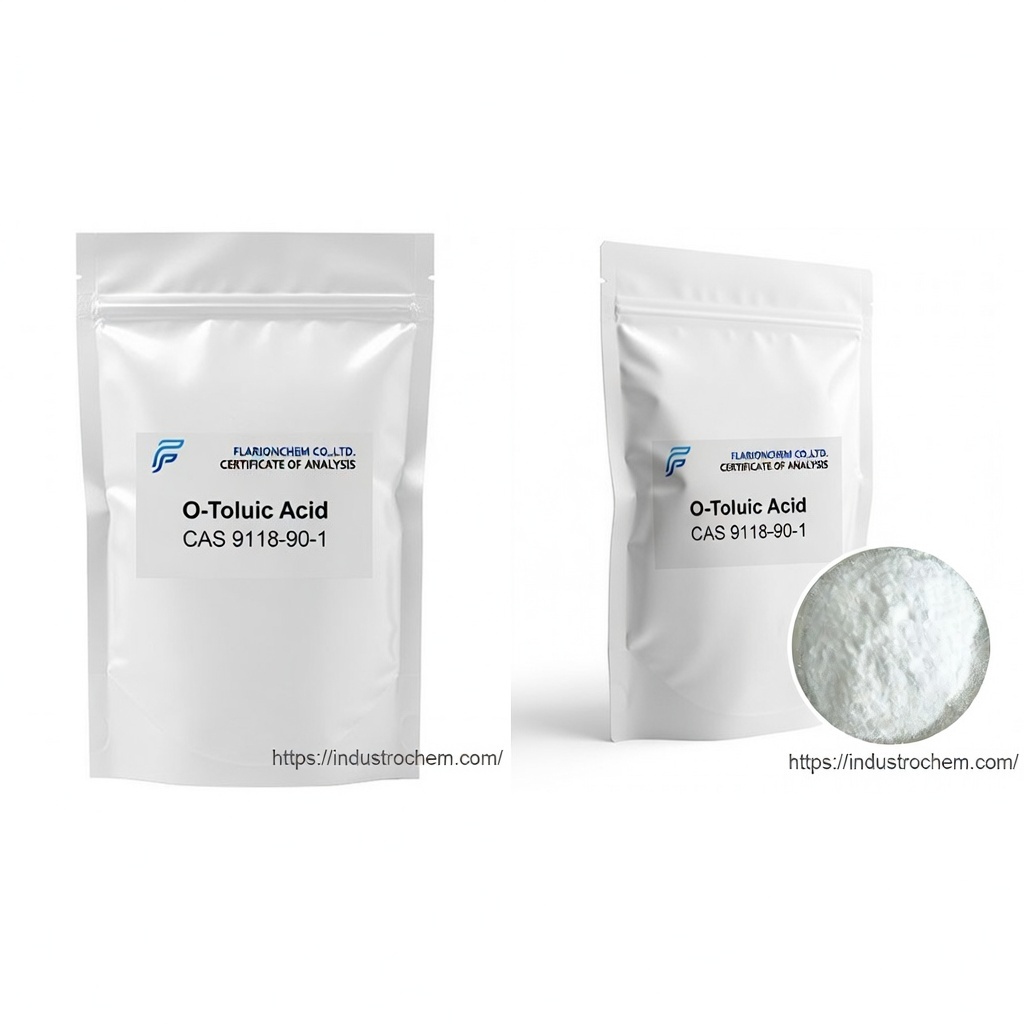
O-Toluic acid, also called 2-methylbenzoic acid or ortho-toluic acid, CAS 118-90-1, is a white to off-white crystalline aromatic carboxylic acid supplied for agrochemical, pharmaceutical, and specialty synthesis. Confirm the required grade and specification, then request a quotation with COA/TDS/SDS for bulk supply.
O-Toluic Acid CAS 118-90-1
- CAS: 118-90-1
- Synonyms: 2-Methylbenzoic acid, Ortho-toluic acid, 2-Toluic acid, o-Methylbenzoic acid, 2-Carboxytoluene
- Einecs: 204-284-9
- Molecular Formula: C8H8O2
- Grade: Industrial Grade / Pharmaceutical Grade
- Package: 25kg/fiber drum or 500kg/bulk bag
Product Description
O-Toluic Acid CAS 118-90-1, also called 2-methylbenzoic acid or ortho-toluic acid, is an aromatic carboxylic acid with the molecular formula C8H8O2 and EINECS 204-284-9.
Synonyms: 2-Methylbenzoic acid; Ortho-toluic acid; 2-Toluic acid; o-Methylbenzoic acid; 2-Carboxytoluene.
CAS: 118-90-1.
Molecular formula: C8H8O2.
It is supplied as a white or light yellow crystalline powder with an assay (HPLC/GC) of not less than 99.0%.
The melting point is about 102.0-105.0 °C, boiling point about 258-259 °C, and loss on drying not more than 0.5%.
Ash content is not more than 0.1%; it is soluble in ethanol and ether and slightly soluble in water.
In agrochemical synthesis it is an intermediate for systemic fungicides and herbicides, where the ortho-methyl group provides biological activity.
In pharmaceutical intermediates it is a precursor for medicinal compounds including anti-inflammatory agents and discovery reagents.
In polymer additives it is used for high-performance polymerization initiators and as a modifier for specific resin systems.
In dyes and pigments it is an intermediate for organic pigments and aromatic colorants for textiles and plastics.
Store in a cool, dry, well-ventilated warehouse with containers tightly closed, protected from moisture and away from strong oxidizing agents and bases.
During handling avoid skin and eye contact and prevent inhalation of dust or vapors.
Use nitrile or neoprene gloves, chemical safety goggles, and an N95-equivalent dust mask; full-body protection is recommended for large-scale handling.
Every batch is tested by GC and HPLC to monitor isomer distribution and organic impurities.
Stable process control maintains a narrow melting range and low moisture for high-yield and pharmaceutical-grade production.
Confirm appearance, assay, melting point, boiling point, loss on drying, ash content, solubility, and grade as required.
The page is an RFQ entry point and does not state stock, price, MOQ, or fixed lead time.
For an RFQ, state the intended application, required grade, quantity, packaging, destination, and document needs.
FAQ - Technical & Supply Chain
-
Q:
What is O-Toluic Acid CAS 118-90-1?
A: CAS 118-90-1 is o-toluic acid, also called 2-methylbenzoic acid or ortho-toluic acid, with the molecular formula C8H8O2. It is a white to off-white crystalline aromatic carboxylic acid. -
Q:
What are the key physical properties of o-toluic acid?
A: The compound typically melts around 103-105 degrees C and boils around 258-260 degrees C. It is only slightly soluble in water but dissolves readily in organic solvents such as ethanol and ether. -
Q:
How is o-toluic acid distinguished from m-toluic and p-toluic acid?
A: All three toluic acid isomers share the same molecular formula, but the methyl group is attached at different positions on the benzene ring. In o-toluic acid the methyl group is ortho to the carboxylic acid group, giving it a distinct CAS number and different melting point and reactivity profile. -
Q:
What are the main industrial uses of O-Toluic Acid CAS 118-90-1?
A: It is used as an intermediate in pharmaceutical and agrochemical synthesis, including antibiotics, fungicides, and herbicides. It also serves as a precursor for dyes, pigments, heterocyclic compounds, and other specialty organic chemicals. -
Q:
Is o-toluic acid suitable for direct water-based formulations?
A: It has low water solubility at room temperature, so it is usually handled in organic solvent systems or used as a reactive intermediate rather than as a directly dissolved aqueous additive. Process conditions and solvent choice should match the downstream chemistry.
Ordering & Documentation
Key information for document requests, quotations, and supply planning.
Documents
Tell us which documents your procurement team needs. Before an order, we will check whether the quoted source can provide them for the offered lot.
Quotation
Send the CAS number, grade, quantity, packing preference and destination.
Sample & Supply
Ask whether samples, trial quantities or repeat orders are possible. We will check each request against the sourced product and current offer.
Storage & Shipping
Product-specific conditions are confirmed before order.