










p-Methylbenzoic Acid, CAS 99-94-5, is also known as 4-methylbenzoic acid or p-toluic acid. It is an aromatic carboxylic acid used as a chemical intermediate in organic synthesis. Confirm the para-isomer identity, required analytical specification, quantity, packaging, destination and document needs before quotation.
p-Methylbenzoic Acid (p-Toluic Acid) CAS 99-94-5
- CAS: 99-94-5
- Synonyms: p-Methylbenzoic acid; 4-Methylbenzoic acid; p-Toluic acid
- Einecs: 202-803-3
- Molecular Formula: C₈H₈O₂
- Grade: Confirm the current product-specific specification.
- Package: Confirm packaging for the offered material and destination requirements.
Product Description
Alternative names: p-Methylbenzoic acid; 4-Methylbenzoic acid; p-Toluic acid.
Molecular formula: C₈H₈O₂.
Molar mass: 136.15 g/mol.
CAS Number: 99-94-5.
EINECS: 202-803-3.
Melting point: confirm the current product-specific value.
Boiling point: confirm the current product-specific value.
Physical form, appearance, and key quality limits: confirm the current product-specific specification.
Flash point and handling requirements: confirm the current product-specific value.
Vapor-pressure requirements: confirm the current product-specific value.
Solubility and formulation compatibility: confirm the current product-specific value.
p-Methylbenzoic Acid is an aromatic carboxylic acid. Confirm the offered material by CAS 99-94-5 because ortho-, meta-, and para-toluic acid isomers are not interchangeable.
Typical use: p-Methylbenzoic Acid is an aromatic intermediate used in organic synthesis. Confirm the required para-isomer identity and analytical specification.
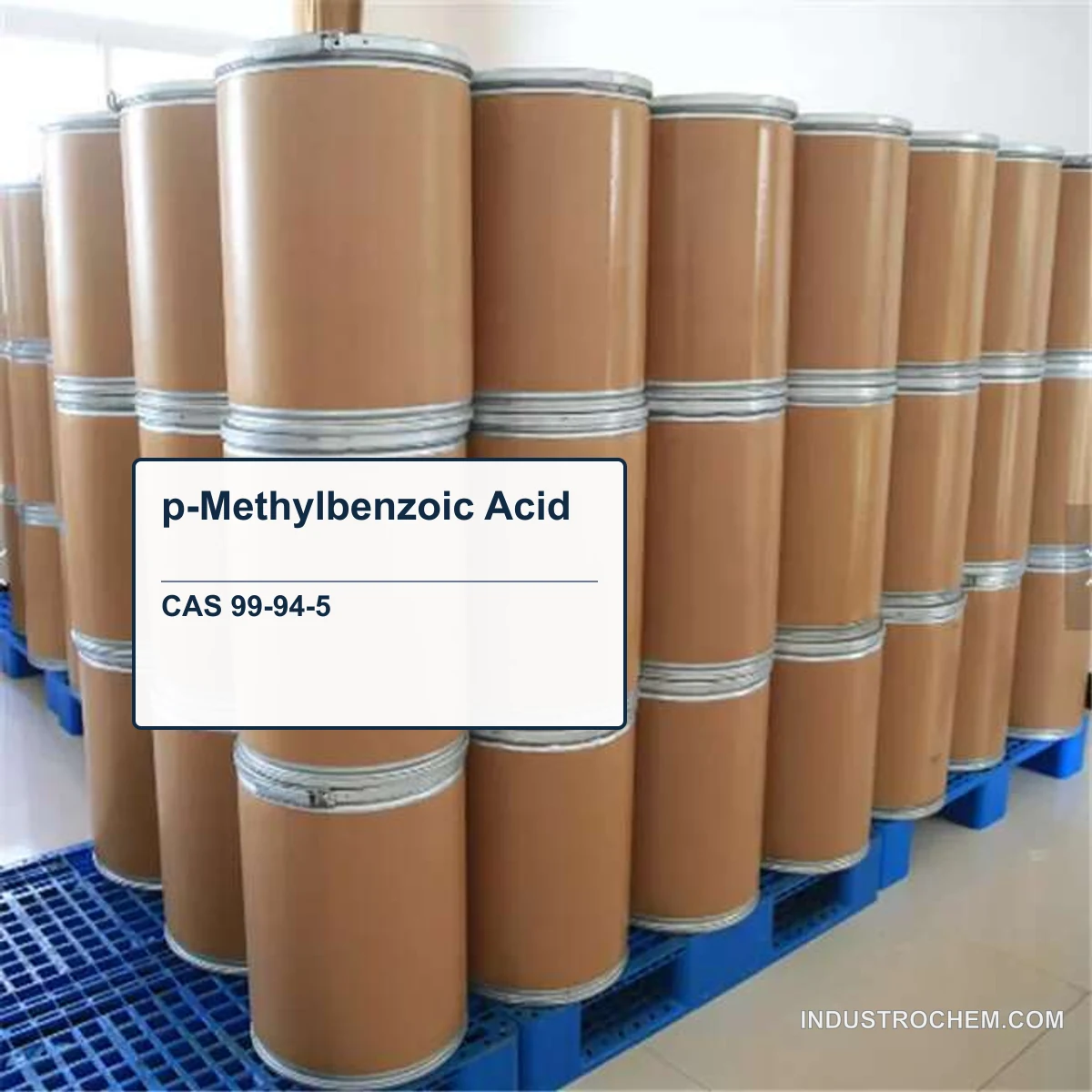
FAQ - Technical & Supply Chain
-
Q:
What is p-Methylbenzoic Acid used for?
A: p-Methylbenzoic Acid, also called 4-Methylbenzoic Acid or p-Toluic Acid, is an aromatic carboxylic-acid intermediate. It is used in pharmaceuticals such as para-aminomethylbenzoic acid and p-tolunitrile, plus agrochemicals, dyes, pigments, photosensitive materials, polymer stabilizers and other organic synthesis routes. -
Q:
Why must the para isomer be specified for Methylbenzoic Acid?
A: The toluic acid isomers are not interchangeable. p-Methylbenzoic Acid is CAS 99-94-5, while m-toluic acid is CAS 99-04-7 and o-toluic acid is CAS 118-90-1. They differ in melting behavior, reactivity and downstream suitability, so the complete name, CAS and para-isomer requirement should be stated. -
Q:
What should be specified when ordering p-Methylbenzoic Acid?
A: Specify GC or HPLC assay, water, color and appearance, melting range, and limits for o-toluic acid, m-toluic acid, benzoic acid or other related impurities. Confirm the physical form, quantity, packaging and destination acceptance against the current product-specific specification. -
Q:
What physical properties identify p-Methylbenzoic Acid?
A: It is usually a white to pale-yellow crystalline solid or powder with a melting range around 177-182 degrees Celsius, commonly cited near 179-181 degrees Celsius, a boiling point around 274-275 degrees Celsius and a density near 1.06 g/cm3 at 20 degrees Celsius. Lot acceptance should use the current specification rather than literature values alone. -
Q:
How should p-Methylbenzoic Acid be stored and handled?
A: Store it in a cool, dry, well-ventilated area in tightly closed containers, away from strong oxidizers, strong bases and incompatible materials. Minimize dust generation and use the current product-specific safety information for personal protection, spill handling and local disposal requirements.
Ordering & Documentation
Key information for document requests, quotations, and supply planning.
Documents
Tell us which documents your procurement team needs. Before an order, we will check whether the quoted source can provide them for the offered lot.
Quotation
Send the CAS number, grade, quantity, packing preference and destination.
Sample & Supply
Ask whether samples, trial quantities or repeat orders are possible. We will check each request against the sourced product and current offer.
Storage & Shipping
Product-specific conditions are confirmed before order.