










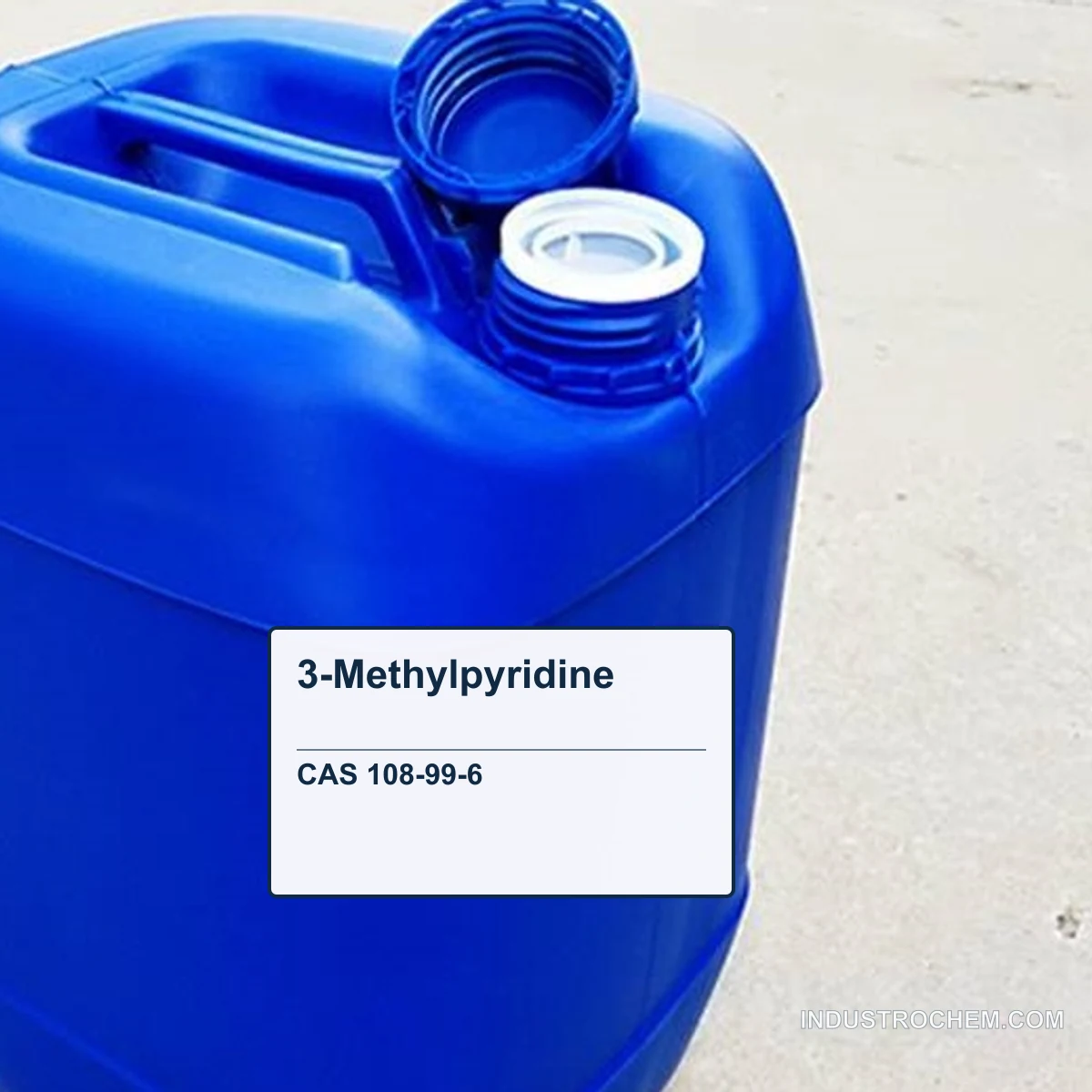
3-Methylpyridine, CAS 108-99-6, is also known as 3-picoline or beta-picoline. It is a pyridine derivative used as a chemical intermediate in the manufacture of niacin, niacinamide, pharmaceuticals and agrochemicals, and as a solvent in industrial processing. Confirm the required assay, physical form and intended use before requesting a quotation.
3-Methylpyridine (3-Picoline) CAS 108-99-6
- CAS: 108-99-6
- Synonyms: 3-Methylpyridine; 3-Picoline; beta-Picoline; m-Methylpyridine
- Einecs: 203-636-9
- Molecular Formula: C₆H₇N
- Grade: Confirm the current product-specific specification.
- Package: Confirm packaging for the offered form and destination requirements.
Product Description
3-Methylpyridine, also called 3-Picoline or beta-Picoline, is a pyridine derivative identified by CAS 108-99-6.
Synonyms: 3-Methylpyridine; 3-Picoline; beta-Picoline; m-Methylpyridine.
Chemical formula: C₆H₇N
Molecular weight: 93.13 g/mol
CAS Number: 108-99-6
EINECS: 203-636-9
Melting point: -19 °C
Boiling point: 144 °C
Flash point: 38 °C (closed cup)
Refractive index: 1.504 (20 °C)
Saturated vapor pressure: 0.6 kPa (20 °C)
Critical pressure: 4.4 MPa
Ignition temperature: 500 °C
Upper explosion limit (vol% in air): 8.7%.
Lower explosion limit (vol% in air): 1.3%.
Appearance: colorless or yellow liquid
Solubility: soluble in water and in most organic solvents such as ethanol and ether
Technical use context
3-Methylpyridine is used as a chemical intermediate and solvent in industrial processing. Confirm suitability for the intended route with the current product-specific specification.
Handling and storage review
Use the current product-specific SDS and specification to assess handling, storage and local regulatory suitability.
FAQ - Technical & Supply Chain
-
Q:
What is 3-Methylpyridine used for?
A: 3-Methylpyridine (3-Picoline) is mainly used as a chemical intermediate in the manufacture of niacin, niacinamide, pharmaceuticals, agrochemicals and other pyridine derivatives. It is also used as an industrial solvent in selected pharmaceutical, resin, dye and rubber-accelerator processes, so the intended reaction and purity requirement should be confirmed before ordering. -
Q:
Are 3-Methylpyridine, 3-Picoline and Beta-Picoline the same product?
A: Yes. 3-Methylpyridine, 3-Picoline and beta-Picoline all identify CAS 108-99-6. Do not shorten this to Picoline on a purchase order because 2-Picoline and 4-Picoline are different positional isomers with different CAS numbers, physical properties and downstream suitability. -
Q:
How is 3-Methylpyridine different from 2-Picoline and 4-Picoline?
A: They are positional isomers with the methyl group at different positions on the pyridine ring. 3-Methylpyridine is CAS 108-99-6, while 2-Picoline is CAS 109-06-8 and 4-Picoline is CAS 108-89-4. These isomers differ in boiling point, reactivity and suitability for specific syntheses, so the exact isomer must be stated on the inquiry. -
Q:
What should be specified for 3-Methylpyridine, including physical form, storage, and transport?
A: State the required GC assay, water, color and appearance, plus limits for pyridine and other picoline isomers when the downstream synthesis is sensitive. It is normally a colorless to yellow liquid soluble in water and many organic solvents. Store it in a cool, well-ventilated area away from ignition sources, keep containers tightly closed, and confirm the current product-specific safety information. It is normally transported as UN 2313, Hazard Class 3, Packing Group III.
Ordering & Documentation
Key information for document requests, quotations, and supply planning.
Documents
Tell us which documents your procurement team needs. Before an order, we will check whether the quoted source can provide them for the offered lot.
Quotation
Send the CAS number, grade, quantity, packing preference and destination.
Sample & Supply
Ask whether samples, trial quantities or repeat orders are possible. We will check each request against the sourced product and current offer.
Storage & Shipping
Product-specific conditions are confirmed before order.
