










Vinyl Chloroacetate, CAS 2549-51-1, is also known as ethenyl 2-chloroacetate. It is a reactive vinyl ester monomer for functional copolymers, acrylic and ethylene-based elastomers, dyeable acrylic fibres and water-resistant films. Specify the intended polymer process and any stabilizer or inhibitor requirement before requesting a quotation.
Vinyl Chloroacetate CAS 2549-51-1
- CAS: 2549-51-1
- Synonyms: Vinyl Chloroacetate; Ethenyl 2-chloroacetate
- Einecs: 219-834-3
- Molecular Formula: C₄H₅ClO₂
- Grade: Confirm the current product-specific specification.
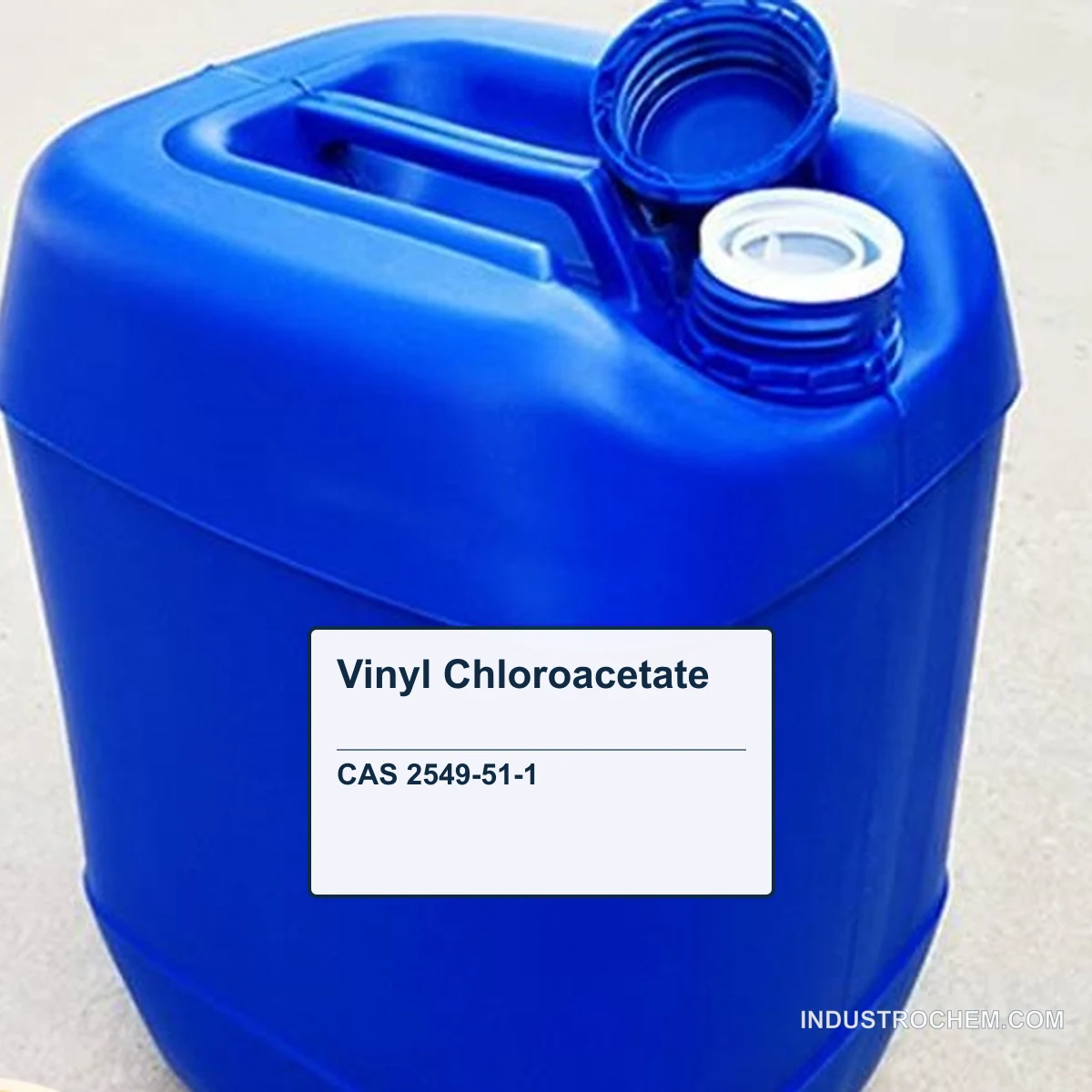
- Package: Confirm packaging for the offered form and destination requirements.
Product Description
Vinyl Chloroacetate is an ethenyl 2-chloroacetate monomer identified by CAS 2549-51-1.
Synonym: Ethenyl 2-chloroacetate.
Chemical formula: C₄H₅ClO₂
Molecular weight: 120.53 g/mol
CAS Number: 2549-51-1
EINECS: 219-834-3
Melting point: -68 °C
Boiling point: 37-38 °C (16 mmHg)
Density: 1.192 g/cm³
Appearance: colorless liquid
Flash point: 51 °C
Application suitability depends on the buyer’s formulation or process and must be assessed against the current product-specific specification.
Technical use context
Vinyl Chloroacetate is a vinyl ester monomer used in polymer-related processing.
Confirm any stabilizer or inhibitor requirement for the intended process with the current product-specific specification.
Compatibility with a particular comonomer, resin or crosslinking system must be assessed against the current product-specific specification.
Confirm suitability for a specific film, adhesive, coating, dye or elastomer system against the current product-specific specification.
Use the current product-specific SDS and specification to assess handling, storage and local regulatory suitability.
FAQ - Technical & Supply Chain
-
Q:
What is Vinyl Chloroacetate used for?
A: Vinyl Chloroacetate is mainly used as a reactive vinyl ester monomer for functional copolymers, acrylic and ethylene-based elastomers, dyeable acrylic fibers and water-resistant films. Its chloroacetate group provides a reactive site for later crosslinking or modification, so the comonomer system and inhibitor requirement should be confirmed with the current product-specific specification. -
Q:
How is Vinyl Chloroacetate different from Vinyl Acetate?
A: Vinyl Chloroacetate contains a chloroacetate group and has CAS 2549-51-1, while Vinyl Acetate has CAS 108-05-4. The chlorine-containing ester group makes Vinyl Chloroacetate useful as a functional or crosslinkable monomer, but it also changes toxicity, handling, inhibitor requirements and process suitability, so the two monomers are not interchangeable. -
Q:
Is commercial Vinyl Chloroacetate normally supplied with an inhibitor?
A: Often yes. Commercial material may contain MEHQ or another stated polymerization inhibitor, and the concentration is part of the offered grade. Do not assume an inhibited and inhibitor-free product are interchangeable; confirm inhibitor identity and level before process approval. -
Q:
What should be confirmed before ordering and storing Vinyl Chloroacetate?
A: Confirm GC assay, inhibitor type and concentration, water, acidity, color and any process-specific impurity limits. State quantity, packaging and storage-temperature requirement. Vinyl Chloroacetate is normally a colorless liquid and is typically stored refrigerated around 2-8 degrees Celsius with the stated inhibitor, tightly closed and away from heat, light and moisture. -
Q:
What transport classification applies to Vinyl Chloroacetate?
A: Vinyl Chloroacetate is commonly transported as UN 2589, Hazard Class 6.1 toxic liquid, Packing Group II, and it has a flammable-liquid flash point around 51 degrees Celsius. Confirm the exact classification, subsidiary hazards and approved packaging with the current product-specific safety information and destination requirements.
Ordering & Documentation
Key information for document requests, quotations, and supply planning.
Documents
Tell us which documents your procurement team needs. Before an order, we will check whether the quoted source can provide them for the offered lot.
Quotation
Send the CAS number, grade, quantity, packing preference and destination.
Sample & Supply
Ask whether samples, trial quantities or repeat orders are possible. We will check each request against the sourced product and current offer.
Storage & Shipping
Product-specific conditions are confirmed before order.