






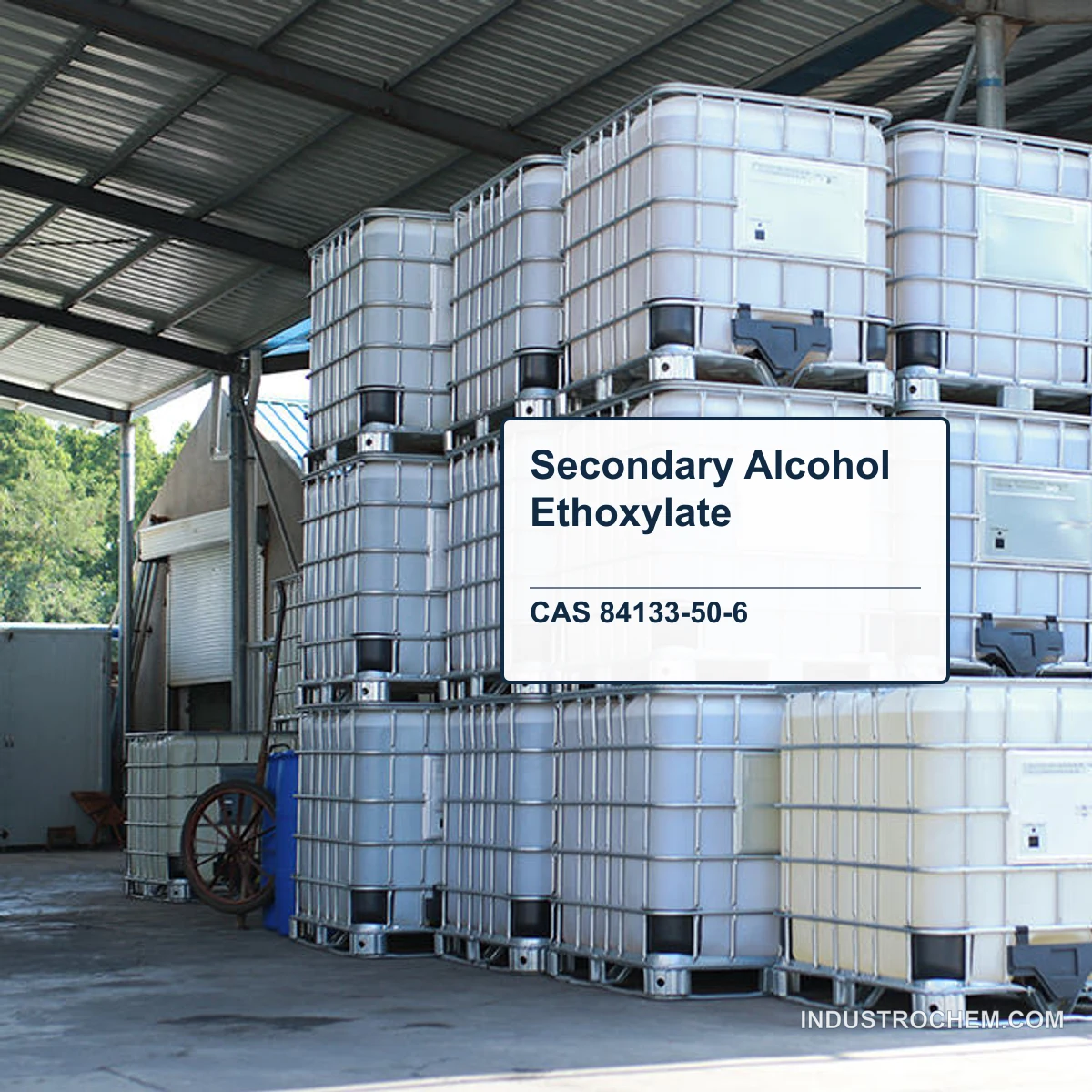
Alcohols, C12-14-secondary, ethoxylated, CAS 84133-50-6, is also known as a secondary alcohol ethoxylate. It is a UVCB nonionic surfactant category. State the target ethoxylation range, product form and intended formulation when requesting current specifications.
Alcohols, C12-14-secondary, ethoxylated CAS 84133-50-6
- CAS: 84133-50-6
- Synonyms: Alcohols, C12-14-secondary, ethoxylated; Secondary alcohol ethoxylate; Secondary alcohols, C12-14, ethoxylated
- Einecs: 617-534-0
- Grade: Confirm the current product-specific specification.
- Package: Confirm packaging for the offered form and destination requirements.
Product Description
Alcohols, C12-14-secondary, ethoxylated is a UVCB nonionic-surfactant category. Confirm ethoxylation distribution, trade-name equivalence, APEO status, biodegradability and performance criteria in the current product-specific specification.
Technical use context
Application suitability depends on the buyer’s formulation or process and must be assessed against the current product-specific specification.
Confirm low-temperature behavior in the current product-specific specification before formulating.
FAQ - Technical & Supply Chain
-
Q:
Does CAS 84133-50-6 define one fixed secondary alcohol ethoxylate grade?
A: No. The CAS number covers a UVCB surfactant family rather than one fixed molecule. Commercial grades can differ in average ethoxylation, molecular-weight distribution, active content, physical form, cloud point, HLB and residual unreacted alcohol. -
Q:
What are C12-14 secondary alcohol ethoxylates used for?
A: They are nonionic surfactants used for wetting, cleaning, emulsification, dispersion and detergency in hard-surface cleaners, textile and leather processing, metal cleaning, paper, coatings and agrochemical formulations. The exact ethoxylation grade determines the foam and temperature profile. -
Q:
How do secondary alcohol ethoxylates differ from primary alcohol ethoxylates?
A: The hydroxyl group in a secondary alcohol ethoxylate is attached to an internal carbon, not a terminal carbon as in a primary alcohol ethoxylate. This structural difference generally affects wetting speed, foam profile, gel behavior, viscosity and temperature response. -
Q:
Which test values should be compared for C12-14 secondary alcohol ethoxylates?
A: Compare average EO level or grade designation, active matter, water, cloud point with its stated method and solution concentration, pH, HLB, pour point and viscosity. For sensitive formulations, also request residual alcohol and polyethylene-glycol levels. -
Q:
Can one C12-14 secondary alcohol ethoxylate replace another without testing?
A: Not reliably. Wetting, detergency, foam profile, emulsification, solubility and temperature response vary with ethoxylation and distribution. Match the candidate to the current grade data, then qualify it in the complete formulation and operating-temperature range.
Ordering & Documentation
Key information for document requests, quotations, and supply planning.
Documents
Tell us which documents your procurement team needs. Before an order, we will check whether the quoted source can provide them for the offered lot.
Quotation
Send the CAS number, grade, quantity, packing preference and destination.
Sample & Supply
Ask whether samples, trial quantities or repeat orders are possible. We will check each request against the sourced product and current offer.
Storage & Shipping
Product-specific conditions are confirmed before order.