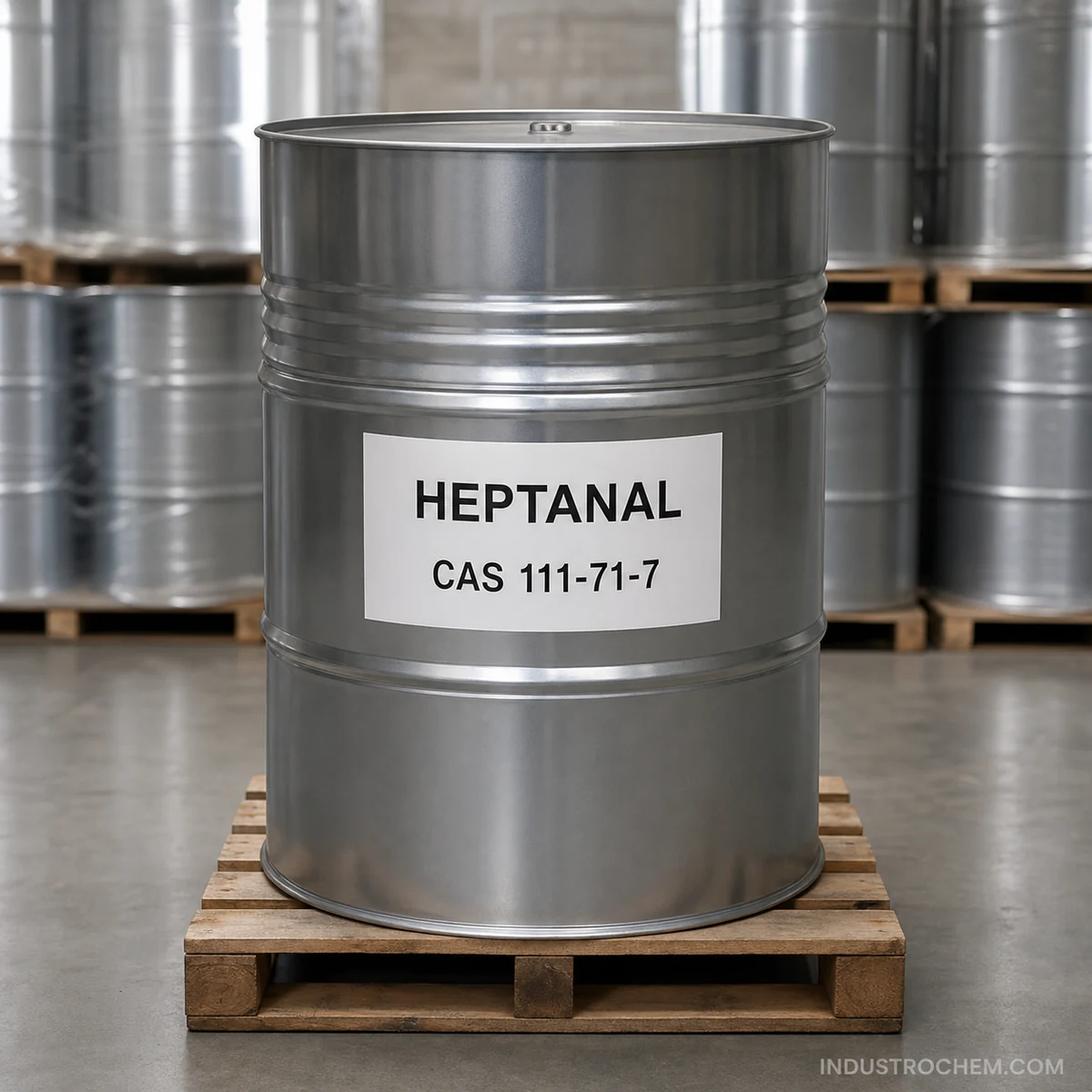
Heptanal is a linear aliphatic aldehyde used as a chemical raw material in industrial formulation processes. This compound, also known in industry as n-heptanal, heptaldehyde, or enanthaldehyde, contains a reactive aldehyde functional group that readily participates in oxidation, condensation, and acetal formation reactions. Identified by CAS 111-71-7, it is typically applied as a flavor and fragrance intermediate, where controlled reactivity and carbon chain length are required for downstream synthesis and formulation stability.
In industrial supply contexts, this product is available with competitive factory pricing, customized specifications, complete documentation including MSDS, TDS, COA, and supports bulk supply for manufacturing use.
Heptanal CAS 111-71-7
- CAS: 111-71-7
- Synonyms: Heptaldehyde, n-Heptanal, Enanthaldehyde, Heptyl aldehyde
- Einecs: 203-898-4
- Molecular Formula: C₇H₁₄O
- Grade: Industrial grade 99%
- Package: 200kg iron drum or 50kg plastic drum packaging
Product Description
Physicochemical properties
| Property | Description |
|---|---|
| Chemical Name | Heptanal |
| Synonyms | n-Heptanal, Heptaldehyde, Enanthaldehyde |
| CAS Number | 111-71-7 |
| Molecular Formula | C₇H₁₄O |
| Molecular Weight | 114.186 g/mol |
| Appearance | Colorless oily liquid |
| Odor | Fresh, green, sweet, fruity, with a pungent undertone |
| Boiling Point | 150.4 ± 3.0 °C (at 760 mmHg) |
| Melting Point | -43 °C (lit.) |
| Density | 0.8 ± 0.1 g/cm³ (or 0.817 g/mL at 25 °C) |
| Flash Point | 35.0 ± 0.0 °C (or 95 °F) |
| Solubility | Insoluble in water; miscible with ethanol, ether, and fixed oils; slightly soluble in carbon tetrachloride |
| Vapor Pressure | 3.9 ± 0.3 mmHg (at 25 °C) |
| Refractive Index | 1.4094 (at 25 °C) |
| Stability | Stable under normal conditions; incompatible with strong oxidizers, strong acids, and strong bases |
| Hazard Class | Flammable liquid, category 3 (GHS02); skin irritant, category 2 (GHS07) |
Application Areas
(1) Spices and essence industry
It is used for blending citrus, rose, jasmine, fruit and other flavor essence.
As a food additive (complying with food safety standards), it is used to enhance the flavor of cream, cheese, nuts, and other foods.
(2) Organic synthesis
Used for synthesizing compounds such as heptanol, heptanoic acid, unsaturated aldehydes, etc.
As a pharmaceutical intermediate (such as certain antibiotics, antifungal drugs).
Used for the synthesis of surfactants and plastic plasticizers.
(3) Other applications
A small amount is used in industries such as rubber, coatings, lubricants, etc.
Storage conditions
(1) Environmental conditions
Temperature: Store in a cool, ventilated place, recommended to refrigerate at 2-8 ° C (to slow down oxidation).
Avoid light: Use brown glass bottles or opaque containers to prevent light from decomposing.
Sealing: Strictly isolate air (can be filled with nitrogen for protection) to prevent oxidation into heptanoic acid.
(2) Container selection
Recommended materials: Glass, stainless steel, or polyethylene (HDPE) containers.
Avoid using metal containers such as copper and aluminum that are prone to corrosion.
(3) Isolation storage
Stay away from oxidants (such as peroxides, nitrates), strong acids, and strong bases.
Safety precautions
(1) Personal protection
Respiratory protection: Use organic vapor masks (such as 3M 6001) in poorly ventilated areas.
Skin protection: Wear nitrile/chloroprene rubber gloves and chemical resistant clothing.
(2) Fire and explosion prevention
Flash point: 38 ° C (closed cup), classified as flammable liquid
Equipped with dry powder fire extinguishers (Class ABC) or carbon dioxide fire extinguishers, do not spray directly with water.
(3) Emergency measures
Inhalation: Move to fresh air. If breathing is difficult, seek medical attention immediately.
Skin contact: Immediately rinse with soapy water and plenty of water for 15 minutes.
Eye contact: Rinse with physiological saline or clean water for at least 15 minutes and seek medical attention.
Ingestion: Do not induce vomiting, rinse your mouth immediately and seek medical attention.
FAQ - Technical & Supply Chain
-
Q:
Are heptanal and heptaldehyde the same substance?
A: Yes. Heptanal and heptaldehyde are common names referring to the same chemical substance and correspond to a single CAS registry entry. -
Q:
Is heptanal intended for industrial formulation rather than laboratory research use?
A: Heptanal is commonly supplied for industrial formulation and synthesis processes, where it functions as a reactive aldehyde intermediate rather than a research-only reagent.
Documents and Product Support
For product review and sourcing evaluation, supporting documents can be coordinated according to the product type, inquiry stage, and order requirements.
- COA for batch-based quality reference
- TDS for key physical and chemical information
- SDS / MSDS for handling, storage, and safety reference
- Packing information for sample, trial, and bulk orders
- Technical communication based on application and specification requirements
Information to Confirm Before Quotation
Clear sourcing information helps reduce specification mismatch and allows a more accurate quotation before sample or bulk order discussion.
- Product name and CAS number
- Application or intended end use
- Required purity, grade, or specification
- Sample quantity, trial order, or bulk demand
- Preferred packing form or net weight
- Destination country or port
- Required documents or compliance expectations
Packaging, Storage, and Handling Notes
Packaging form, storage conditions, shelf life, and shipment arrangements should be confirmed according to the product characteristics, package size, and destination requirements.
Before order confirmation, buyers are advised to review the corresponding product documents and confirm whether any special storage, labeling, or handling requirements apply.
Sample, Bulk Order and Repeat Supply Support
Support can be arranged for sample discussion, bulk supply planning, packaging confirmation, and routine sourcing communication based on the actual product and order requirements.
For repeat-use formulations or long-term procurement plans, buyers may discuss specification consistency, packaging preferences, delivery expectations, and document coordination in advance.
Contact Form
Use our contact form to send us your questions, suggestions or comments. We will respond as soon as possible.
Product Categories
Related Products
-
Sodium Methoxide CAS 124-41-4 -
Sodium Fluoride CAS 7681-49-4 -
GPE 3000 CAS 9082-00-2 -
Polypropylene Glycol 1000 CAS 25322-69-4 -
Polypropylene Glycol 2000 CAS 25322-69-4 -
AEO-9 / MOA-9 (Fatty Alcohol Ethoxylate 9EO) – CAS 9002‑92‑0 -
Polypropylene Glycol 200 (PPG-200) CAS 25322-69-4 -
PPG 2000 (Polyether Polyol 220) CAS 25322-69-4