










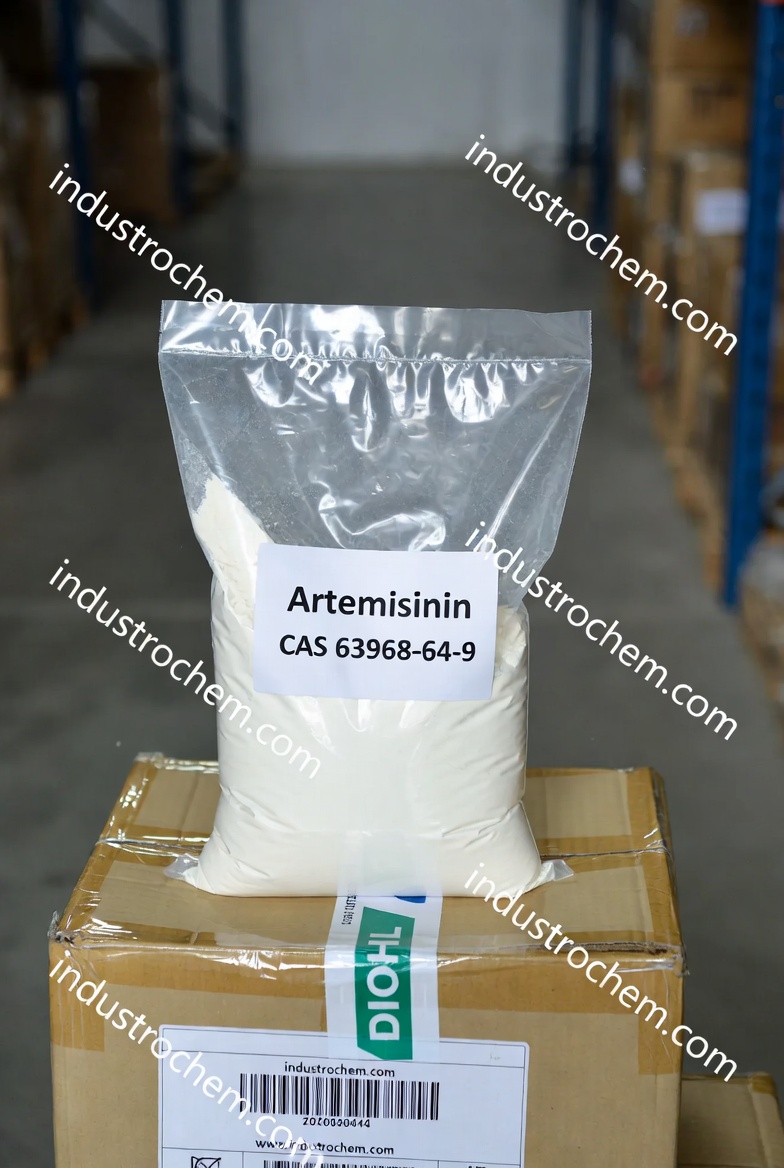
Artemisinin CAS 63968-64-9 is a naturally occurring sesquiterpene lactone that serves as a high-purity API & Intermediates component for global pharmaceutical manufacturing. Within industrial medicinal chemistry, this qinghaosu functions as the foundational raw material for the semi-synthesis of critical derivatives such as dihydroartemisinin and artemether. This arteannuin is characterized by its unique endoperoxide bridge, which is the core structural element responsible for its reactive oxygen species (ROS) generation during metabolic activation, while huanghuahaosu is refined through standardized extraction and crystallization processes to ensure consistent potency for large-scale antimalarial production. The industrial theanine-like crystalline structure of artemisinine facilitates stable handling in dry-formulations and capsule manufacturing environments. We provide bulk supply with competitive factory pricing to pharmaceutical partners worldwide, ensuring all shipments are validated with MSDS, TDS, COA and we offer customized specifications regarding purity levels and particle size to meet global pharmacopeia standards.
Artemisinin CAS 63968-64-9
- CAS: 63968-64-9
- Synonyms: Qinghaosu, Arteannuin, Artemisinine, Huanghuahaosu, Octahydro-3,6,9-trimethyl-3,12-epoxy-12H-pyrano[4,3-j]-1,2-benzodioxepin-10(3H)-one
- Einecs: 1308068-626-2
- Molecular Formula: C15H22O5
- Grade: Pharmaceutical Grade / USP / EP / CP
- Package: 25kg/drum, 1kg/bag, or customized bulk supply
Product Description
Technical Data (Physicochemical Properties)
| Property Category | Parameter | Specification (Pharma Grade) |
| Physical State | Appearance | White needle-like crystalline powder |
| Odor | Practically odorless | |
| Purity Analysis | Assay (HPLC) | 99.0% – 101.0% |
| Specific Rotation | +75° to +78° | |
| Melting Point | 150°C – 153°C | |
| Purity Control | Loss on Drying | <= 0.5% |
| Residue on Ignition | <= 0.1% | |
| Related Substances | Individual <= 0.2%; Total <= 0.5% | |
| Contaminants | Heavy Metals | <= 10 ppm |
| Arsenic (As) | <= 2 ppm | |
| Solubility | Water Solubility | Practically insoluble |
| Organic Solubility | Soluble in chloroform, acetone, ethyl acetate |
Applications
- Antimalarial API: Used as the primary therapeutic agent and raw material for the production of ACTs (Artemisinin-based Combination Therapies).
- Pharmaceutical Intermediates: Acts as the starting material for the synthesis of dihydroartemisinin (DHA), artesunate, and artemether.
- Oncology Research: Utilized as an industrial research chemical for exploring endoperoxide-mediated cytotoxicity in specific cancer cell lines.
- Veterinary Medicine: Applied in the formulation of anti-parasitic treatments for specialized livestock and companion animal health.
Storage & Safety
- Storage: Store in a cool, dry, and well-ventilated warehouse. Keep containers tightly closed and protected from light, as the endoperoxide bridge is sensitive to degradation. Recommended storage temperature is 2°C – 8°C for long-term stability.
- Safety Operations (PPE): Wear standard laboratory protective gear, including chemical-resistant gloves, safety goggles, and a dust-filtering mask.
- Handling: Avoid generating dust during bulk transfer. Ensure the work area is equipped with appropriate local exhaust ventilation to maintain exposure below recommended industrial limits.
Quality Assurance
Our extraction and purification facility operates under strict GMP-aligned protocols to ensure the highest pharmaceutical integrity. We utilize High-Performance Liquid Chromatography (HPLC) for precise assay determination and Gas Chromatography (GC) for residual solvent monitoring. Each batch of Artemisinin is subjected to full spectrum analysis, including IR and NMR, to confirm molecular identity and chiral purity, providing a transparent traceability chain for international pharmaceutical procurement and regulatory audits.
FAQ - Technical & Supply Chain
-
Q:
How does the CAS 63968-64-9 identifier distinguish this material from synthetic artemisinin derivatives?
A: CAS 63968-64-9 specifically refers to the natural extract obtained from Artemisia annua. For industrial procurement, this is critical because semi-synthetic derivatives like Artesunate (CAS 88495-63-0) or Artemether (CAS 71963-77-4) have different CAS numbers, physical properties, and solubility profiles, and cannot be used interchangeably in drug formulation without adjusting the chemical synthesis route. -
Q:
Why is Artemisinin typically applied as a precursor rather than a standalone therapeutic in modern medicine?
A: Artemisinin is commonly used as a starting material because its direct solubility in water and oil is relatively low, which limits its bioavailability. In industrial pharmaceutical production, it is typically converted into more soluble derivatives—such as the water-soluble artesunate or oil-soluble artemether—to improve the pharmacokinetic profile and clinical efficacy of the final medicinal product. -
Q:
Is this product intended for direct clinical use or as an industrial raw material?
A: This material is supplied as a bulk industrial API intended for use by licensed pharmaceutical manufacturers. It is designed to be further processed, formulated, and packaged within a controlled pharmaceutical environment and is not intended for direct consumer or retail use in its raw crystalline form.
Documents and Product Support
For product review and sourcing evaluation, supporting documents can be coordinated according to the product type, inquiry stage, and order requirements.
- COA for batch-based quality reference
- TDS for key physical and chemical information
- SDS / MSDS for handling, storage, and safety reference
- Packing information for sample, trial, and bulk orders
- Technical communication based on application and specification requirements
Information to Confirm Before Quotation
Clear sourcing information helps reduce specification mismatch and allows a more accurate quotation before sample or bulk order discussion.
- Product name and CAS number
- Application or intended end use
- Required purity, grade, or specification
- Sample quantity, trial order, or bulk demand
- Preferred packing form or net weight
- Destination country or port
- Required documents or compliance expectations
Packaging, Storage, and Handling Notes
Packaging form, storage conditions, shelf life, and shipment arrangements should be confirmed according to the product characteristics, package size, and destination requirements.
Before order confirmation, buyers are advised to review the corresponding product documents and confirm whether any special storage, labeling, or handling requirements apply.
Sample, Bulk Order and Repeat Supply Support
Support can be arranged for sample discussion, bulk supply planning, packaging confirmation, and routine sourcing communication based on the actual product and order requirements.
For repeat-use formulations or long-term procurement plans, buyers may discuss specification consistency, packaging preferences, delivery expectations, and document coordination in advance.


