









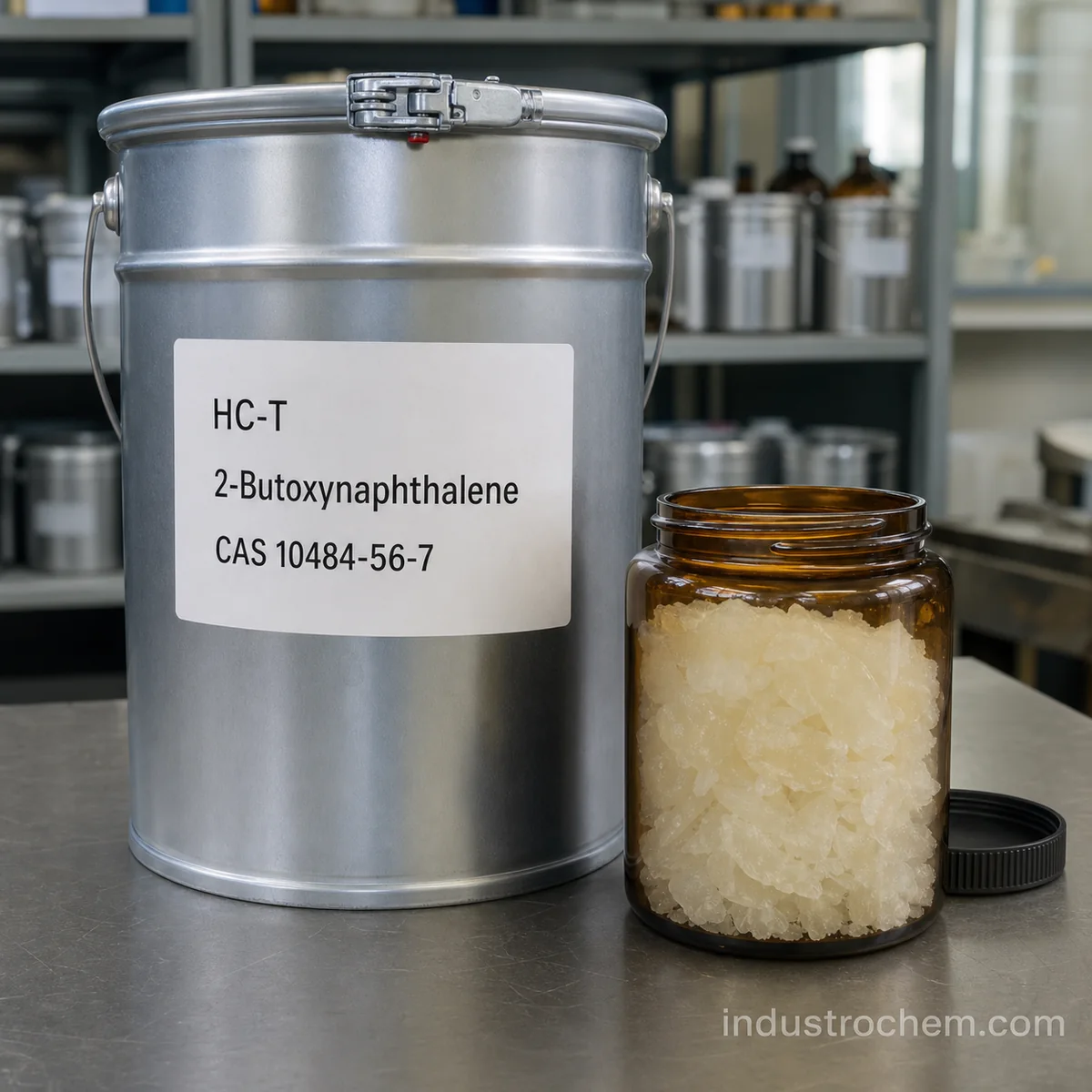
2-Butoxynaphthalene CAS 10484-56-7
Release time: 2025-07-22
Physicochemical properties
| Property | Value |
|---|---|
| IUPAC Name | 2-Butoxynaphthalene |
| CAS Number | 10484-56-7 |
| Molecular Formula | C14H16O |
| Molecular Weight | 200.28 g/mol |
| Appearance | White to Off-White Solid |
| Odor | Sweet, fruity, floral (reminiscent of berry, strawberry, raspberry) |
| Melting Point | 35-36 °C |
| Boiling Point | 147-150 °C (at 4 Torr) or 315.3 ± 11.0 °C (at 760 mmHg) |
| Density | 1.016 ± 0.06 g/cm3 (Predicted) |
| Flash Point | 123.5 ± 8.5 °C |
| LogP (Octanol-Water Partition Coefficient) | 4.96 (indicating lipophilicity) |
| Solubility | Slightly soluble in Acetonitrile and Chloroform |
| Storage Conditions | Sealed in dry, at Room Temperature |
| Chemical Structure | Contains a naphthalene ring system with a butoxy group (-O-CH2CH2CH2CH3) attached at the 2-position |
Application Areas
Spice and essence industry: as a spice ingredient (FEMA No. 4634), it is widely used to mix sweet, fruity and floral essence.
In the pharmaceutical field, as a key intermediate involved in drug molecule synthesis, such as developing drugs with specific biological activities (such as anti-inflammatory and antibacterial agents) through structural modification.
In the field of pesticides, it is used to synthesize new pesticide molecules and enhance the stability and targeting of pesticides by introducing butoxynaphthalene structures.
Materials Science: As precursors for synthesizing polymer materials (such as wear-resistant and corrosion-resistant engineering plastics) or functional coatings/dyes, their derivatives may possess high strength or special optical properties.
Storage conditions
Temperature conditions: Store in the dark at -20 ℃ and keep at room temperature for no more than 2 weeks during transportation.
Environmental requirements: Avoid contact with fire and heat sources, store in a dry and well ventilated place
Safety precautions
Operation protection
Wear gas masks, chemical safety goggles, and anti-static work clothes.
The operating area should be kept away from open flames and use explosion-proof ventilation equipment.
Emergency measures
Skin contact: Immediately remove contaminated clothing and rinse thoroughly with soap and water.
Eye contact: Rinse with flowing water or saline solution for at least 15 minutes and seek medical attention.
Inhalation: Move to a place with fresh air, keep the respiratory tract unobstructed, and perform artificial respiration if necessary.
Ingestion: Do not induce vomiting, rinse mouth immediately and seek medical attention.