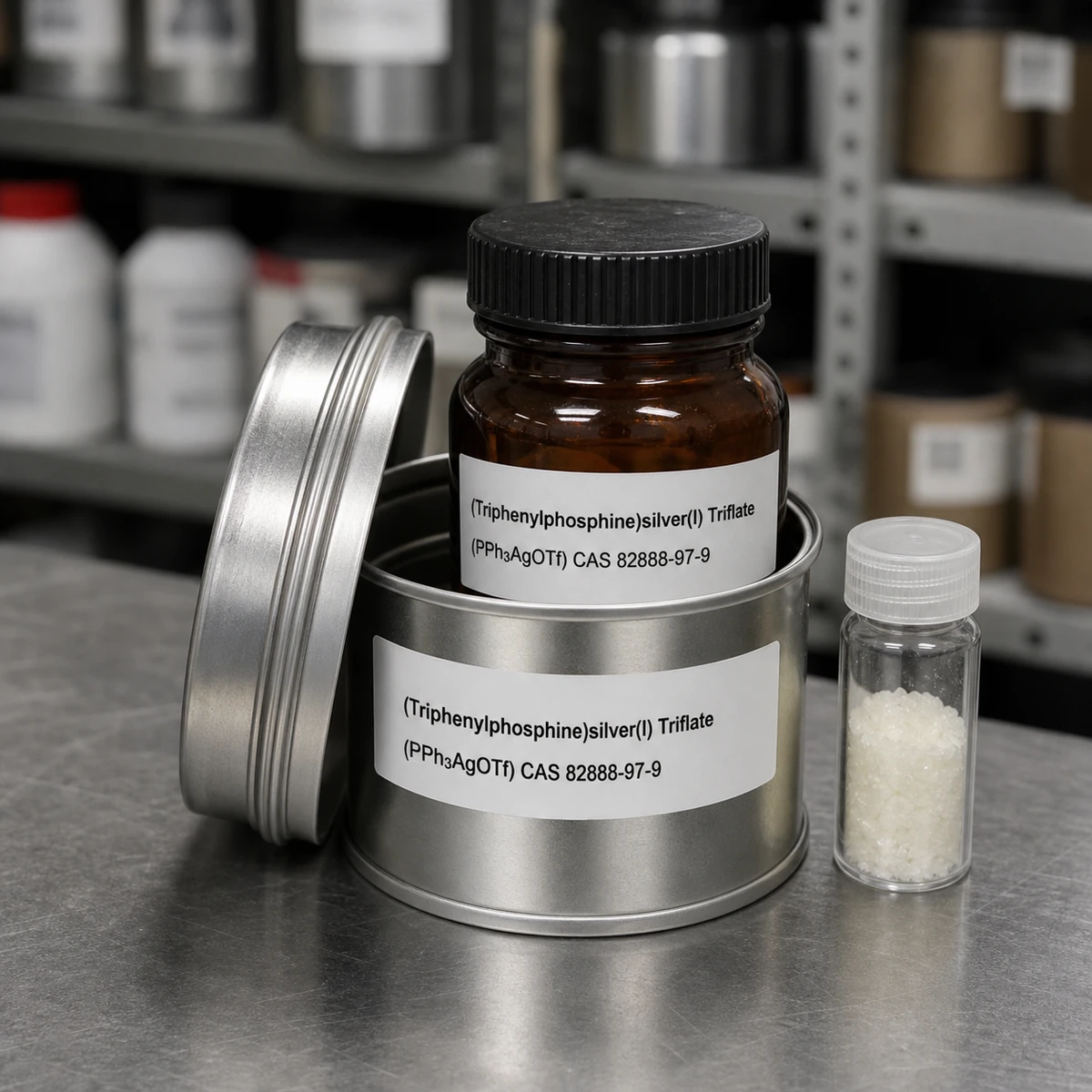
(Triphenylphosphine)silver(I) triflate is an organometallic silver(I) coordination compound consisting of a triphenylphosphine ligand bound to a silver center with triflate as the counterion. As a defined metal–phosphine complex, it is categorized as a specialty organometallic compound within professional and research‑oriented chemical supply chains. (Triphenylphosphine)silver(I) triflate (CAS 86676-88-6) is handled as a discrete molecular substance under regulated laboratory and industrial environments, with emphasis on material identification and compliance documentation rather than end‑use formulation.
This material is supplied with standardized specifications and complete technical documentation including MSDS, TDS, and COA, supporting compliant handling and traceability.
(Triphenylphosphine)silver(I) Triflate CAS 86676-88-6
- CAS: 86676-88-6
- Synonyms: (Triphenylphosphine)silver(I) triflate, Triphenylphosphine silver triflate, AgOTf·PPh3, Silver(I) triphenylphosphine triflate
- Grade: Industrial grade 99%
- Package: 200kg iron drum or 50kg plastic drum packaging
Product Description
Physicochemical properties
| Property | Value |
|---|---|
| IUPAC Name | Triphenylphosphine silver trifluoromethanesulfonate |
| Other Names | Silver trifluoromethanesulfonate triphenylphosphine complex |
| Chemical Formula | AgOTf(PPh₃) or Ag(CF₃SO₃)(PPh₃) |
| Molecular Weight | Approximately 535.24 g/mol (calculated based on atomic weights of Ag, C, F, S, O, and P) |
| Appearance | Yellow powder or crystalline solid (as described in commercial products and laboratory preparations) |
| Solubility | Soluble in most organic solvents (e.g., benzene, dichloromethane, ethyl ether, N,N-dimethylformamide, tetrahydrofuran, acetonitrile) |
| Sensitivity | Light-sensitive (as indicated for related compounds like silver trifluoromethanesulfonate) |
| Reactivity | Acts as a strong Lewis acid and catalyst in organic synthesis, facilitating reactions such as C-H bond additions, cyclizations, and oxidations |
| Preparation | Can be prepared by reacting silver trifluoromethanesulfonate (AgOTf) with triphenylphosphine (PPh₃) in a suitable solvent |
| Storage Conditions | Should be stored in a dry, sealed container, away from light and moisture |
Application Areas
Organic synthesis catalysis: catalyzing the formation and cleavage of glycosidic bonds, assisting in the development of anticancer sugar conjugates.
Cationic polymerization: Initiate the polymerization of vinyl ether and epoxy monomers to synthesize high transparency optical resins.
Preparation of Fluorinated Materials: Catalyze the reaction of fluorine-containing monomers to produce aerospace sealing materials that are resistant to high temperatures and corrosion.
Biopharmaceutical research: Silver complexes are formed by binding with ferrocene phosphine ligands, exhibiting potential anti-cancer activity.
Storage conditions
Environmental conditions
Temperature: It is recommended to store at -20 ℃ in the dark (refer to similar silver complex standards).
Humidity: Sealed in a dry environment, relative humidity ≤ 85%.
Isolation requirements: Store separately from oxidants and active metals to avoid mixing storage.
Containers and Packaging
Use glass or polytetrafluoroethylene containers with good sealing properties and fill them with argon gas for protection.
During transportation, ultra-low temperature ice packs are required to maintain a stable environment
Safety precautions
Personal protection: Wear work clothes that prevent toxic substances from penetrating, chemical protective goggles, and chemical resistant gloves.
Operation standard: Operate in an explosion-proof fume hood to avoid inhaling steam or dust
Leakage: absorb a small amount of leakage with sand, build a dike and cover it with foam in case of a large amount of leakage.
Environmental risk: Avoid leakage into water bodies and prevent toxicity to aquatic organisms
FAQ - Technical & Supply Chain
-
Q:
Does CAS 86676-88-6 specifically correspond to (Triphenylphosphine)silver(I) triflate?
A: Yes. This CAS number is assigned specifically to the silver(I)–triphenylphosphine triflate coordination compound. -
Q:
Is this compound supplied as a mixture or formulation?
A: No. It is supplied as a defined coordination compound for professional handling in regulated research or industrial environments.
Documents and Product Support
For product review and sourcing evaluation, supporting documents can be coordinated according to the product type, inquiry stage, and order requirements.
- COA for batch-based quality reference
- TDS for key physical and chemical information
- SDS / MSDS for handling, storage, and safety reference
- Packing information for sample, trial, and bulk orders
- Technical communication based on application and specification requirements
Information to Confirm Before Quotation
Clear sourcing information helps reduce specification mismatch and allows a more accurate quotation before sample or bulk order discussion.
- Product name and CAS number
- Application or intended end use
- Required purity, grade, or specification
- Sample quantity, trial order, or bulk demand
- Preferred packing form or net weight
- Destination country or port
- Required documents or compliance expectations
Packaging, Storage, and Handling Notes
Packaging form, storage conditions, shelf life, and shipment arrangements should be confirmed according to the product characteristics, package size, and destination requirements.
Before order confirmation, buyers are advised to review the corresponding product documents and confirm whether any special storage, labeling, or handling requirements apply.
Sample, Bulk Order and Repeat Supply Support
Support can be arranged for sample discussion, bulk supply planning, packaging confirmation, and routine sourcing communication based on the actual product and order requirements.
For repeat-use formulations or long-term procurement plans, buyers may discuss specification consistency, packaging preferences, delivery expectations, and document coordination in advance.