










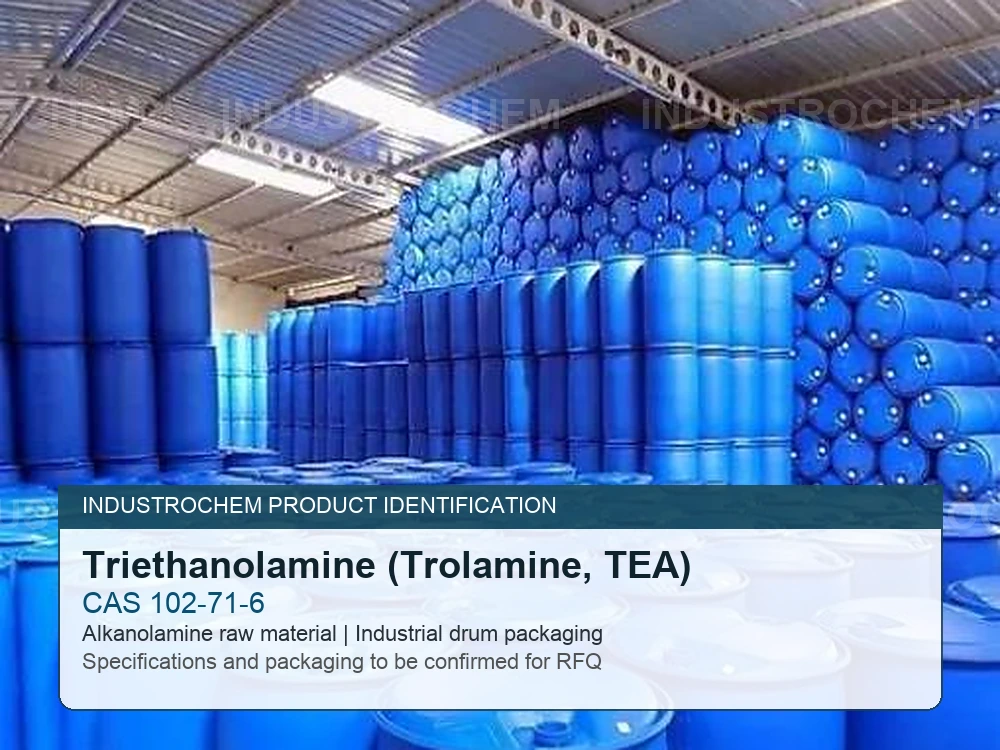
Trolamine (CAS 102-71-6), chemically known as Triethanolamine (TEA 99%), is a viscous, colorless tertiary amine and organic compound primarily utilized as a pH adjuster and neutralizing agent in the manufacturing of cosmetic emulsions, carbomer gels, and pharmaceutical preparations. This 2,2',2''-Nitrilotriethanol compound functions as a versatile alkalizing agent that reacts with fatty acids to form soaps in Tris(2-hydroxyethyl)amine based formulations, providing excellent emulsion stability and thickening properties in lotions, sunscreens, and liquid laundry detergents. To support industrial-scale requirements, we provide bulk supply with competitive factory pricing and ensure rigorous quality control through customized specifications alongside standard technical documentation, including MSDS, TDS, COA.
Trolamine CAS 102-71-6
- CAS: 102-71-6
- Synonyms: Triethanolamine, TEA, 2,2',2''-Nitrilotriethanol, Tris(2-hydroxyethyl)amine, Daltogen
- Einecs: 203-049-8
- Molecular Formula: C6H15NO3
- Grade: Industrial grade 99%
- Package: 200kg iron drum or 50kg plastic drum packing
Product Description
alias: triethanolamine
Formula: C6H15NO3
Molecular weight: 149.1882
Boiling point (°C, 101.3kPa): 360
Melting point (°C): 21.2
Relative density (g/ml, 20/4°C): 1.1242
CAS Number: 102-71-6
Characteristics: Colorless to light yellow transparent viscous liquid, slightly ammonia smell, colorless to yellowish cubic crystals at low temperature.
The color gradually darkens when exposed in the air. It is easily soluble in water, ethanol, acetone, glycerin and ethylene glycol, etc., and slightly soluble in benzene, ether and carbon tetrachloride, etc., and is almost insoluble in non-polar solvents. Solubility at 5°C: benzene 4.2%, ether 1.6%, carbon tetrachloride 0.4%, n-heptane less than 0.1%。 It is strongly alkaline, and the pH of 0.1mol/L aqueous solution is 10.5. It is irritating. Hygroscopic. It can absorb acidic gases such as carbon dioxide and hydrogen sulfide. Pure triethanolamine does not work on steel, iron, nickel and other materials, but is highly corrosive to copper, aluminum and their alloys. Unlike monoethanolamine and diethanolamine, triethanolamine and iodine hydroacid (HI) can form iodine hydrochloride precipitate. Combustible. Low toxicity. Avoid contact with oxidants and acids.
How to use:
– Used as raw materials for synthesizing surfactants, detergents, stabilizers and fabric softeners.
– Used in cosmetic formulations to neutralize soap with fatty acids and synthesize amine salts from sulfated fatty alcohols.
Waste gas treatment neutralizes the cleaning liquid to remove acid gases such as hydrogen sulfide and carbon dioxide.
It is also used as a vulcanization activator for natural rubber and synthetic rubber, and as a polymerization activator for nitrile rubber.
It is also used as an anti-corrosion additive for lubricating oil, dye solvent, papermaking auxiliary, ink, etc.
Other Uses:
1. Raw materials for detergents, beauty products, skin care products, and cosmetics.
2. Triethanolamine is also a highly effective chelating agent that can chelate various heavy metals.
3. Triethanolamine is also a good solvent, hygroscopic agent, and is used in the textile industry.
4. It also has the effect of neutralizing agent in cosmetics, which can be neutralized with CP-940 to achieve thickening and moisturizing effects.
5. Raw materials for concrete superplasticizer and early strength agent.
6. Used in surfactants, cutting oils, antifreeze, in the metalworking industry, it can be used to prepare corrosion inhibitors, protect metal surfaces, and prevent oxidation.
Triethanolamine acts as a neutralizer in cosmetics. It can be neutralized with CP-940 to achieve a thickening and moisturizing effect. Used as an emulsifier, moisturizer, humidifier, thickener, PH balancer in cosmetics (including skin washing, eye gel, moisturizing, shampoo, etc.). Cream products made with triethanolamine have the characteristics of delicate paste and bright white.
In cosmetic formulations, it is used to neutralize soap with fatty acids and aminoforming salts with sulfated fatty acids. Triethanolamine is a commonly used emulsifier in cream preparations, and cream products emulsified with triethanolamine have the characteristics of delicate paste and bright white. In addition, the colloidal phase formed by triethanolamine and higher fatty acids or higher fatty alcohols has good stability, stable product quality, and high proportion of added components. Triethanolamine is the most commonly used neutralizer for acidic polymer gels containing carbomer, which forms a stable polymer structure by neutralizing with carboxyl groups such as carbomer, achieving the application effect of thickening and moisturizing.
Triethanolamine can be used for industrial gas purification, pH control stabilizer, rubber vulcanization accelerator, developer stabilizer, engine carbon deposition preventor, vulcanization activator for natural rubber and synthetic rubber, nitrile rubber polymerization activator, and can also be used as lubricating oil and anti-corrosion additive. Triethanolamine needs to develop in the direction of more refinement, higher purity and diversification in the future.
FAQ - Technical & Supply Chain
-
Q:
Is Trolamine (CAS 102-71-6) the same as Triethanolamine 85%?
A: No, Trolamine (TEA 99%) is the high-purity grade (C6H15NO3) specifically required for cosmetic and pharmaceutical applications to minimize impurities like diethanolamine, whereas TEA 85% is a lower-grade mixture typically used in cement grinding or industrial construction. -
Q:
What is the primary function of Trolamine in carbomer-based gels?
A: It acts as a neutralizing base that uncoils the polymer chains of carbomers (polyacrylic acid), causing the formulation to thicken instantly into a clear, stable gel.
Documents and Product Support
For product review and sourcing evaluation, supporting documents can be coordinated according to the product type, inquiry stage, and order requirements.
- COA for batch-based quality reference
- TDS for key physical and chemical information
- SDS / MSDS for handling, storage, and safety reference
- Packing information for sample, trial, and bulk orders
- Technical communication based on application and specification requirements
Information to Confirm Before Quotation
Clear sourcing information helps reduce specification mismatch and allows a more accurate quotation before sample or bulk order discussion.
- Product name and CAS number
- Application or intended end use
- Required purity, grade, or specification
- Sample quantity, trial order, or bulk demand
- Preferred packing form or net weight
- Destination country or port
- Required documents or compliance expectations
Packaging, Storage, and Handling Notes
Packaging form, storage conditions, shelf life, and shipment arrangements should be confirmed according to the product characteristics, package size, and destination requirements.
Before order confirmation, buyers are advised to review the corresponding product documents and confirm whether any special storage, labeling, or handling requirements apply.
Sample, Bulk Order and Repeat Supply Support
Support can be arranged for sample discussion, bulk supply planning, packaging confirmation, and routine sourcing communication based on the actual product and order requirements.
For repeat-use formulations or long-term procurement plans, buyers may discuss specification consistency, packaging preferences, delivery expectations, and document coordination in advance.
Contact Form
Use our contact form to send us your questions, suggestions or comments. We will respond as soon as possible.
Product Categories
Related Products
-
Polyquaternium-10 (PQ-10) CAS 68610-92-4 -
Docosalkyltrimethyl Ammonium Chloride CAS 17301-53-0 -
Aluminum Chlorohydrate (ACH) (CAS 12042-91-0) -
Polyquaternium-10 (PQ-10) (CAS 68610-92-4) -
Kojic Acid (CAS 501-30-4) -
Hydroxypinacolone Retinoate (HPR) (CAS 893412-73-2) -
Guar Hydroxypropyltrimonium Chloride (CAS 65497-29-2) -
Niacinamide CAS 98-92-0


