










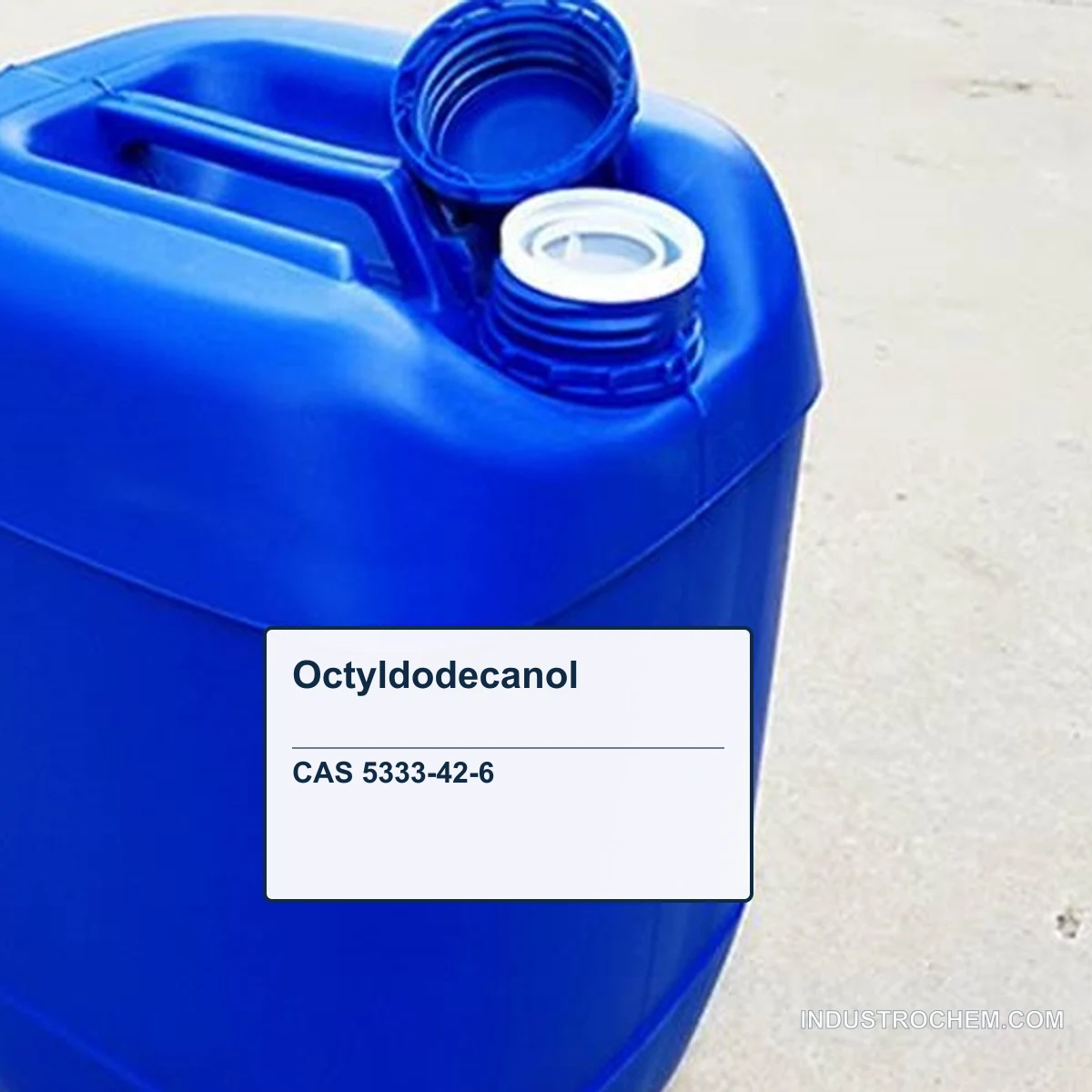
Octyldodecanol CAS 5333-42-6 is a branched C20 fatty alcohol used as an emollient, pigment wetting agent, and solvent in cosmetic and personal-care formulations. Confirm grade, color, acid value or hydroxyl value, intended application, quantity, packaging, and documents before quotation.
Octyldodecanol CAS 5333-42-6
- CAS: 5333-42-6
- Synonyms: 2-Octyldodecan-1-ol, 2-Octyl dodecanol, Isoarachidyl alcohol, Branched C20 alcohol
- Einecs: 226-242-9
- Molecular Formula: C₂₀H₄₂O
- Grade: Confirm the current product-specific specification.
- Package: Confirm packaging requirements with quantity, destination, and handling needs.
Product Description
Octyldodecanol is a branched C20 Guerbet fatty alcohol identified by CAS 5333-42-6.
Synonyms: 2-Octyldodecan-1-ol; 2-Octyl dodecanol; Isoarachidyl alcohol; Branched C20 alcohol.
CAS: 5333-42-6.
EINECS / EC: 226-242-9.
Molecular formula: C₂₀H₄₂O.
Confirm grade, color, acid value or hydroxyl value, intended application, quantity, packaging, and documents before purchase.
It is mainly evaluated as an emollient, pigment wetting agent, and solvent in cosmetic and personal-care formulations.
Confirm the current product-specific specification.
Confirm packaging requirements with quantity, destination, and handling needs.
Document requirements should be confirmed from the current specification, SDS, COA, or other product-specific files.
Regulated-use suitability must be confirmed separately with current product-specific documentation.
The page is an RFQ entry point and does not state stock, price, MOQ, or fixed lead time.
For an RFQ, state the intended use, required specification, quantity, packaging, destination, and document needs.

FAQ - Technical & Supply Chain
-
Q:
Is Octyldodecanol a straight-chain fatty alcohol?
A: No. Octyldodecanol CAS 5333-42-6 is a branched C20 Guerbet alcohol, also known as 2-octyldodecan-1-ol. Its branched structure gives it a low pour point and good spreadability compared with many straight-chain fatty alcohols. -
Q:
Which specifications matter for Octyldodecanol?
A: Compare content or assay, hydroxyl value, acid value, saponification value, iodine value, peroxide value, color, odor, density, refractive index and viscosity. Cosmetic and pharmaceutical applications usually need low acid, peroxide and odor values, with a typical hydroxyl value around 175-190 mg KOH/g. -
Q:
What is Octyldodecanol used for?
A: Octyldodecanol is mainly used as a cosmetic emollient and masking agent in skin care, sun care and color cosmetics. It is also used in pharmaceutical or topical formulations as an excipient or emulsion stabilizer, and in industrial applications as a solvent, lubricant component or oleochemical intermediate. -
Q:
How should Octyldodecanol be stored?
A: Store in tightly closed, clean containers in a cool, dry, ventilated area away from excessive heat, ignition sources and strong oxidizers. Protect from moisture and contamination, and confirm the recommended storage temperature for the specific cosmetic, pharmaceutical or industrial grade. -
Q:
What are the key physical properties of Octyldodecanol?
A: Octyldodecanol is a clear branched C20 liquid with formula C₂₀H₄₂O and molar mass about 298.6 g/mol. It typically has density around 0.835-0.845 g/mL at 20 °C, boiling point near 358 °C at atmospheric pressure, low melting point around -40 °C or below, and refractive index about 1.4535-1.4555.
Ordering & Documentation
Key information for document requests, quotations, and supply planning.
Documents
Tell us which documents your procurement team needs. Before an order, we will check whether the quoted source can provide them for the offered lot.
Quotation
Send the CAS number, grade, quantity, packing preference and destination.
Sample & Supply
Ask whether samples, trial quantities or repeat orders are possible. We will check each request against the sourced product and current offer.
Storage & Shipping
Product-specific conditions are confirmed before order.