










Hydrogenated Castor Oil (HCO) is a hydrogenated castor-oil derivative. It may be evaluated for rheology modification, wax additive, grease, coating, and personal-care raw-material evaluation. For an RFQ, state the intended use, required specification, quantity, packaging, destination, and document needs.
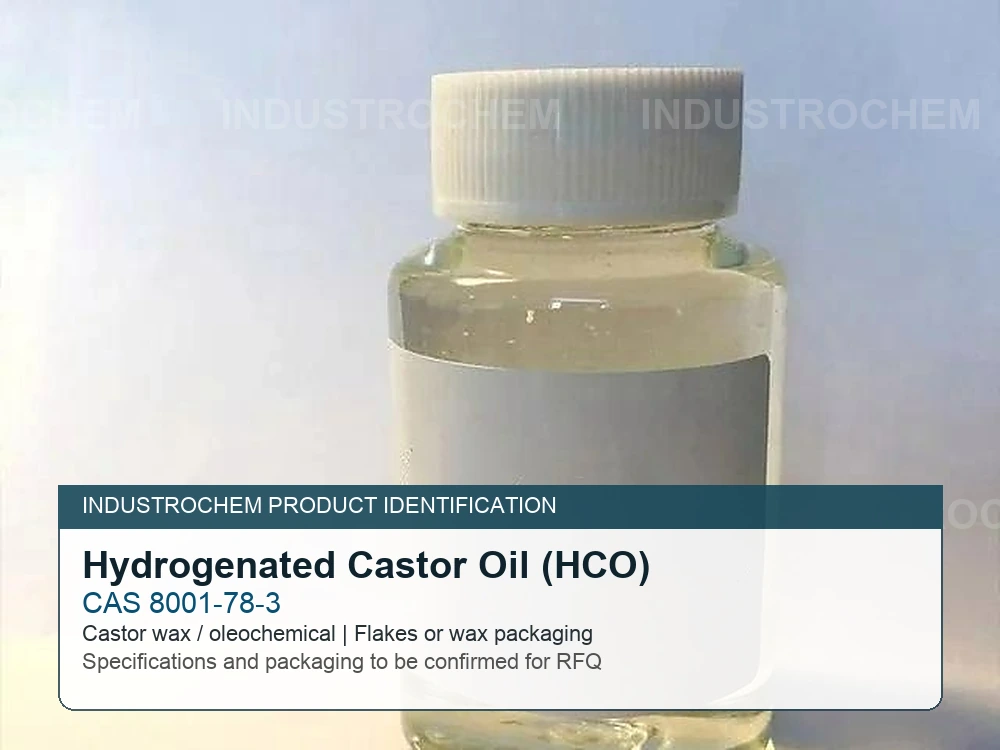
Hydrogenated Castor Oil (HCO) CAS 8001-78-3
- CAS: 8001-78-3
- Synonyms: Hydrogenated Castor Oil; Castor Wax; HCO; Castor Oil Hydrogenated
- Einecs: 232-292-2
- Molecular Formula: Not specified for this natural-oil derivative
- Grade: Confirm the current product-specific specification.
- Package: Confirm packaging requirements for the proposed material and destination.
Product Description
Hydrogenated Castor Oil (HCO) is a hydrogenated castor-oil derivative.
- Synonyms: Hydrogenated Castor Oil; Castor Wax; HCO; Castor Oil Hydrogenated.
- CAS: 8001-78-3.
- EINECS / EC: 232-292-2.
- Molecular formula: Not specified for this natural-oil derivative.
- Confirm form, melting range, hydroxyl value, iodine value, intended application, quantity, packaging, and SDS before purchase.
- It may be evaluated for rheology modification, wax additive, grease, coating, and personal-care raw-material evaluation.
Confirm the current product-specific specification.
Confirm packaging requirements for the proposed material and destination.
Document requirements should be confirmed from the current specification, SDS, COA, or other product-specific files.
Regulated-use suitability must be confirmed separately with current product-specific documentation.
FAQ - Technical & Supply Chain
-
Q:
What is Hydrogenated Castor Oil CAS 8001-78-3?
A: Hydrogenated Castor Oil, also called Castor Wax or HCO, is the saturated, hardened derivative of castor oil with EINECS 232-292-2. It is normally a hard waxy solid supplied as flakes or powder, with a melting point commonly around 83-88 deg C. -
Q:
How does Hydrogenated Castor Oil differ from unmodified Castor Oil?
A: Unmodified castor oil is liquid or low-melting and contains unsaturated ricinoleic acid derivatives. Hydrogenation saturates the oil and raises the melting point, producing the solid Castor Wax form identified by CAS 8001-78-3, with much lower iodine value and different rheology. -
Q:
What are the main applications of Hydrogenated Castor Oil?
A: HCO is used as a thickener in lithium and calcium greases, a wax or rheology modifier in coatings, adhesives and polishes, and a hard wax in cosmetics and personal-care sticks. It can also serve as a pharmaceutical ointment base or excipient and as a feedstock for derivatives such as 12-hydroxystearic acid. -
Q:
Which specifications should be confirmed for Hydrogenated Castor Oil?
A: Key parameters are melting point, hydroxyl value, iodine value, acid value, saponification value, color and physical form. Typical values include melting point 83-88 deg C, hydroxyl value 145-165 mg KOH/g, iodine value max about 5 and saponification value about 174-186 mg KOH/g, but grease, coating and personal-care grades can differ. -
Q:
How should Hydrogenated Castor Oil be stored, and what should a sourcing inquiry specify?
A: Store HCO in tightly closed containers in a cool, dry and ventilated area, away from heat, strong oxidizers and ignition sources. A sourcing inquiry should specify CAS 8001-78-3, melting range, hydroxyl value, iodine value, physical form, intended application, quantity, packaging and destination.
Ordering & Documentation
Key information for document requests, quotations, and supply planning.
Documents
Tell us which documents your procurement team needs. Before an order, we will check whether the quoted source can provide them for the offered lot.
Quotation
Send the CAS number, grade, quantity, packing preference and destination.
Sample & Supply
Ask whether samples, trial quantities or repeat orders are possible. We will check each request against the sourced product and current offer.
Storage & Shipping
Product-specific conditions are confirmed before order.