
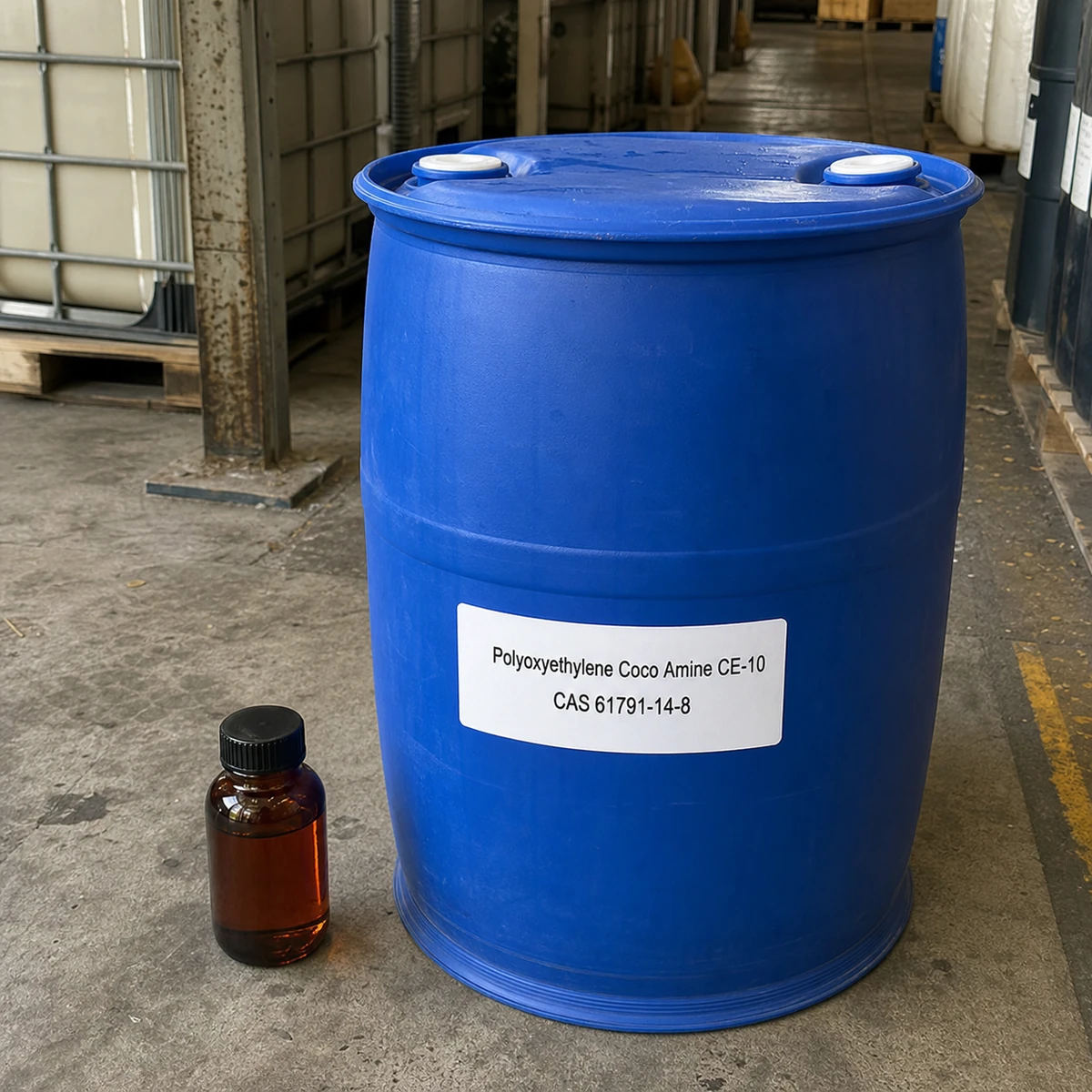
CE-10 (CAS 61791-14-8), also called Polyoxyethylene Coco Amine or PEG-10 Cocamine, is an ethoxylated coco alkyl amine with a nominal average near 10 EO units. It is used as a wetting, emulsifying, dispersing, antistatic and corrosion-inhibiting component in textile, cleaning, metalworking and agrochemical formulations. Nominal EO level, total and tertiary amine values, water content and physical form are key selection parameters. A Certificate of Analysis (COA), Technical Data Sheet (TDS) and Safety Data Sheet (SDS) can be provided for specification and handling review.
Polyoxyethylene Coco Amine CE-10 CAS 61791-14-8
- CAS: 61791-14-8
- Synonyms: Polyoxyethylene Coco Amine, CE-10, PEG-10 Cocamine, Cocoamine Ethoxylate 10EO, Amines, Coco Alkyl, Ethoxylated
- Molecular Formula: R-N[(CH₂CH₂O)ₓH][(CH₂CH₂O)ᵧH] (nominal x+y ≈ 10)
- Grade: Specified by nominal EO, total and tertiary amine values, active matter, water, color and physical form; see the current TDS and COA.
- Package: Drums or bulk packaging; container material and net weight are agreed in the quotation.
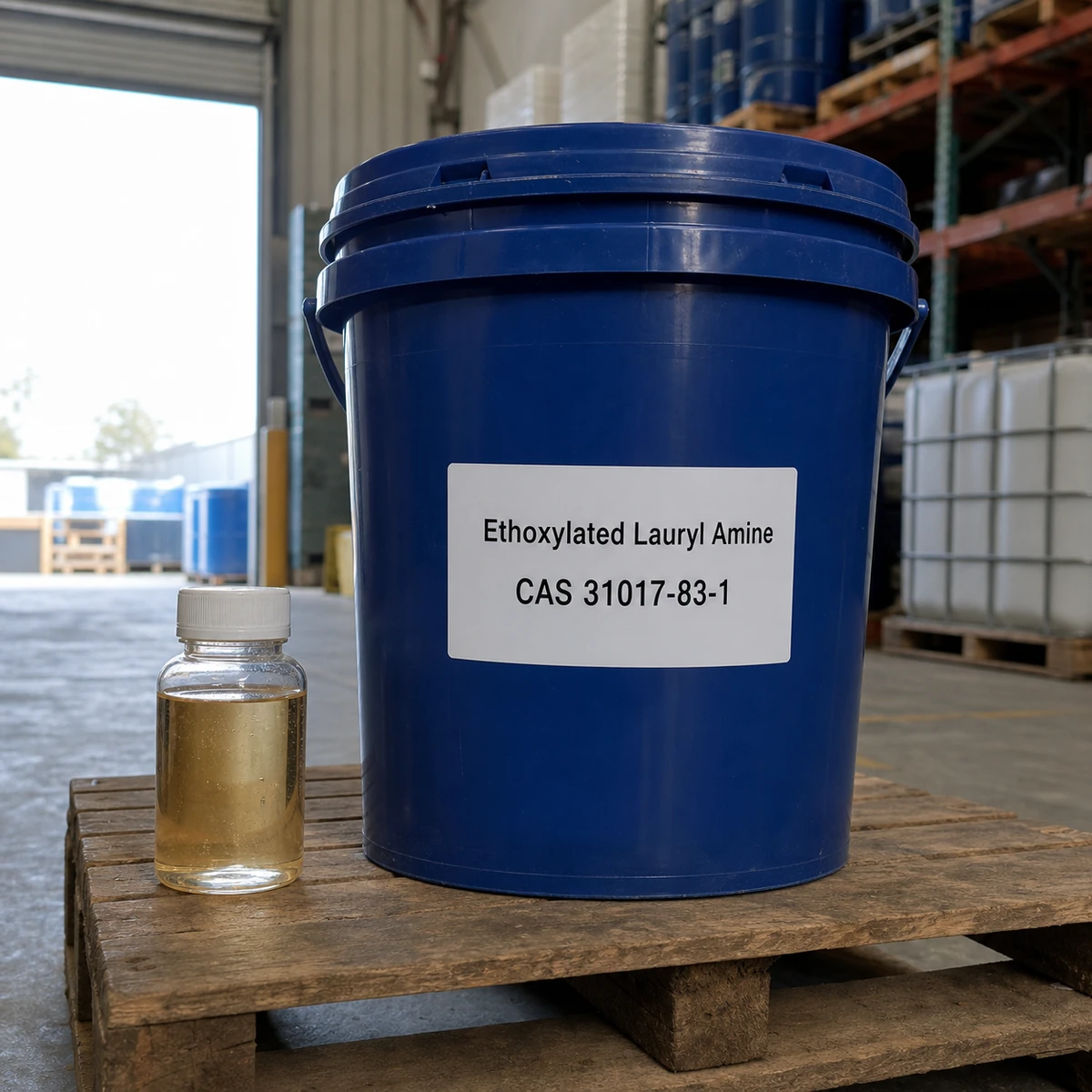
Product Description
Identity and physicochemical profile
| Item | Technical guidance |
|---|---|
| Product identity | Polyoxyethylene Coco Amine CE-10; ethoxylated coco alkyl amine with nominal average near 10 EO units |
| CAS | 61791-14-8 |
| Nominal structure | R-N[(CH₂CH₂O)ₓH][(CH₂CH₂O)ᵧH], with nominal x+y near 10; alkyl and EO distributions are grade-dependent |
| Ionic behavior | The amine becomes more protonated and cationic at lower pH; ionic behavior also depends on the ethoxylation degree and formulation |
| Typical quality controls | Total and tertiary amine values, nominal average EO degree, water, appearance, color, pH and physical form, with stated test methods |
| Identity boundary | This CAS number describes ethoxylated coco amines, not coconut-oil ester or fatty-acid ester chemistry |
Quality controls and analytical reports
Total and tertiary amine values are reported separately in mg KOH/g using the stated titration procedures. Water-content results identify the Karl Fischer method, while active-matter content states its analytical and reporting basis. pH results state the test medium, concentration and temperature. We can provide applicable quality-test information; any chromatographic report used for homolog distribution or free polyethylene glycol identifies the measured fraction, method, calibration and reporting basis. Chromatographic peak-area percentages do not establish mass purity.
Applications and grade selection
CE-10 is evaluated as a wetting, emulsifying, dispersing, antistatic or corrosion-inhibiting component in textile, industrial-cleaning, metalworking and agrochemical formulations. Performance depends on pH, co-surfactants, electrolytes, temperature and nominal ethoxylation level.
- Check compatibility with anionic ingredients at both concentrate and use dilution, especially under acidic conditions where the amine is protonated.
- Compare amine values, nominal EO, water and physical form before testing wetting, emulsion or dispersion stability and substrate performance.
- A CE-10 trade description does not establish cosmetic, biocidal, food-contact or other regulated-use suitability without the relevant grade documentation.
Storage and handling
Keep containers tightly closed in a dry, ventilated area. The TDS and SDS for the supplied grade specify storage temperature, incompatible materials and any instructions for warming, mixing or sampling when low temperature changes the physical form.
Safety, documentation and procurement
Ethoxylated amines may require protection against corrosive or irritating effects depending on composition and pH. The SDS for the supplied grade gives instructions for protective equipment, spill response, transport and disposal. For a quotation, send the grade or intended application, approximate quantity and destination.
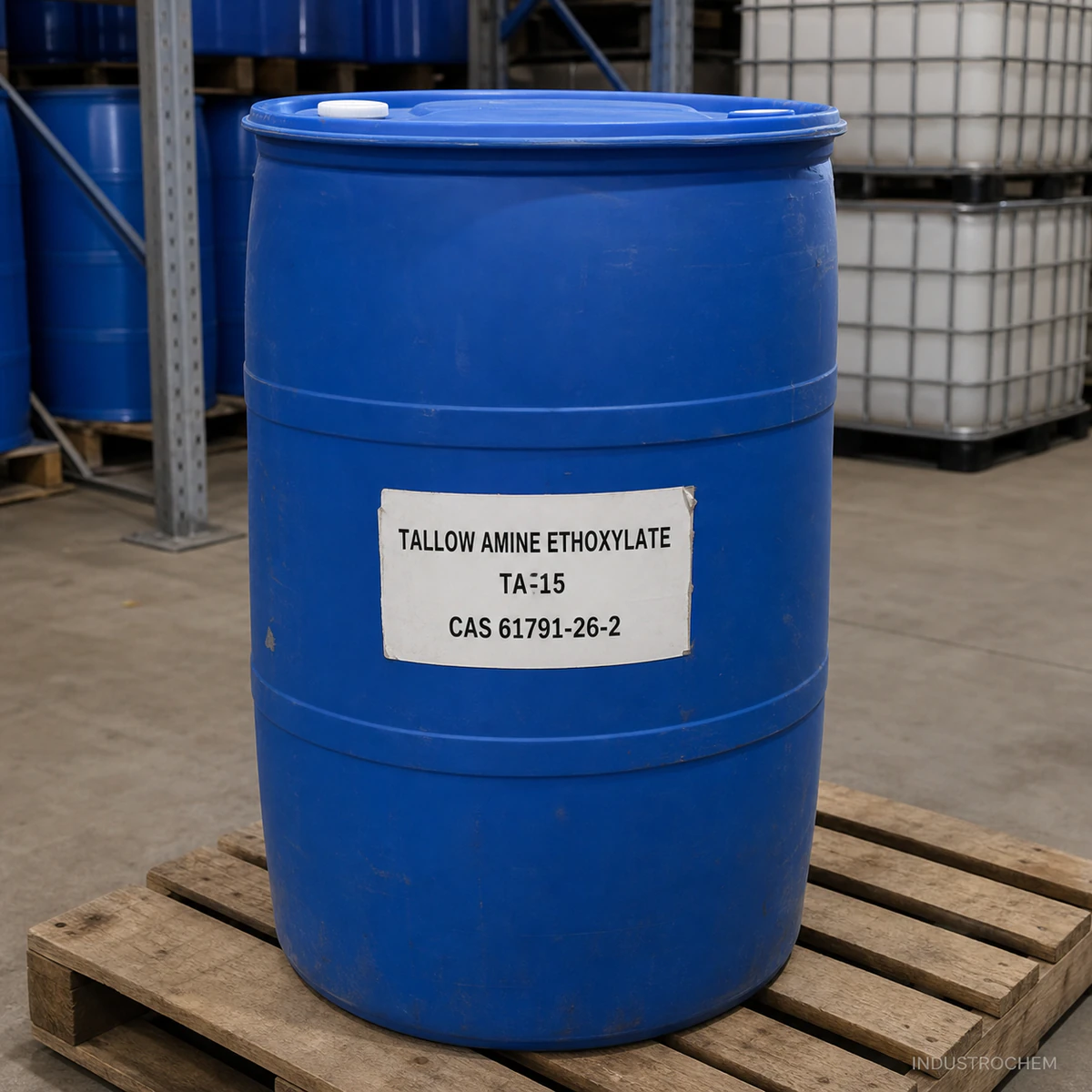
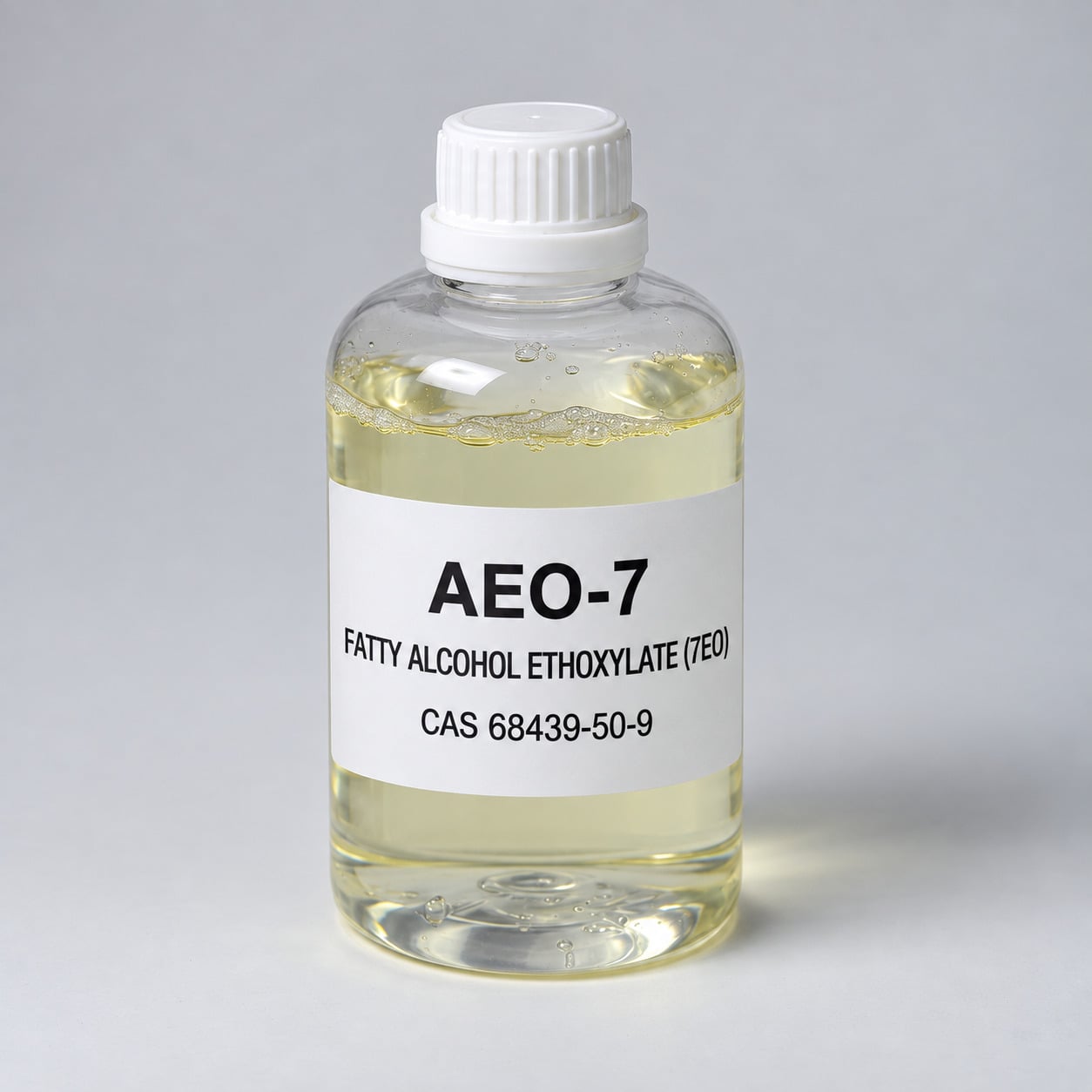
For formulation comparison, Ethoxylated Lauryl Amine and Tallow Amine Ethoxylate TA-15 offer different alkyl-chain or ethoxylation profiles, while PEG-2 Oleamine provides a lower-EO oleyl-amine comparison. Fatty Alcohol Ethoxylate AEO-7 / MOA-7 is an option for nonionic wetting and cleaning. These products are not direct substitutes; selection depends on application pH, compatibility and required performance.
FAQ - Technical & Supply Chain
-
Q:
Does CE-10 identify a fixed molecule or a defined ten-EO coco amine grade?
A: CE-10 denotes a commercial coco-alkyl amine ethoxylate grade with a nominal average near ten EO units. Coco feedstock contains different alkyl-chain lengths, and the EO chain lengths also vary. CAS 61791-14-8 describes the wider ethoxylated coco-amine family, so the CAS alone does not specify ten EO units. The TDS and COA describe the supplied grade and its quality parameters. -
Q:
What compatibility check is important when using CE-10 with anionic ingredients?
A: Coco amine ethoxylates can become more cationic as pH decreases, so compatibility cannot be inferred from the nonionic label alone. Test the actual pH range, order of addition, dilution, temperature and storage stability with the complete anionic formulation before scale-up.
Ordering & Documentation
Key information for document requests, quotations, and supply planning.
Documents
Tell us which documents your procurement team needs. Before an order, we will check whether the quoted source can provide them for the offered lot.
Quotation
Send the CAS number, grade, quantity, packing preference and destination.
Sample & Supply
Ask whether samples, trial quantities or repeat orders are possible. We will check each request against the sourced product and current offer.
Storage & Shipping
Product-specific conditions are confirmed before order.