









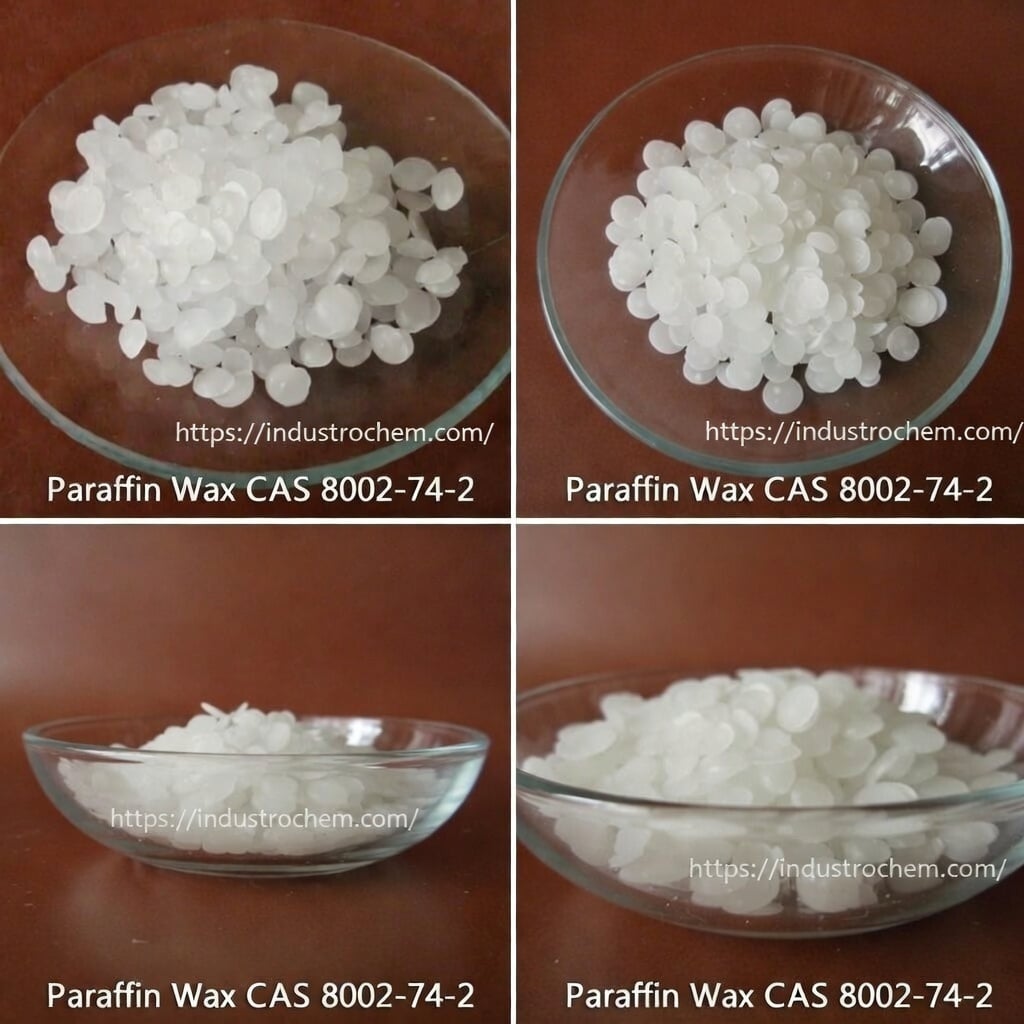
Paraffin Wax is a solid, colorless or white crystalline mixture of straight-chain hydrocarbons categorized under Industrial & Specialty Chemicals, functioning as a critical hydrophobic agent and thermal energy storage medium. This petroleum-derived substance is characterized by its distinct melting point range and low oil content, which dictates its structural hardness and barrier efficiency when applied to various substrates. Within industrial manufacturing, it serves as a fundamental lubricant and release agent in the production of rubber auxiliaries and plastic additives, where it prevents adhesion and improves the surface finish of molded components. Its high dielectric strength also renders it an essential component for electrical insulation and moisture-proofing in the electronics and paper industries. We provide this versatile hydrocarbon material with competitive factory pricing to support international manufacturing sectors, offering customized specifications for various oil content levels and melting points ranging from 54°C to 64°C. Each consignment is rigorously tested and accompanied by MSDS, TDS, COA to ensure compliance with purity and safety standards for bulk supply to global industrial markets.
Paraffin Wax CAS 8002-74-2
- CAS: 8002-74-2
- Synonyms: Fully Refined Paraffin Wax, Semi-Refined Paraffin Wax, Petroleum Wax, Hard Paraffin, Microcrystalline Wax
- Einecs: 232-315-6
- Molecular Formula: CnH2n+2
- Grade: Fully Refined / Semi-Refined / Industrial Grade
- Package: Fully Refined / Semi-Refined / Industrial Grade
Product Description
Technical Data
| Physicochemical Properties | Fully Refined (Typical Data) | Semi-Refined (Typical Data) |
| Appearance | White crystalline slab/pellet | White to off-white slab |
| Melting Point | 58 – 60°C | 58 – 60°C |
| Oil Content | ≤ 0.5% | ≤ 1.5% – 2.0% |
| Color (Saybolt) | +28 to +30 | +25 to +27 |
| Needle Penetration (25°C) | 15 – 19 (1/10mm) | 16 – 22 (1/10mm) |
| Odor Number | ≤ 1 | ≤ 2 |
| Solubility | Insoluble in water | Insoluble in water |
Applications
- Paper & Packaging: Used as a waterproof coating for corrugated boxes and food-grade wrapping to prevent moisture penetration.
- Rubber & Plastic Processing: Acts as an external lubricant and ozone-protecting wax in tire manufacturing and PVC extrusion.
- Wood Treatment: Applied as a sealant for medium-density fiberboard (MDF) and particleboard to control water absorption.
- Textile & Leather: Utilized in finishing processes to provide gloss, smoothness, and improved handle to fabrics and leather goods.
Storage & Safety
- Storage: Store in a cool, dry, well-ventilated area away from heat sources, open flames, and oxidizing agents. Keep the temperature below 45°C to prevent melting or deformation of the slabs/pellets. Avoid direct sunlight.
- Safety (PPE): Wear heat-resistant gloves and safety goggles when handling the material in its molten state to prevent thermal burns. Use standard dust masks if handling powdered or flaked forms to avoid respiratory irritation.
Quality Assurance
Our Paraffin Wax production involves advanced solvent de-oiling and hydro-refining processes to achieve ultra-low oil content and high oxidation stability. Each batch undergoes rigorous testing for penetration, melting point, and color stability. We ensure that our fully refined grades meet the strictest industrial standards for purity, providing a consistent raw material for high-precision manufacturing and sensitive packaging applications.+1
FAQ - Technical & Supply Chain
-
Q:
How is the substance identity of Paraffin Wax (CAS 8002-74-2) confirmed during procurement?
A: The identity is verified through the CAS number 8002-74-2 and the specific hydrocarbon chain distribution, which is reflected in the melting point and oil content analysis on the COA. Unlike synthetic waxes, petroleum-derived paraffin shows a characteristic boiling point curve and crystalline structure during thermal analysis (DSC). -
Q:
What is the primary functional difference between Fully Refined and Semi-Refined Paraffin Wax in industrial use?
A: The primary difference lies in the oil content. Fully Refined wax (typically <0.5% oil) is commonly used where high purity, color stability, and odorlessness are required, such as in specialized packaging or high-end coatings. Semi-Refined wax (up to 2.0% oil) is intended for applications where higher oil content is acceptable, providing a more cost-effective solution for industrial lubrication or general waterproofing.
Documents and Product Support
For product review and sourcing evaluation, supporting documents can be coordinated according to the product type, inquiry stage, and order requirements.
- COA for batch-based quality reference
- TDS for key physical and chemical information
- SDS / MSDS for handling, storage, and safety reference
- Packing information for sample, trial, and bulk orders
- Technical communication based on application and specification requirements
Information to Confirm Before Quotation
Clear sourcing information helps reduce specification mismatch and allows a more accurate quotation before sample or bulk order discussion.
- Product name and CAS number
- Application or intended end use
- Required purity, grade, or specification
- Sample quantity, trial order, or bulk demand
- Preferred packing form or net weight
- Destination country or port
- Required documents or compliance expectations
Packaging, Storage, and Handling Notes
Packaging form, storage conditions, shelf life, and shipment arrangements should be confirmed according to the product characteristics, package size, and destination requirements.
Before order confirmation, buyers are advised to review the corresponding product documents and confirm whether any special storage, labeling, or handling requirements apply.
Sample, Bulk Order and Repeat Supply Support
Support can be arranged for sample discussion, bulk supply planning, packaging confirmation, and routine sourcing communication based on the actual product and order requirements.
For repeat-use formulations or long-term procurement plans, buyers may discuss specification consistency, packaging preferences, delivery expectations, and document coordination in advance.