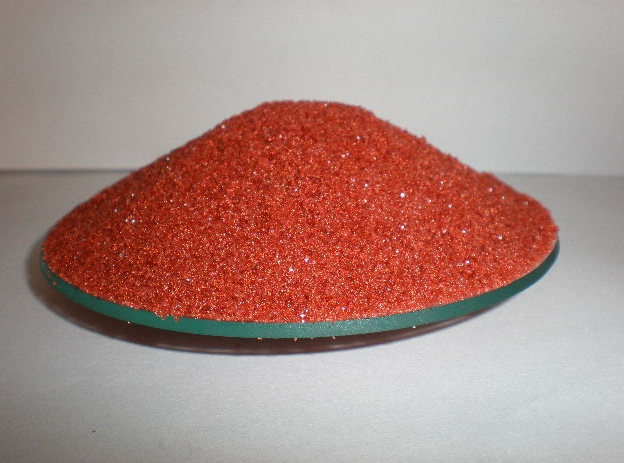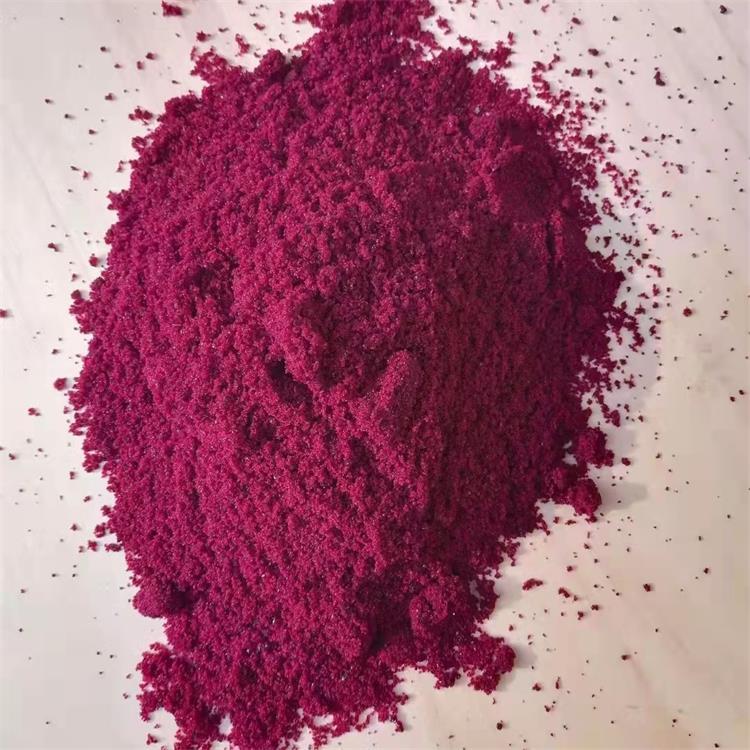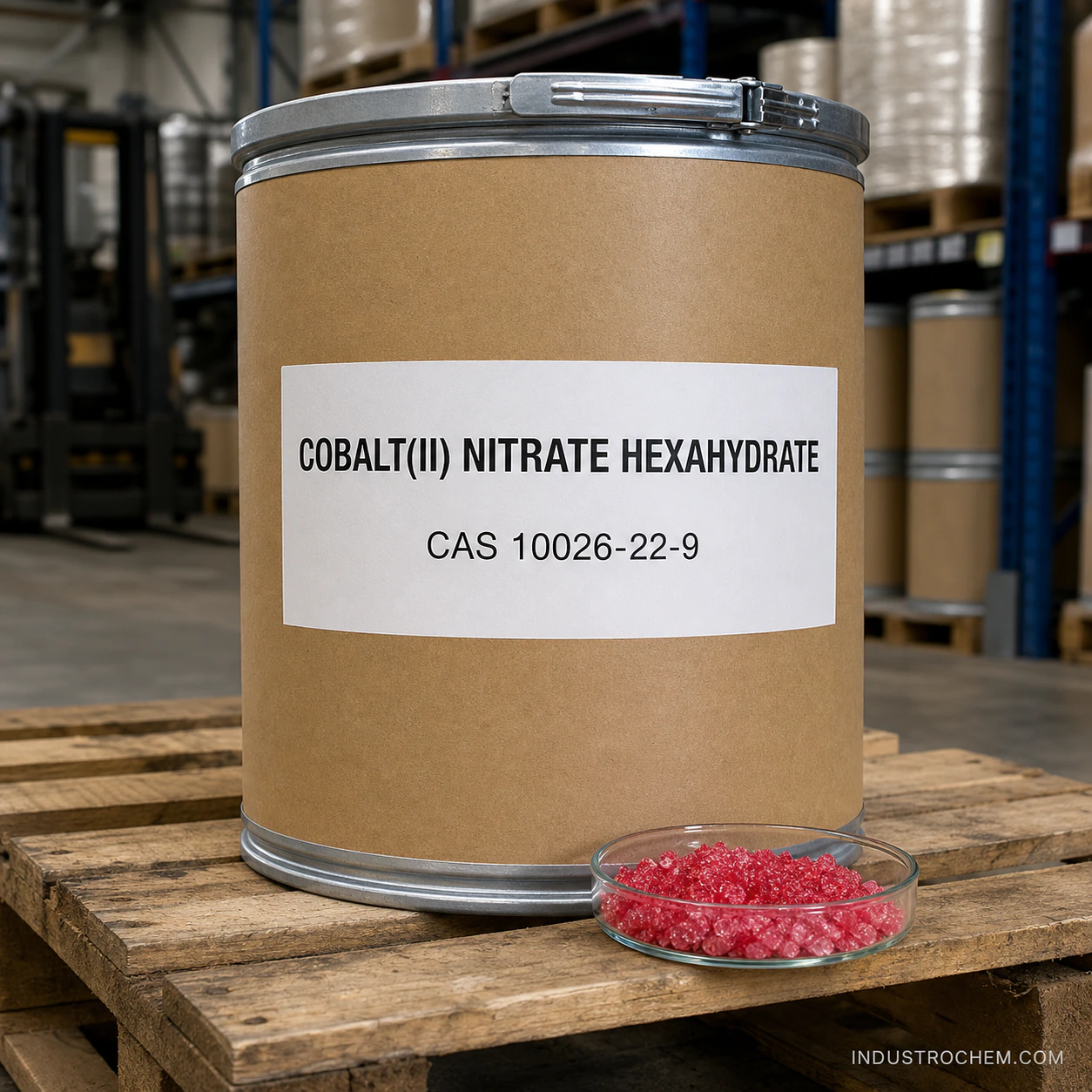
Cobalt(II) Nitrate Hexahydrate is an inorganic cobalt salt commonly supplied as a chemical raw material and intermediate, also referred to in technical contexts as cobaltous nitrate hexahydrate, cobalt nitrate hexahydrate, or cobalt(II) dinitrate hexahydrate. Identified by CAS 10141‑05‑6, it consists of divalent cobalt coordinated with nitrate anions and crystallization water, enabling controlled cobalt ion availability during thermal decomposition or solution‑based reactions. The compound is typically applied as a catalyst precursor in industrial chemical processes where cobalt‑containing phases are generated under defined conditions. From a supply perspective, it is offered with competitive factory pricing, customized specifications, and complete documentation including MSDS, TDS, COA, suitable for regulated bulk supply in industrial use.
Cobalt(II) Nitrate Hexahydrate CAS 10141-05-6
- CAS: 10141-05-6
- Synonyms: Cobalt(II) nitrate hexahydrate, Cobaltous nitrate hexahydrate, Cobalt nitrate hexahydrate, Cobalt(II) dinitrate hexahydrate
- Einecs: 231-158-0
- Molecular Formula: CoN₂O₆
- Grade: Industrial grade 99%
- Package: 200kg iron drum or 50kg plastic drum packaging
Product Description
Physicochemical Properties
| Parameter | Specification | Test Method |
|---|---|---|
| Appearance | Red crystalline powder | Visual Inspection |
| Assay | ≥ 98.0% | Titration |
| Cobalt (Co) | ≥ 19.8% | Gravimetric / ICP |
| Insoluble Matter | ≤ 0.01% | Gravimetric |
| pH (5% solution) | 2.0 – 5.0 | pH Meter |
| Chloride (Cl) | ≤ 0.002% | Ion Chromatography |
| Sulfate (SO₄) | ≤ 0.005% | Turbidimetry |
| Iron (Fe) | ≤ 0.002% | ICP-MS |
| Nickel (Ni) | ≤ 0.01% | ICP-MS |
Applications
Catalyst Manufacturing
- Petrochemicals: Used as a raw material for the preparation of cobalt-based catalysts supported on alumina or silica, essential for hydrodesulfurization (HDS) and Fischer-Tropsch synthesis.
Pigments & Ceramics
- Ceramic Colors: A key ingredient in the production of “Cobalt Blue” pigments for coloring porcelain, glass, and enamels. It provides intense, heat-stable coloration.
Surface Treatment & Plating
- Electroplating: utilized in cobalt electroplating baths and as an additive in nickel plating to improve hardness and brightness.
- Corrosion Protection: Used in chemical conversion coatings for aluminum and steel.
Electronics & Batteries
- Battery Materials: Precursor for synthesizing cobalt oxide and other cathode materials used in lithium-ion batteries.
Quality Assurance (QA/QC)
Our Cobalt Nitrate is produced under strict ISO 9001:2015 protocols to ensure high metal purity and low impurity profiles.
- Metal Analysis: We utilize ICP-OES to strictly control trace impurities like Iron (Fe), Nickel (Ni), and Copper (Cu), which can affect catalyst performance.
- Stoichiometry: Precise control of the hexahydrate form ensures stable cobalt content (approx. 20%) for accurate formulation in downstream processes.
- Solubility Test: Every batch undergoes solubility testing to guarantee a clear solution with no sediment.
Storage & Safety
Storage Guidelines
- Oxidizer: Store separately from flammable materials, reducing agents, and organics.
- Hygroscopic: The product absorbs moisture rapidly. Store in a cool, dry area in tightly sealed containers.
- Temperature: Avoid high temperatures to prevent melting (approx. 55°C) and decomposition.
Safety & PPE Recommendations
- Hazard Class: Oxidizing Solid (Class 5.1). May intensify fire.
- Health Hazard: May cause an allergic skin reaction and is suspected of causing cancer/genetic defects (Carcinogen Category 1B).
- PPE: Wear full protective clothing, P3 dust mask/respirator, and chemical-resistant gloves. Avoid dust generation.
- Environmental: Toxic to aquatic life with long-lasting effects. Prevent release to the environment.
FAQ - Technical & Supply Chain
-
Q:
How does the hexahydrate form differ from anhydrous cobalt nitrate?
A: The hexahydrate contains defined water of crystallization, which affects handling, solubility, and thermal behavior compared to the anhydrous form.
Documents and Product Support
For product review and sourcing evaluation, supporting documents can be coordinated according to the product type, inquiry stage, and order requirements.
- COA for batch-based quality reference
- TDS for key physical and chemical information
- SDS / MSDS for handling, storage, and safety reference
- Packing information for sample, trial, and bulk orders
- Technical communication based on application and specification requirements
Information to Confirm Before Quotation
Clear sourcing information helps reduce specification mismatch and allows a more accurate quotation before sample or bulk order discussion.
- Product name and CAS number
- Application or intended end use
- Required purity, grade, or specification
- Sample quantity, trial order, or bulk demand
- Preferred packing form or net weight
- Destination country or port
- Required documents or compliance expectations
Packaging, Storage, and Handling Notes
Packaging form, storage conditions, shelf life, and shipment arrangements should be confirmed according to the product characteristics, package size, and destination requirements.
Before order confirmation, buyers are advised to review the corresponding product documents and confirm whether any special storage, labeling, or handling requirements apply.
Sample, Bulk Order and Repeat Supply Support
Support can be arranged for sample discussion, bulk supply planning, packaging confirmation, and routine sourcing communication based on the actual product and order requirements.
For repeat-use formulations or long-term procurement plans, buyers may discuss specification consistency, packaging preferences, delivery expectations, and document coordination in advance.
Contact Form
Use our contact form to send us your questions, suggestions or comments. We will respond as soon as possible.
Product Categories
Related Products
-
C12-14 Alkyl Dimethyl Amine Oxide Solution -
Laurylamine Dipropylenediamine CAS 2372-82-9 -
Sodium Methoxide / Sodium Methylate CAS 124-41-4 -
Sodium Fluoride CAS 7681-49-4 -
Sodium Chlorite (CAS 7758-19-2) -
GPE 3000 CAS 9082-00-2 -
Polypropylene Glycol 1000 CAS 25322-69-4 -
Polypropylene Glycol 2000 CAS 25322-69-4