










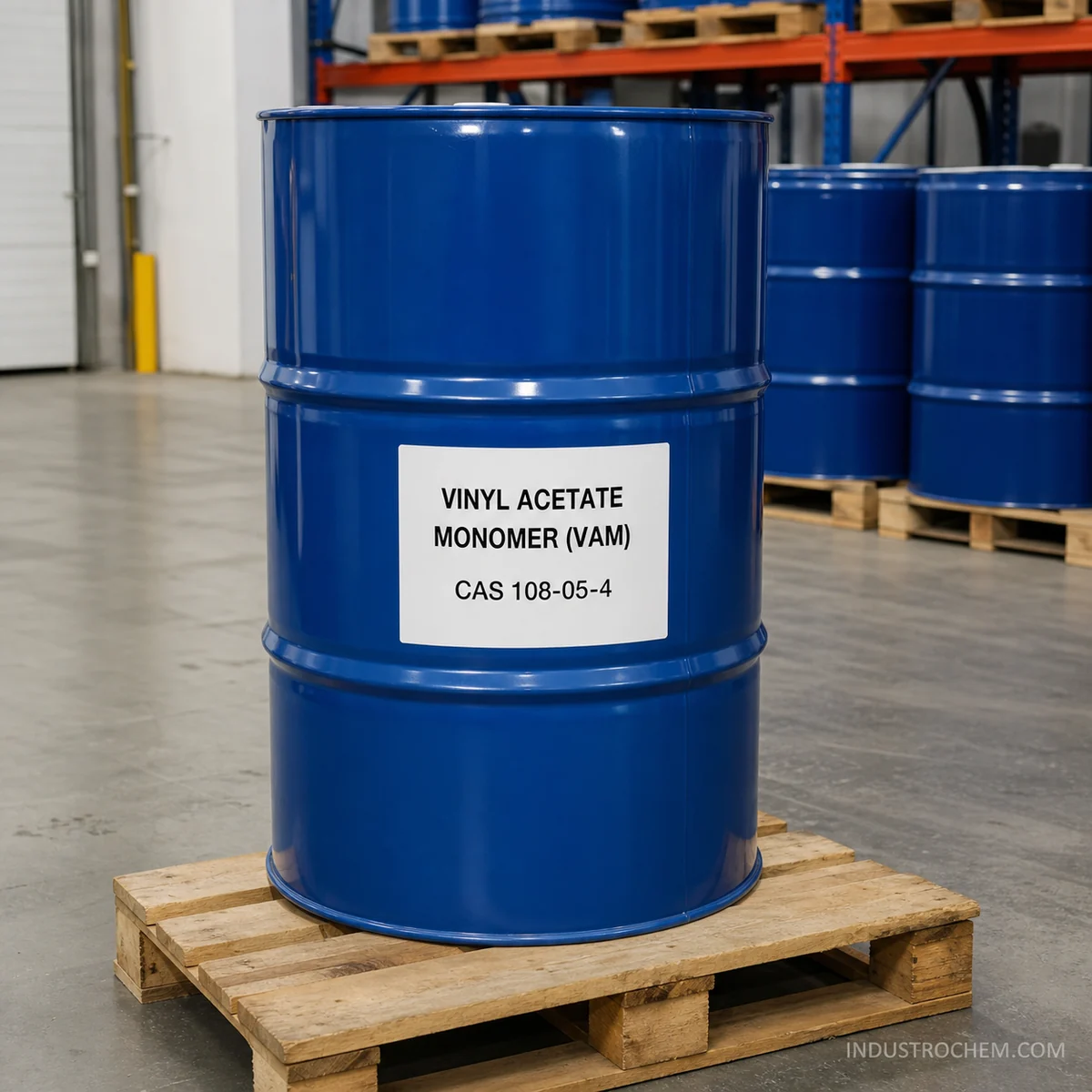
Vinyl Acetate Monomer (VAM), CAS 108-05-4, is also known as ethenyl acetate. It is used for PVAc, VAE, EVA and other vinyl-polymer production. Before requesting a quotation, confirm assay, water, acidity, acetaldehyde, colour, inhibitor identity and level, packaging and storage controls, and request current TDS, COA and SDS.
Vinyl Acetate Monomer (VAM) CAS 108-05-4
- CAS: 108-05-4
- Synonyms: Vinyl acetate; Vinyl acetate monomer; Acetic acid vinyl ester; Vinyl ethanoate; Ethenyl acetate; VAM
- Einecs: 203-545-4
- Molecular Formula: C₄H₆O₂
- Grade: Confirm on the offered specification and lot COA: assay, water, acidity, acetaldehyde, colour, inhibitor identity and level, packaging and storage controls
- Package: Compatible sealed packaging; confirm configuration for quantity, transport mode and destination
Product Description
Physicochemical Properties
| Parameter | Specification |
|---|---|
| Appearance | Confirm on the offered specification and lot COA: physical form and colour. |
| Purity (GC) | Confirm on the offered specification and lot COA: assay and GC method. |
| Acid (as Acetic Acid) | Confirm on the offered specification and lot COA: acidity limit and reporting basis. |
| Water Content | Confirm on the offered specification and lot COA: water limit and test method. |
| Color (Pt-Co) | Confirm on the offered specification and lot COA: colour scale and limit. |
| Density (20°C) | Confirm on the offered specification and lot COA: density range and test temperature. |
| Aldehydes (as Acetaldehyde) | Confirm on the offered specification and lot COA: acetaldehyde limit and method. |
| Inhibitor (Hydroquinone) | Confirm on the offered specification and lot COA: inhibitor identity, content and reporting basis. |
| Non-volatile Matter | Confirm on the offered specification and lot COA: nonvolatile-matter limit and method. |
Applications
Adhesives & Sealants
- PVAc: VAM is polymerized to produce polyvinyl acetate used in adhesive and binder systems; confirm the target polymer process.
- VAE emulsions: VAM is copolymerized with ethylene; define comonomer ratio, inhibitor controls and polymerization requirements before RFQ.
Paints & Coatings
- Architectural coatings: VAM-derived polymers can function as binders; VAM itself is the reactive monomer, not the finished binder.
Textiles & Nonwovens
- Textiles and nonwovens: VAM-derived polymers and copolymers are used as binders and sizing materials; match the monomer specification to the polymer process.
High-Performance Polymers
- EVA: VAM is copolymerized with ethylene to make ethylene-vinyl acetate grades; required VAM content depends on the target resin.
- EVOH: vinyl-acetate polymers are hydrolyzed to produce ethylene-vinyl alcohol materials; define the upstream polymer route before selecting VAM.
Quality Assurance (QA/QC)
Quality acceptance must use the current offered-grade specification and lot COA; this page does not establish ISO certification for the producing facility.
- Confirm on the offered specification and lot COA: minimum assay, GC method and lot result.
- Confirm on the offered specification and lot COA: inhibitor identity, concentration, test timing and storage controls.
- Confirm on the offered specification and lot COA: acetaldehyde, acidity, water, colour and other process-relevant impurities.
For related vinyl-acetate polymer materials, see Polyvinyl Alcohol and Ethylene-vinyl Acetate Copolymer.
Storage & Safety
Storage Guidelines
- Flammability: Highly flammable liquid and vapor. Store in a dedicated flammable liquids warehouse away from sparks and open flames.
- Temperature control: follow the current SDS and supplier instructions for the offered inhibitor system; avoid heat and ignition sources.
- Shelf life: depends on inhibitor system, initial test result, package, temperature and handling; confirm the offered lot before purchase.
Safety & PPE Recommendations
- Classification: use the current SDS and destination transport rules for the offered material.
- Health hazards: review the current SDS classification, exposure limits and workplace controls before handling.
- PPE: select gloves, eye protection, clothing and respiratory controls from the current SDS and site risk assessment.
- Handling: use closed, grounded equipment and controls specified by the current SDS; prevent contamination and uncontrolled polymerization.
FAQ - Technical & Supply Chain
-
Q:
Is Vinyl Acetate Monomer the same substance as Vinyl Acetate?
A: Yes. Vinyl acetate monomer and vinyl acetate refer to CAS 108-05-4, the monomer used to make polyvinyl acetate, vinyl acetate copolymers and polyvinyl alcohol. It is not vinyl acetate polymer or an emulsion. The order should state monomer grade and inhibitor system. -
Q:
Which specifications should be agreed for industrial VAM?
A: Set vinyl acetate assay and method, water, acidity, color, aldehydes, acetaldehyde, nonvolatile matter and inhibitor concentration. Specify whether the stated inhibitor is hydroquinone or another approved system and define the measurement basis. Review the batch COA against the polymerization process limits. -
Q:
What must be confirmed before receiving bulk Vinyl Acetate Monomer?
A: Confirm refrigerated or temperature-controlled handling requirements, inhibitor level, tank material, oxygen or nitrogen management, venting, loading history and unloading connection. Review the SDS and flammable-liquid transport requirements. Do not remove the inhibitor or store outside the agreed temperature range without process approval.
Ordering & Documentation
Key information for document requests, quotations, and supply planning.
Documents
Tell us which documents your procurement team needs. Before an order, we will check whether the quoted source can provide them for the offered lot.
Quotation
Send the CAS number, grade, quantity, packing preference and destination.
Sample & Supply
Ask whether samples, trial quantities or repeat orders are possible. We will check each request against the sourced product and current offer.
Storage & Shipping
Product-specific conditions are confirmed before order.