










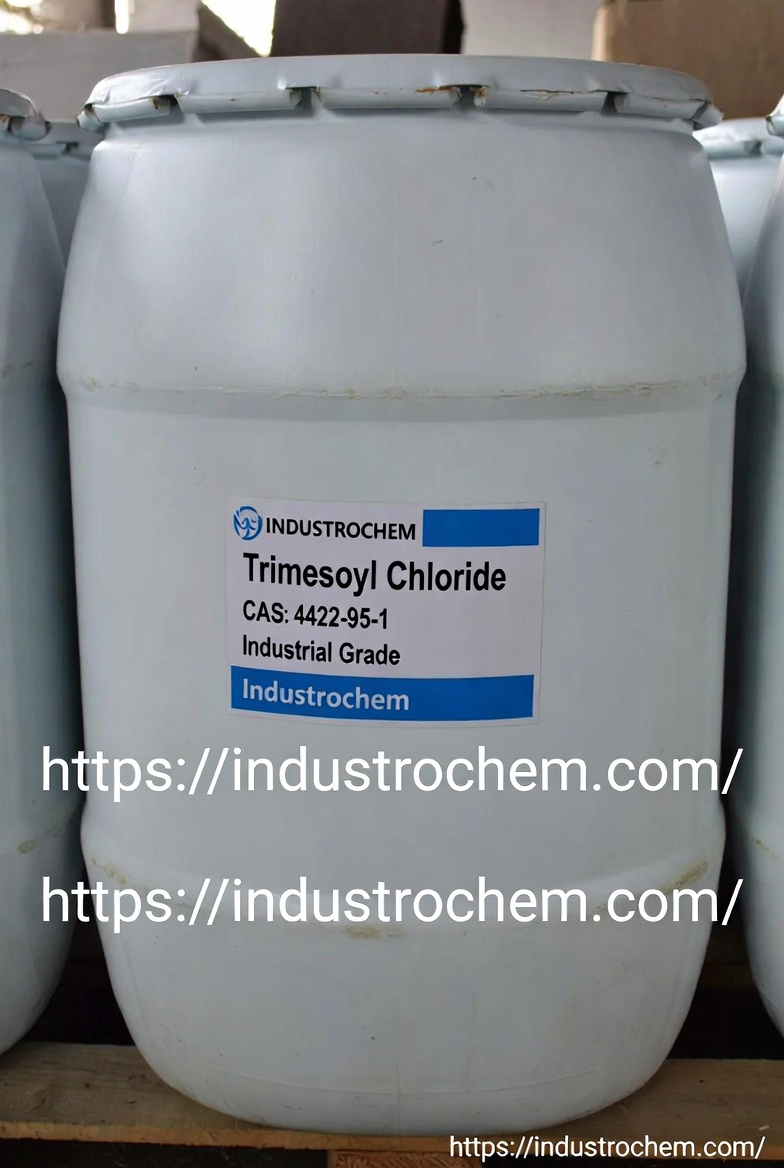
Trimesoyl Chloride is an aromatic acyl chloride derived from trimesic acid and is generally supplied as a reactive intermediate for industrial synthesis rather than a finished-use formulation ingredient. In supply practice, it is commonly positioned as a chemical intermediate or monomer raw material for membrane-related chemistry, polymer synthesis, and other specialty reaction systems that require trifunctional acyl chloride reactivity. This product is typically handled as a moisture-sensitive solid or low-melting material, so packaging, storage, and transportation should be arranged according to the required grade and logistics conditions. Standard export packaging, bulk supply, and routine documents such as COA, TDS, and SDS can be supported for industrial orders.
Trimesoyl Chloride CAS 4422-95-1
- CAS: 4422-95-1
- Synonyms: 1,3,5-Benzenetricarbonyl trichloride; Benzene-1,3,5-tricarbonyl chloride; Trimesic acid trichloride
- Einecs: 224-594-8
- Molecular Formula: C9H3Cl3O3
- Grade: Industrial Grade
- Package: Standard Export Packaging
Product Description
Physicochemical Properties
| Item | Typical Description |
|---|---|
| Appearance | White to pale yellow solid |
| Odor | Pungent characteristic odor |
| Molecular Formula | C9H3Cl3O3 |
| Molecular Weight | 265.47-265.48 |
| Melting Point | About 35°C |
| Boiling Point | About 181°C / 16 mmHg |
| Solubility | Soluble in toluene |
| Supply Form | Powder, lump, or low-melting solid depending on temperature and packing condition |
Typical Applications
- Chemical intermediate for polyamide and specialty polymer synthesis
- Monomer raw material for membrane-related interfacial polymerization systems
- Reactive intermediate for laboratory and industrial acylation or crosslinking chemistry
- Specialty synthesis use where trifunctional aromatic acyl chloride reactivity is required
For related acid chloride intermediate pages, review Fumaryl Chloride, Trichloroacetyl Chloride, and Benzoyl Chloride.
Packaging
Trimesoyl Chloride is commonly supplied in sealed industrial packaging suitable for moisture-sensitive intermediates. Standard export packaging can be arranged in lined containers, bags, drums, or other practical formats according to order quantity, product grade, and transportation requirements. Clean handling and proper sealing are recommended to maintain product condition during storage and shipment.
Storage
Store in a cool, dry, and well-ventilated place. Keep the container tightly closed and protect the product from moisture, direct heat, and contamination. Package integrity should be maintained during storage and transport because the material is reactive and sensitive to environmental exposure.
FAQ - Technical & Supply Chain
-
Q:
What is Trimesoyl Chloride CAS 4422-95-1?
A: Trimesoyl Chloride, also called 1,3,5-benzenetricarbonyl trichloride or trimesic acid trichloride, is a trifunctional aromatic acyl chloride with CAS 4422-95-1, EC 224-594-8, and molecular formula C9H3Cl3O3. It is supplied as a white to pale yellow solid that may appear as powder, lump, or low-melting material depending on temperature and packing condition. -
Q:
What is Trimesoyl Chloride mainly used for?
A: It is mainly used as a monomer raw material for polyamide reverse osmosis and nanofiltration membranes, including thin-film composite membrane interfacial polymerization. It is also used in specialty polymer synthesis and laboratory or industrial acylation and crosslinking chemistry. -
Q:
Why is the trifunctional structure important?
A: Trimesoyl Chloride contains three acyl chloride groups arranged on an aromatic ring. This trifunctionality allows it to participate in interfacial polymerization and crosslinking reactions, forming networked polyamide or specialty polymer structures rather than acting as a simple monofunctional capping reagent. -
Q:
Which specifications should be checked before ordering?
A: Confirm appearance, purity or assay, melting range, color, hydrolyzable chloride, moisture, and related impurities or residual solvent. Also confirm whether powder, lump, or low-melting solid presentation is required, and verify packaging suitable for a moisture-sensitive reactive intermediate. -
Q:
How should Trimesoyl Chloride be stored and handled?
A: Store it in tightly sealed, moisture-protective containers in a cool, dry, well-ventilated area away from water, alcohols, amines, heat, strong oxidizers, and incompatible materials. Use dry handling systems, local exhaust ventilation, and appropriate PPE because the material reacts with water and is moisture sensitive.
Ordering & Documentation
Key information for document requests, quotations, and supply planning.
Documents
COA, TDS, SDS/MSDS and packing details are available on request.
Quotation
Send the CAS number, grade, quantity, packing preference and destination.
Sample & Supply
Support is available for samples, trial orders, bulk and repeat supply.
Storage & Shipping
Product-specific conditions are confirmed before order.

