









Chemical products
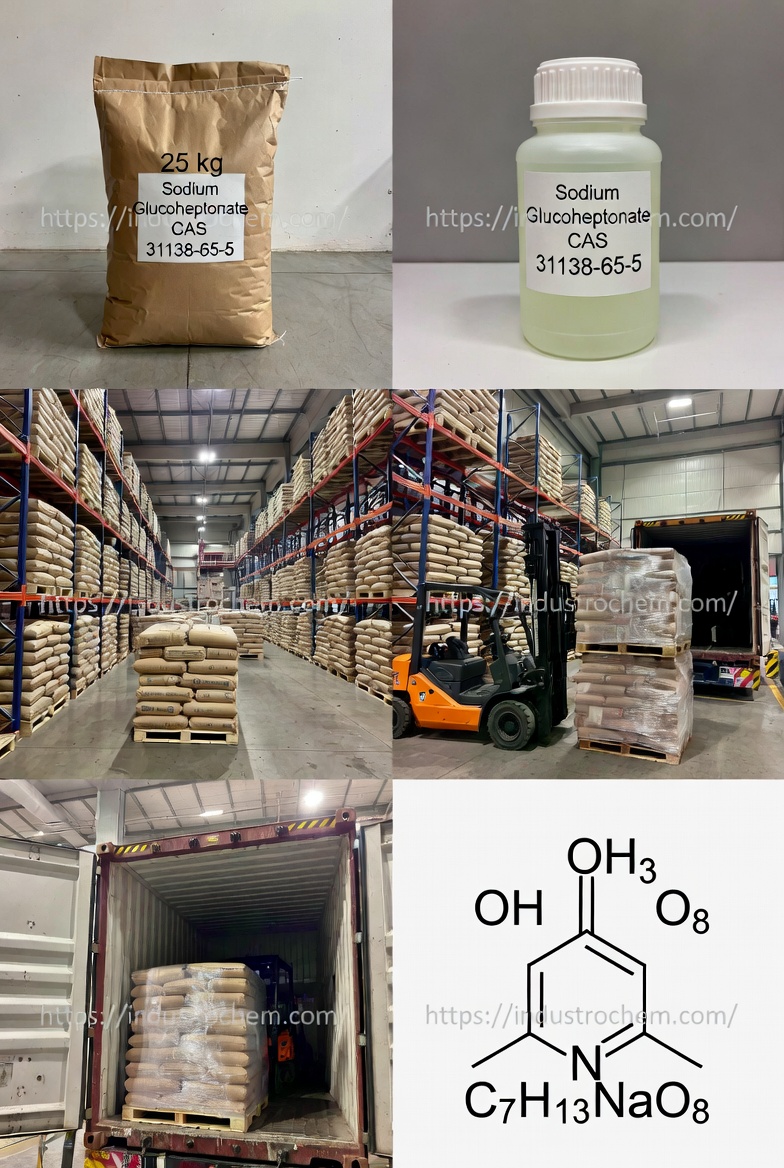
  • Sodium Glucoheptonate CAS 31138-65-5

Sodium Glucoheptonate CAS 31138-65-5

Sodium glucoheptonate, also called sodium gluceptate, CAS 31138-65-5, is a biodegradable sugar-acid chelating agent supplied for cleaning, textile, construction, and water-treatment applications. Confirm the required grade and specification, then request a quotation with COA/TDS/SDS for bulk supply.

  • CAS: 31138-65-5
  • Synonyms: Sodium glucoheptanoate, D-glycero-D-gulo-Heptonic acid sodium salt, Sodium gluceptate, Glucoheptonic acid sodium salt, Sodium alpha-glucoheptonate
  • Einecs: 250-480-2
  • Molecular Formula: C7H13NaO8
  • Grade: Technical Grade / Industrial Grade
  • Package: 25kg/bag, 250kg/drum, or customized bulk supply
Request a quote
Share:

Product Description

Sodium Glucoheptonate CAS 31138-65-5, also called sodium gluceptate, is a sugar-acid salt with the molecular formula C7H13NaO8 and EINECS 250-480-2.

Synonyms: Sodium glucoheptanoate; D-glycero-D-gulo-Heptonic acid sodium salt; Sodium gluceptate; Glucoheptonic acid sodium salt; Sodium alpha-glucoheptonate.

CAS: 31138-65-5.

Molecular formula: C7H13NaO8.

It is supplied as a white to off-white crystalline powder (or a dark brown 50% liquid), odorless in powder form.

Active content is not less than 98.0% for powder and 50.0% for liquid, with pH 7.0-9.0 (1% powder solution).

Chelating power is not less than 500 mg CaCO3/g (powder) or 250 mg CaCO3/g (liquid); the liquid has specific gravity 1.25-1.30 g/cm³.

Chloride and sulfate limits are low; the powder is very soluble in water (>550 g/L) and stable in 10% NaOH.

In industrial cleaning it is used in alkaline cleaners for bottle washing, food equipment, and metal degreasing to control scale and metal contaminants.

In textiles it is a sequestering agent during bleaching and mercerizing to improve dye uptake and prevent metal-induced fiber degradation.

In construction chemicals it is a high-efficiency set retarder in concrete and oil-well cement to extend workability and improve compressive strength.

In water treatment it is a green chelating agent for scale and corrosion inhibition in boilers, cooling towers, and heat exchangers.

Store in a cool, dry, well-ventilated area away from direct sunlight and strong oxidizing agents, with containers tightly closed.

Wear safety glasses with side shields and nitrile or PVC gloves; use a dust mask when handling powder in poorly ventilated areas.

Avoid eye contact and prolonged skin contact, and manage liquid spills promptly with absorbent materials.

Every batch is tested by nonaqueous titration for assay and ICP analysis for trace metals, under ISO 9001 standards.

Confirm form (powder or liquid), active content, pH, chelating power, chloride, sulfate, packaging, and grade as required.

The page is an RFQ entry point and does not state stock, price, MOQ, or fixed lead time.

For an RFQ, state the intended application, required grade, quantity, packaging, destination, and document needs.

FAQ - Technical & Supply Chain

  • Q:

    What is Sodium Glucoheptonate CAS 31138-65-5?

    A: CAS 31138-65-5 is sodium glucoheptonate, also called sodium gluceptate or sodium glucoheptanoate. It is a seven-carbon sugar acid salt that functions as a strong, biodegradable chelating and sequestering agent.
  • Q:

    What are the main industrial uses of sodium glucoheptonate?

    A: It is used in alkaline cleaners, bottle washing, food-processing equipment cleaning, metal degreasing, textile bleaching, and water treatment. It also functions as a construction set retarder and as a chelating additive in cosmetic, agricultural, and specialty formulations.
  • Q:

    Why is it suitable for high-alkaline cleaning systems?

    A: Sodium glucoheptonate remains stable and retains chelating power in strong alkaline conditions, especially in the pH 9-14 range. This makes it useful for caustic cleaning, bottle washing, kier boiling, and metal surface treatment where scale and metal ions must be controlled.
  • Q:

    How does sodium glucoheptonate compare with EDTA?

    A: Both are chelating agents, but sodium glucoheptonate is readily biodegradable and is often used as a lower-persistence alternative to EDTA. It is particularly effective in alkaline systems and can complex calcium, magnesium, iron, zinc, aluminum, and other di- or trivalent metal ions.
  • Q:

    Is Sodium Glucoheptonate available in powder and liquid forms?

    A: Yes. Industrial supply commonly includes a white to off-white crystalline powder and a liquid grade, with the powder being very soluble in water. The product page lists crystalline powder and 50% liquid options to match dosing, handling, and formulation requirements.

Ordering & Documentation

Key information for document requests, quotations, and supply planning.

Documents

Tell us which documents your procurement team needs. Before an order, we will check whether the quoted source can provide them for the offered lot.

Quotation

Send the CAS number, grade, quantity, packing preference and destination.

Sample & Supply

Ask whether samples, trial quantities or repeat orders are possible. We will check each request against the sourced product and current offer.

Storage & Shipping

Product-specific conditions are confirmed before order.

Contact Form

Use our contact form to send us your questions, suggestions or comments. We will respond as soon as possible.
For a quotation, please include the product name or CAS number, quantity, grade or application, and destination country or port. Tell us if you need a sample, COA, TDS or SDS.