









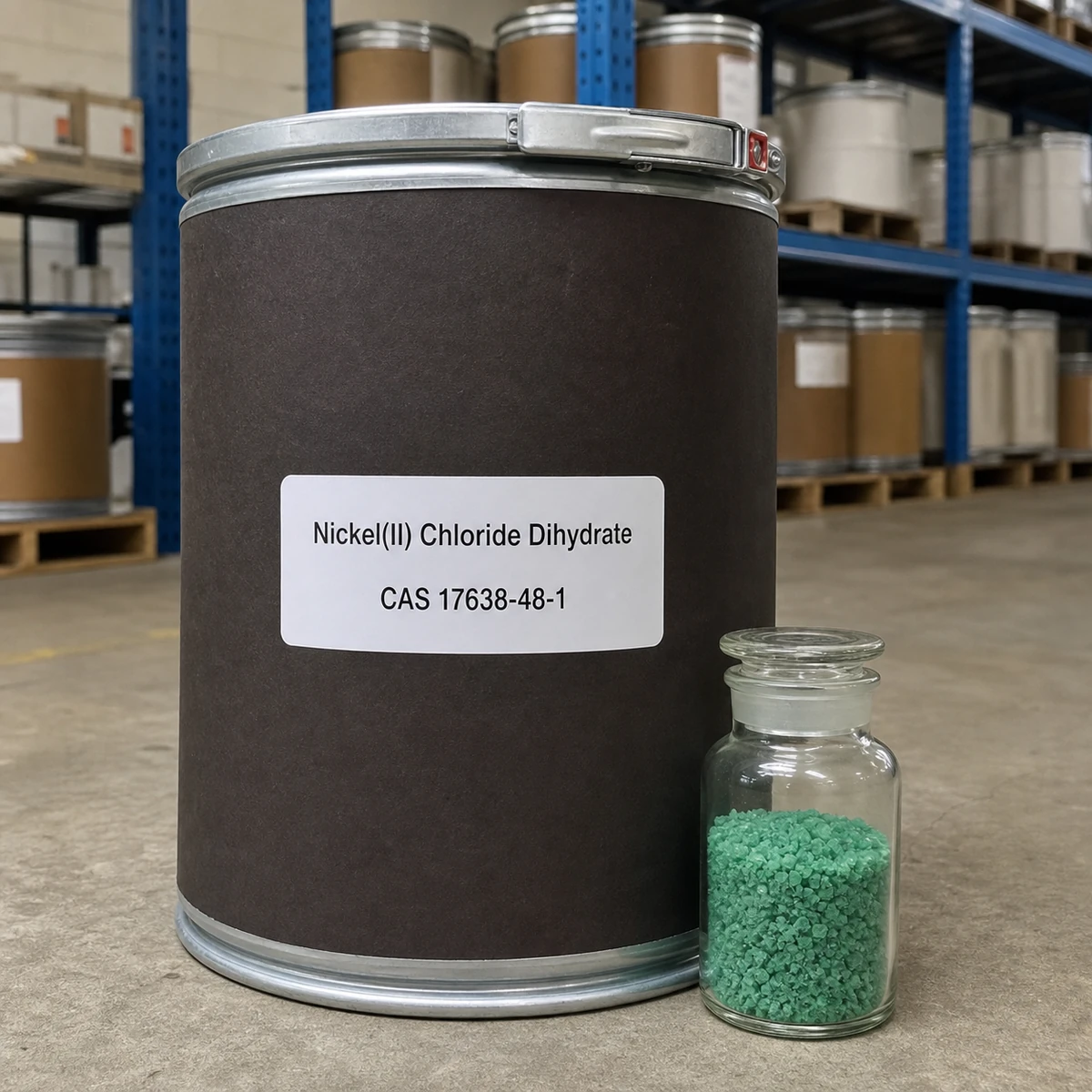
Nickel(II) chloride dihydrate is an inorganic nickel salt consisting of divalent nickel cations and chloride anions, supplied in its dihydrated crystalline form. The defined hydration state is essential to its material identity and classification within professional chemical supply chains. Nickel(II) Chloride Dihydrate (CAS 17638-48-1) is handled as a discrete inorganic compound in regulated industrial and research environments, where accurate material identification, documentation, and compliance are required.
The material is supplied with standardized specifications and complete technical documentation, including MSDS, TDS, and COA, supporting traceability and regulatory conformity.
Nickel(II) Chloride Dihydrate CAS 17638-48-1
- CAS: 17638-48-1
- Synonyms: Nickel(II) chloride dihydrate, NiCl2·2H2O, Nickel chloride dihydrate
- Einecs: 231-868-0
- Molecular Formula: Cl₂H₄NiO₂
- Grade: Industrial grade 99%
- Package: 200kg iron drum or 50kg plastic drum packaging
Product Description
Physicochemical properties
| Property | Value |
|---|---|
| Chemical Name | Nickel(II) chloride dihydrate |
| Molecular Formula | Cl2H4NiO2 (or NiCl2·2H2O) |
| Molecular Weight | 182.74 g/mol (calculated based on the molecular formula including water of crystallization) |
| CAS Number | 17638-48-1 |
| Appearance | Green crystalline powder |
| Solubility | Soluble in water, ethanol, and ammonia; forms an acidic aqueous solution (pH ~4) |
| Density | Not explicitly provided in references, but related compounds suggest a density range of 1.9-2.1 g/cm³ for hydrated forms |
| Melting Point | Not explicitly provided in references (decomposes upon heating) |
| Boiling Point | Not applicable (decomposes before boiling) |
| Stability | Hygroscopic; absorbs moisture from the air; stable under normal storage conditions but may decompose upon prolonged exposure to heat or light |
| Hazard Class | Toxic; harmful if swallowed, inhaled, or absorbed through the skin; irritating to eyes, respiratory system, and skin |
| Storage Condition | Store in a cool, dry, well-ventilated area away from incompatible substances such as oxidizing agents, acids, and moisture |
Application Areas
Chemical synthesis: Participate in coupling reactions or selective reduction reactions as a Lewis acid.
Electroplating industry: used for the preparation of nickel coatings.
Catalyst: catalyzing the formation of carbon carbon bonds in organic synthesis
Storage conditions
Environmental requirements: Store in a cool, dry and sealed place, avoiding contact with oxides and moisture.
Temperature control: Store at room temperature, powder is easily deliquescent, and should be moisture-proof.
Container selection: Use a sealed container (such as a glass bottle or an inert gas shielded container)
Safety precautions
Operation protection: Wear chemical resistant gloves, goggles, and dust masks to avoid inhaling dust. Do not eat or smoke while operating inside the fume hood.
Toxicity risk: Class 1 carcinogens, long-term exposure may cause sensitization or carcinogenesis. Seek medical attention immediately after ingestion or skin contact.
Leakage treatment: Cover with inert adsorbent material (such as sand) and dispose of as hazardous waste
FAQ - Technical & Supply Chain
-
Q:
Does CAS 17638-48-1 specifically refer to nickel(II) chloride dihydrate?
A: Yes. CAS 17638-48-1 is assigned specifically to the dihydrate form of nickel(II) chloride. -
Q:
Is nickel(II) chloride dihydrate supplied as a mixture or formulated product?
A: No. It is supplied as a defined inorganic compound for professional handling within regulated industrial or research environments.
Documents and Product Support
For product review and sourcing evaluation, supporting documents can be coordinated according to the product type, inquiry stage, and order requirements.
- COA for batch-based quality reference
- TDS for key physical and chemical information
- SDS / MSDS for handling, storage, and safety reference
- Packing information for sample, trial, and bulk orders
- Technical communication based on application and specification requirements
Information to Confirm Before Quotation
Clear sourcing information helps reduce specification mismatch and allows a more accurate quotation before sample or bulk order discussion.
- Product name and CAS number
- Application or intended end use
- Required purity, grade, or specification
- Sample quantity, trial order, or bulk demand
- Preferred packing form or net weight
- Destination country or port
- Required documents or compliance expectations
Packaging, Storage, and Handling Notes
Packaging form, storage conditions, shelf life, and shipment arrangements should be confirmed according to the product characteristics, package size, and destination requirements.
Before order confirmation, buyers are advised to review the corresponding product documents and confirm whether any special storage, labeling, or handling requirements apply.
Sample, Bulk Order and Repeat Supply Support
Support can be arranged for sample discussion, bulk supply planning, packaging confirmation, and routine sourcing communication based on the actual product and order requirements.
For repeat-use formulations or long-term procurement plans, buyers may discuss specification consistency, packaging preferences, delivery expectations, and document coordination in advance.