









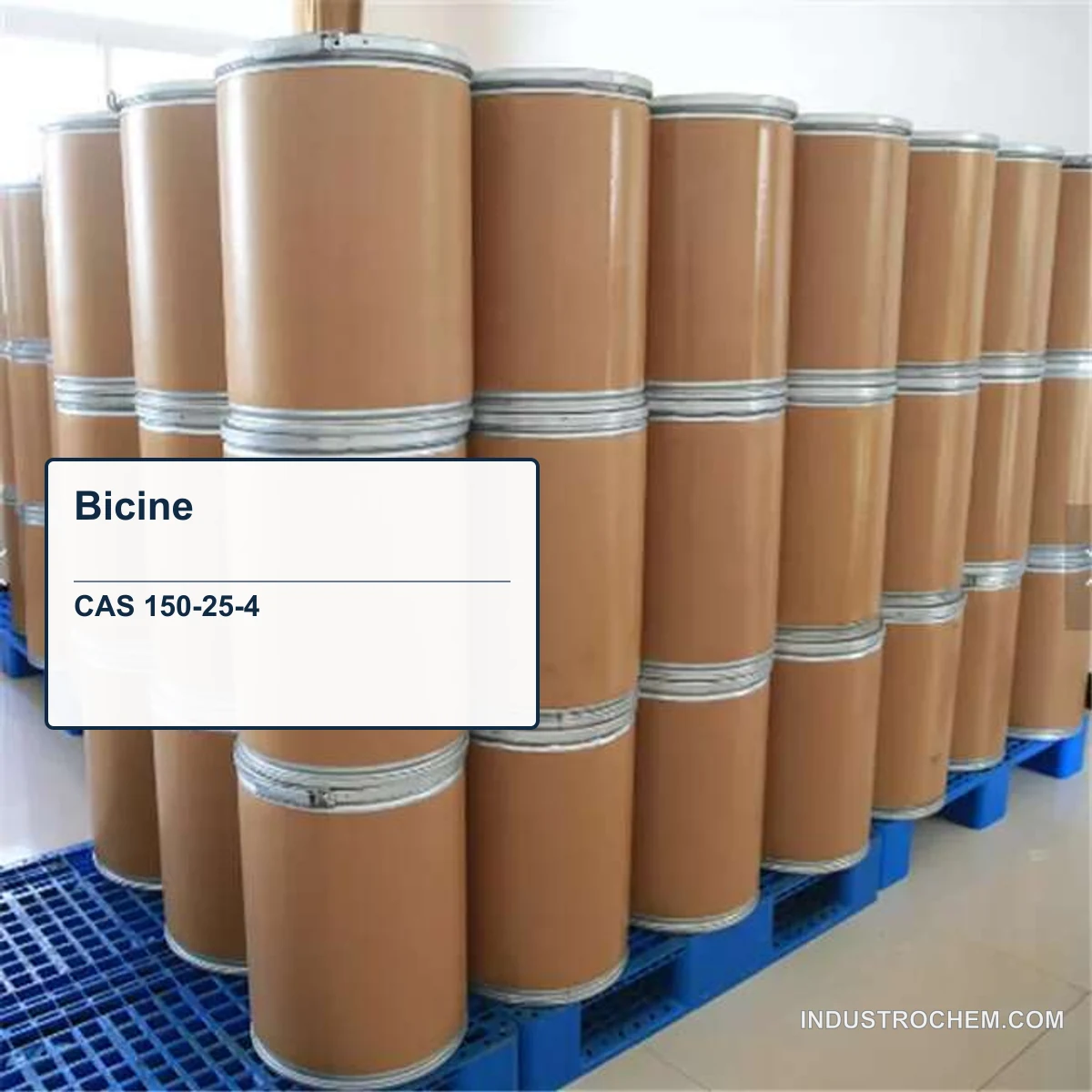
Bicine (N,N-Bis(2-hydroxyethyl)glycine), CAS 150-25-4, is also known as Diethylolglycine. It is a zwitterionic biological buffer and chelating component, not a ready-to-use buffer solution. For a buffer-system inquiry, state the target pH, ionic strength, purity and preparation method.
Bicine (N,N-Bis(2-hydroxyethyl)glycine) CAS 150-25-4
- CAS: 150-25-4
- Synonyms: N,N-Bis(2-hydroxyethyl)glycine; Diethylolglycine
- Einecs: 205-755-1
- Molecular Formula: C₆H₁₃NO₄
- Grade: Confirm the current product-specific specification.
- Package: Confirm packaging requirements for the proposed material and destination.
Product Description
Bicine (N,N-Bis(2-hydroxyethyl)glycine)
Synonyms: N,N-Bis(2-hydroxyethyl)glycine; Diethylolglycine.
Grade and assay: confirm the current product-specific specification.
CAS Number: 150-25-4.
Molecular formula: C₆H₁₃NO₄.
Molar mass: 163.17 g/mol.
Physical form: confirm the current product-specific specification.
Buffer conditions and application requirements: confirm the current product-specific specification.
Confirm packaging requirements for the proposed material and destination.
Bicine is used as a buffer component in biochemical and analytical buffer formulation; confirm target pH, ionic strength, purity, and method requirements before quotation.
FAQ - Technical & Supply Chain
-
Q:
What is Bicine, and is it the same as glycine or Tricine?
A: Bicine is N,N-bis(2-hydroxyethyl)glycine, CAS 150-25-4, with formula C6H13NO4 and molecular weight about 163.17 g/mol. It is a discrete zwitterionic biological buffer and chelating agent, not glycine, Tricine, HEPES or a ready-to-use buffer solution. -
Q:
What pH range is Bicine most suitable for?
A: Bicine is commonly useful in biochemical and analytical buffer systems around pH 7.6 to 9.0 at 25 C, with a reported pKa near 8.3. The exact working pH depends on temperature, concentration, ionic strength and the intended enzyme, electrophoresis or crystallization protocol. -
Q:
What is Bicine used for?
A: Bicine is used as a buffering and chelating component in enzyme reaction buffers, electrophoresis buffers, protein crystallization, and other biochemical or analytical methods. The required grade depends on the assay sensitivity, target pH, ionic strength and cell-culture or research use. -
Q:
Which specifications should be checked for analytical or cell-culture use?
A: Confirm assay, residue on ignition, heavy metals or elemental impurities, pH of a defined aqueous solution, appearance, water or loss on drying, and relevant UV absorbance. High-sensitivity methods may require additional endotoxin, trace metal or bioburden data. -
Q:
What are the key physical properties and storage conditions for Bicine?
A: Bicine is normally a white crystalline powder, very soluble in water, with a melting point commonly reported around 185-195 C and possible decomposition at the upper end. Store it at room temperature in a dry, tightly closed, moisture-protective container away from strong oxidizers.
Ordering & Documentation
Key information for document requests, quotations, and supply planning.
Documents
Tell us which documents your procurement team needs. Before an order, we will check whether the quoted source can provide them for the offered lot.
Quotation
Send the CAS number, grade, quantity, packing preference and destination.
Sample & Supply
Ask whether samples, trial quantities or repeat orders are possible. We will check each request against the sourced product and current offer.
Storage & Shipping
Product-specific conditions are confirmed before order.