










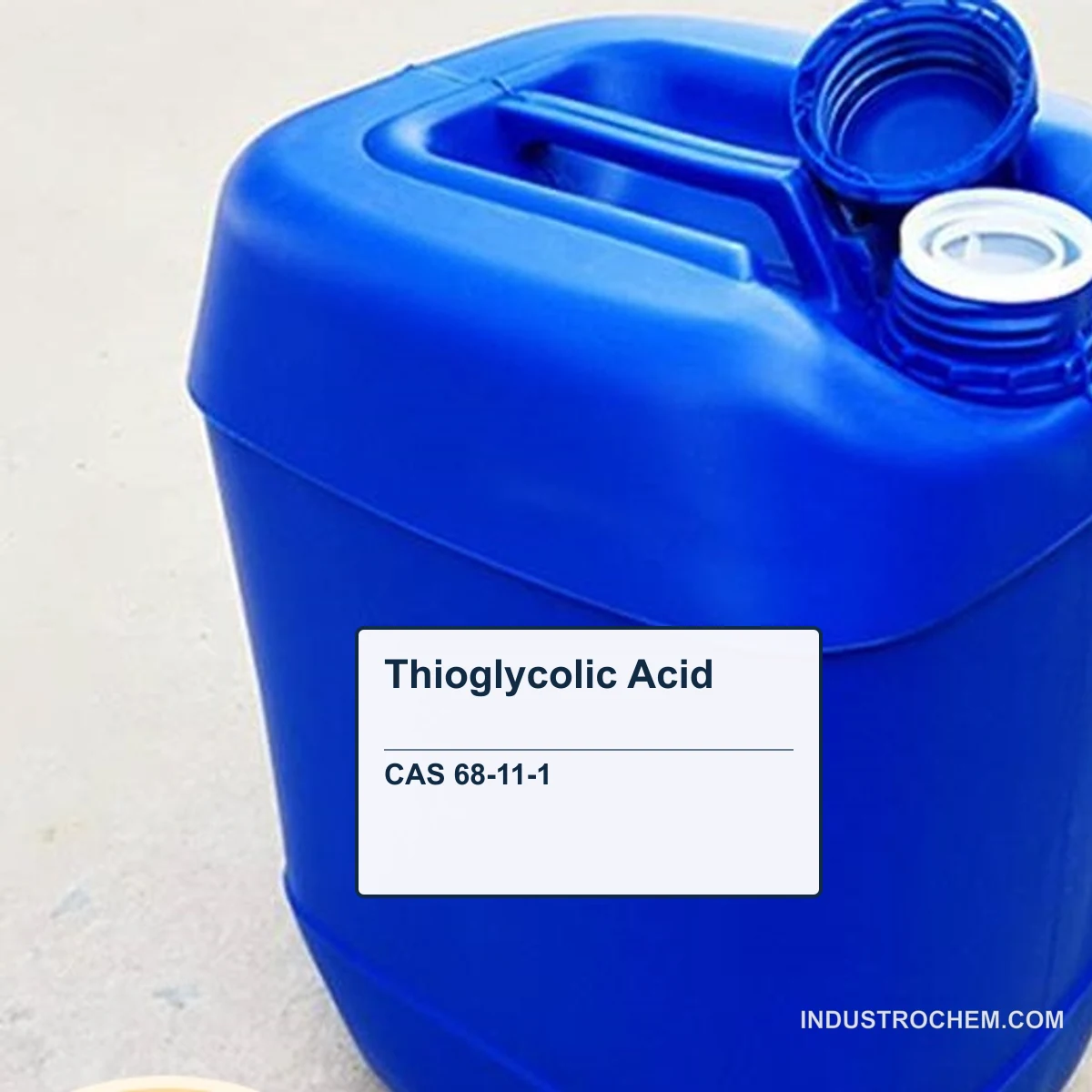
Thioglycolic Acid (TGA), CAS 68-11-1, is also known as Mercaptoacetic Acid. It is a sulfur-containing carboxylic acid. For an inquiry, state the required concentration, intended process and material-compatibility requirements.
Thioglycolic Acid (TGA) CAS 68-11-1
- CAS: 68-11-1
- Synonyms: Mercaptoacetic Acid; 2-Mercaptoacetic Acid; TGA
- Einecs: 200-677-4
- Molecular Formula: C₂H₄O₂S
- Grade: Confirm the current product-specific specification.
- Package: Confirm packaging requirements for the proposed material and destination.
Product Description
1. Product identity: Thioglycolic Acid (TGA), also called mercaptoacetic acid, is a sulfur-containing carboxylic acid identified by CAS 68-11-1.
2. Product-specific specification: Confirm the current product-specific specification.
| Inspection item | Current product-specific specification |
| Assay / concentration | Confirm the current product-specific specification. |
| Density | Confirm the current product-specific specification. |
| pH | Confirm the current product-specific specification. |
3. Industrial context: Thioglycolic acid may be evaluated for sulfur-chemistry processes when the required concentration, process compatibility, and safety controls are defined.
4. Packaging: Confirm packaging requirements for the proposed material and destination.
For a related mercapto-acid raw material, see 3-Mercaptopropionic Acid.
5. Storage and handling: Handling, storage, and process requirements must be reviewed against the applicable SDS and current product-specific specification.
6. Safety review: Handling, storage, and process requirements must be reviewed against the applicable SDS and current product-specific specification.
FAQ - Technical & Supply Chain
-
Q:
Are Thioglycolic Acid, TGA and Mercaptoacetic Acid the same material?
A: Yes. These names identify CAS 68-11-1, formula C2H4O2S and molecular weight about 92.12 g/mol. Commercial TGA is supplied at different concentrations such as 70%, 80%, 90% or 99%+, so state the concentration and water basis. -
Q:
What is Thioglycolic Acid used for?
A: TGA is used in hair-waving and depilatory products, PVC stabilizer chemistry, epoxy resin systems, metal treatment and cleaning, and as a sulfur-containing reducing reagent. The intended reaction or formulation determines whether a dilute aqueous grade or high-assay material is needed. -
Q:
Which specifications should be agreed when purchasing industrial TGA?
A: Confirm TGA content and method, water basis, color or Pt-Co number, density, iron and chloride or organic-chlorine limits. Concentration and impurity limits differ between 80%, 90% and high-assay grades. -
Q:
What are typical physical properties of Thioglycolic Acid?
A: TGA is normally a colorless to pale-yellow liquid with typical density about 1.32-1.33 g/cm3 and melting point around -16 C. Reported boiling point is commonly around 96 C at 5 mmHg, with possible decomposition at higher temperature; a reported closed-cup flash point is near 130-132 C. -
Q:
How should Thioglycolic Acid be stored, shipped and handled?
A: Keep it cool, dry and tightly closed away from oxidizers, heat and incompatible metals. TGA is UN 1940, Class 8 corrosive, and many grades recommend storage around 2-8 C with protective equipment during transfer. Agree container material, net quantity, seals and destination requirements before bulk delivery.
Ordering & Documentation
Key information for document requests, quotations, and supply planning.
Documents
Tell us which documents your procurement team needs. Before an order, we will check whether the quoted source can provide them for the offered lot.
Quotation
Send the CAS number, grade, quantity, packing preference and destination.
Sample & Supply
Ask whether samples, trial quantities or repeat orders are possible. We will check each request against the sourced product and current offer.
Storage & Shipping
Product-specific conditions are confirmed before order.