









Carbomer (CAS 9007-20-9) is a crosslinked polyacrylic-acid rheology modifier for gels, creams and emulsions. Grade selection depends on viscosity, clarity, dispersion behaviour, neutralization and electrolyte tolerance. For a bulk quotation, specify the grade or target formulation performance, quantity and destination, and request COA/TDS/SDS.
Carbomer CAS 9007-20-9
- CAS: 9007-20-9
- Synonyms: Carbomer; Crosslinked Polyacrylic Acid; Acrylic Polymer Thickener; Carbopol-type Polymer
- Molecular Formula: Not specified
- Grade: Grade-specific crosslinked polyacrylic acid rheology modifier.
- Package: Moisture-resistant lined fiber drum or bag; confirm the offered grade and net weight.
Product Description
Carbomer
Synonyms: Carboxypolymethylene; Cross-linked polyacrylic acid
CAS number: 9007-20-9
Molecular formula: Not specified (cross-linked polymer)
Molecular weight: Not fixed for a polymer
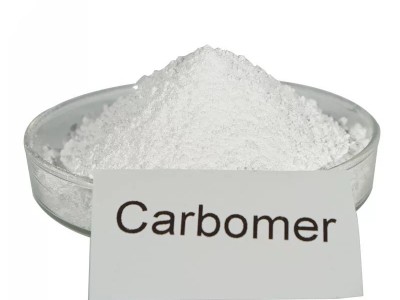
Carbomer is a white, fluffy, hygroscopic powder that disperses in water to form an acidic dispersion. Neutralization ionizes its carboxyl groups, allowing the crosslinked polymer network to swell and build viscosity and yield stress. It helps suspend particles and stabilize emulsions. Clarity and thickening efficiency depend on the grade, concentration and formulation. Electrolytes, especially multivalent ions, can reduce viscosity; test compatibility with the complete formulation.
Comparing Carbomer Grades
Compare grade codes together with their test conditions. For example, Lubrizol lists Carbopol 940 NF and 980 NF at 40,000–60,000 cP, and 941 NF at 4,000–10,000 cP, for 0.5% dispersions neutralized to pH 7.5. Similar viscosity ranges do not make grades interchangeable: polymerization solvents, clarity and formulation performance may differ.
Quality Control and Analytical Methods
Carbomer quality evaluation includes infrared identification, carboxylic acid content, loss on drying and neutralized-dispersion viscosity. Report viscosity with polymer concentration, pH, temperature, spindle and speed. Residual acrylic acid can be measured by HPLC, and residual process solvents by a suitable GC method. These chromatograms assess impurities, not polymer purity. Request COA/TDS/SDS and the relevant HPLC/GC chromatograms with methods, calibration and impurity limits.
FAQ - Technical & Supply Chain
-
Q:
Does CAS 9007-20-9 identify one universal Carbomer grade?
A: No. CAS 9007-20-9 covers a family of crosslinked polyacrylic-acid polymers, not one material with a universal molecular weight, formula or viscosity. Grades differ in crosslinker, polymer architecture, residual-solvent controls and rheology. State the commercial grade or desired performance. -
Q:
What is Carbomer used for?
A: Carbomer is used as a low-dose rheology modifier and suspending agent for transparent gels, emulsions, creams and other formulations. It can suspend insoluble particles, oils and water-insoluble ingredients while building yield value and viscosity after neutralization. -
Q:
Which specifications should be compared when selecting Carbomer?
A: Compare viscosity only at the same polymer concentration, neutralization pH, spindle, speed and temperature. Also confirm carboxyl content, loss on drying, bulk density, residual monomers or solvents, clarity, dispersion time and regulatory grade where applicable. -
Q:
How should pH and electrolytes be considered before choosing a Carbomer grade?
A: Provide the finished formulation pH, salt type and concentration, surfactants, alcohol or polyol level and intended neutralizer. Conventional carbomers build viscosity after neutralization and may lose viscosity as electrolyte loading rises, while specialized grades can be more salt-tolerant. -
Q:
What packaging and storage should be confirmed for Carbomer?
A: Confirm the offered grade, net weight and moisture-resistant lined fibre drum or bag. Store in a dry area because carbomer is hygroscopic, and follow appropriate handling and dust-control precautions.
Ordering & Documentation
Key information for document requests, quotations, and supply planning.
Documents
Tell us which documents your procurement team needs. Before an order, we will check whether the quoted source can provide them for the offered lot.
Quotation
Send the CAS number, grade, quantity, packing preference and destination.
Sample & Supply
Ask whether samples, trial quantities or repeat orders are possible. We will check each request against the sourced product and current offer.
Storage & Shipping
Product-specific conditions are confirmed before order.