










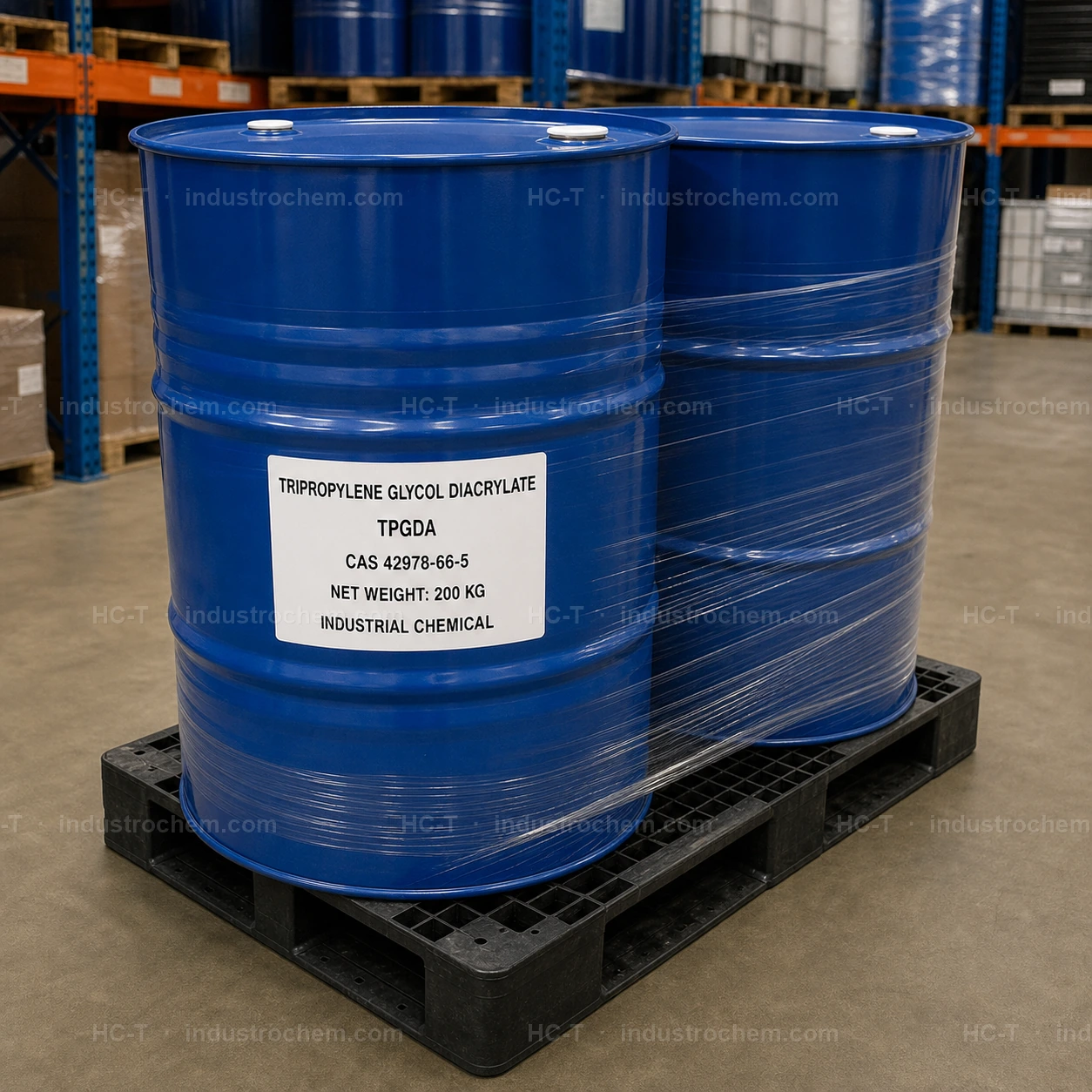
Tripropylene Glycol Diacrylate, commonly abbreviated TPGDA, CAS 42978-66-5, is a difunctional acrylate monomer supplied for radiation-curable coatings, inks and adhesives. Confirm the required grade, then request a quotation with COA/TDS/SDS for bulk supply.
Tripropylene Glycol Diacrylate (TPGDA) CAS 42978-66-5
- CAS: 42978-66-5
- Synonyms: Tripropylene glycol diacrylate; TPGDA; Tripropylene glycol di-2-propenoate
- Einecs: Not specified
- Molecular Formula: C15H24O6
- Grade: Industrial stabilized acrylate monomer; inhibitor system and specifications confirmed for the formulation
- Package: Steel drums or IBCs for liquid monomer grades; final pack and stabilizer declaration confirmed for the shipment
Product Description
Tripropylene Glycol Diacrylate (TPGDA) CAS 42978-66-5 is tri(propylene glycol) diacrylate, with molecular formula C15H24O6.
Synonyms: Tripropylene glycol diacrylate; TPGDA; tripropylene glycol di-2-propenoate.
CAS: 42978-66-5.
Molecular formula: C15H24O6.
It is normally supplied as a clear, low-viscosity liquid.
It is a difunctional reactive diluent used in UV, LED and electron-beam curable formulations.
Its two acrylate groups take part in the cured network, so it lowers oligomer viscosity without acting as a non-reactive solvent.
It is used in UV- and LED-curable industrial coatings, overprint varnishes, screen and packaging inks.
It also appears in adhesives, sealants and formulated resin systems where controlled viscosity and difunctional crosslinking are required.
TPGDA is difunctional, while TMPTA is trifunctional and tends to give a harder, more brittle cured film.
They are not direct one-for-one replacements; choice depends on target viscosity, cure response, flexibility and final film properties.
Liquid grades are selected by viscosity, colour and inhibitor system.
For comparison, specify appearance, GC purity, density, colour, viscosity at 25 C, acid value, water, residual solvent and inhibitor level.
Keep the material cool, dry, dark and well-sealed to avoid premature polymerization.
Handle as a stabilized reactive chemical and use suitable PPE and exposure controls.
Confirm appearance, purity, viscosity, colour and inhibitor system on the COA.
Confirm grade, packaging, and specification as required.
The page is an RFQ entry point and does not state stock, price, MOQ, or fixed lead time.
For an RFQ, state the intended application, required grade, quantity, packaging, destination, and document needs.
FAQ - Technical & Supply Chain
-
Q:
What is Tripropylene Glycol Diacrylate (TPGDA) CAS 42978-66-5?
A: TPGDA is a difunctional acrylate monomer also known as tri(propylene glycol) diacrylate or tripropylene glycol di-2-propenoate. It has CAS 42978-66-5, molecular formula C15H24O6 and a molecular weight of about 300.35 g/mol, and is normally supplied as a clear low-viscosity liquid. -
Q:
Why is TPGDA used as a reactive diluent in radiation-curable systems?
A: TPGDA lowers the high viscosity contributed by oligomers without acting as a non-reactive solvent, because its two acrylate groups take part in the cured network. This helps formulators adjust application viscosity while retaining reactivity and crosslink formation in UV, LED or EB cure. -
Q:
What are the main applications of TPGDA?
A: TPGDA is used in UV- and LED-curable industrial coatings, overprint varnishes, screen and packaging inks, and other graphic-arts formulations. It also appears in adhesives, sealants and formulated resin systems where controlled viscosity and difunctional crosslinking are required. -
Q:
How does TPGDA compare with TMPTA in cure formulations?
A: TPGDA is difunctional, while TMPTA is trifunctional and therefore tends to produce a higher crosslink density and harder, more brittle cured film. They are not direct one-for-one replacements; the choice depends on the target viscosity, cure response, flexibility and final film properties. -
Q:
Which specification parameters should be compared between TPGDA grades?
A: Compare appearance, GC purity, density, colour, viscosity at 25 deg C, acid value, water, residual solvent or methylbenzene and the inhibitor level. The inhibitor type and concentration also matter because they affect storage stability and photoinitiator/cure response. -
Q:
Why is TPGDA supplied as a stabilized monomer?
A: TPGDA is a reactive acrylate monomer and can undergo premature polymerization if exposed to heat, light, oxygen depletion or incompatible materials. A stabilizer or inhibitor system, usually MEHQ or a mixed inhibitor package, is therefore added and the material should be kept cool, dry, dark and well-sealed until use.
Ordering & Documentation
Key information for document requests, quotations, and supply planning.
Documents
Tell us which documents your procurement team needs. Before an order, we will check whether the quoted source can provide them for the offered lot.
Quotation
Send the CAS number, grade, quantity, packing preference and destination.
Sample & Supply
Ask whether samples, trial quantities or repeat orders are possible. We will check each request against the sourced product and current offer.
Storage & Shipping
Product-specific conditions are confirmed before order.