









1,6-Hexanediol Diacrylate, commonly abbreviated HDDA, CAS 13048-33-4, is a difunctional acrylate monomer supplied for UV, LED and EB-curable coatings, inks and adhesives. Confirm the required grade, then request a quotation with COA/TDS/SDS for bulk supply.
1,6-Hexanediol Diacrylate (HDDA) CAS 13048-33-4
- CAS: 13048-33-4
- Synonyms: 1,6-Hexanediol diacrylate; HDDA; Hexamethylene diacrylate; Hexanediol diacrylate
- Einecs: Not specified
- Molecular Formula: C12H18O4
- Grade: Industrial stabilized acrylate monomer; select against formulation and cure requirements
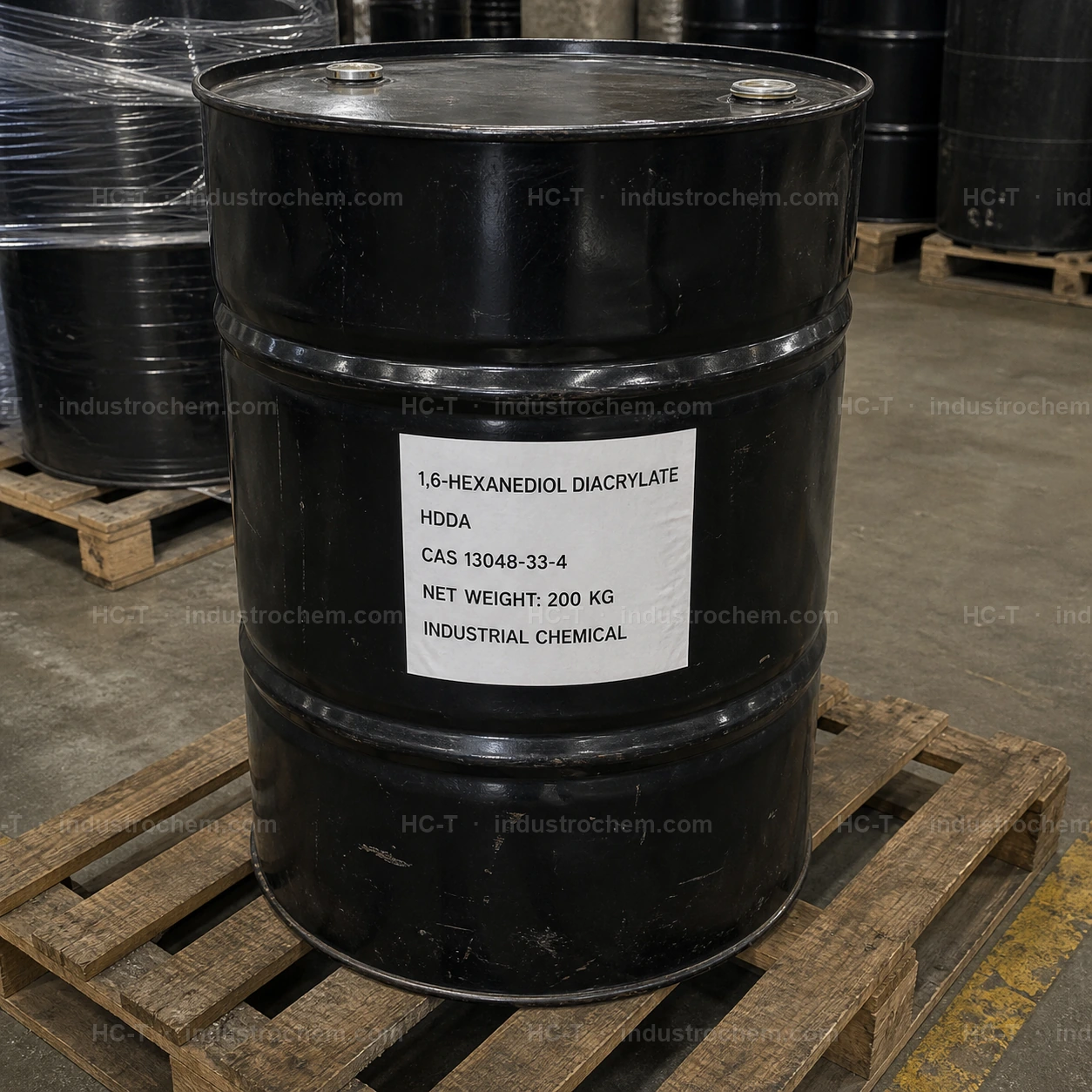
- Package: Steel drums or IBCs for liquid monomer grades; final pack and stabilizer declaration confirmed for the shipment
Product Description
1,6-Hexanediol Diacrylate (HDDA) CAS 13048-33-4 is hexamethylene diacrylate, with molecular formula C12H18O4.
Synonyms: 1,6-Hexanediol diacrylate; HDDA; hexamethylene diacrylate; hexanediol diacrylate.
CAS: 13048-33-4.
Molecular formula: C12H18O4.
It is supplied as a clear, colourless to pale-yellow liquid.
It is a low-viscosity difunctional reactive diluent used in UV, LED and electron-beam curable formulations.
Both terminal acrylate groups enter the cured polymer network, so it lowers oligomer viscosity without acting as a non-reactive solvent.
It is used in radiation-curable industrial coatings, overprint varnishes, graphic-arts inks and laminating or pressure-sensitive adhesives.
It also appears in SLA and DLP 3D-printing resins, optical-fibre coatings, conformal coatings and other formulated systems.
HDDA has a relatively short hexamethylene backbone and two acrylate groups, giving lower viscosity and faster cure with a harder network than longer-chain difunctional TPGDA.
TMPTA is trifunctional and tends to create higher crosslink density, so it is not a direct one-for-one substitute.
Grades are defined by viscosity, colour and stabilizer system.
For comparison, specify appearance, ester content or purity, colour, viscosity at 25 C, density, acid value, water, residual solvent and inhibitor type/concentration.
Keep the material cool, dry, dark and tightly sealed to avoid premature polymerization.
Handle as a stabilized reactive monomer and use suitable PPE and exposure controls.
Confirm appearance, purity, viscosity, colour and stabilizer system on the COA.
Confirm grade, packaging, and specification as required.
The page is an RFQ entry point and does not state stock, price, MOQ, or fixed lead time.
For an RFQ, state the intended application, required grade, quantity, packaging, destination, and document needs.
FAQ - Technical & Supply Chain
-
Q:
What is 1,6-Hexanediol Diacrylate (HDDA) CAS 13048-33-4?
A: 1,6-Hexanediol diacrylate, abbreviated HDDA, is a difunctional acrylate monomer also known as hexamethylene diacrylate or 1,6-hexanediyl diacrylate. It has CAS 13048-33-4, molecular formula C12H18O4 and a molecular weight of about 226.27 g/mol, and is supplied as a clear, colourless to pale-yellow liquid. -
Q:
Why is HDDA described as a low-viscosity difunctional reactive diluent?
A: HDDA lowers the high viscosity contributed by oligomers without behaving like a non-reactive solvent, because both terminal acrylate groups enter the cured polymer network. This allows formulators to control application viscosity while still obtaining crosslinking in UV, LED or electron-beam cure. -
Q:
What are the main applications of HDDA?
A: HDDA is used in radiation-curable industrial coatings, overprint varnishes, graphic-arts inks and laminating or pressure-sensitive adhesives. It also appears in SLA and DLP 3D-printing resins, optical-fibre coatings, conformal coatings and other formulated systems that need low viscosity plus difunctional crosslinking. -
Q:
How does HDDA differ from TPGDA and TMPTA?
A: HDDA has a relatively short hexamethylene backbone and two acrylate groups, which generally gives lower viscosity and faster cure with a harder or less flexible network than the longer-chain difunctional monomer TPGDA. TMPTA is trifunctional, so it tends to create a higher crosslink density and is not a direct one-for-one substitute. -
Q:
Which specification parameters should be compared between HDDA grades?
A: Compare appearance, ester content or purity, colour, viscosity at 25 deg C, density, acid value, water, residual solvent, and the type and concentration of inhibitor. These values affect both how the material processes and how reliably it cures in the final formulation. -
Q:
Why is HDDA supplied and stored as a stabilized monomer?
A: HDDA is a reactive acrylate and can polymerize prematurely when exposed to heat, light, oxygen depletion or incompatible materials. A stabilizer or inhibitor, commonly MEHQ or a mixed inhibitor package, is added to maintain shelf life, and the product should be kept cool, dry, dark and tightly sealed until use.
Ordering & Documentation
Key information for document requests, quotations, and supply planning.
Documents
Tell us which documents your procurement team needs. Before an order, we will check whether the quoted source can provide them for the offered lot.
Quotation
Send the CAS number, grade, quantity, packing preference and destination.
Sample & Supply
Ask whether samples, trial quantities or repeat orders are possible. We will check each request against the sourced product and current offer.
Storage & Shipping
Product-specific conditions are confirmed before order.