










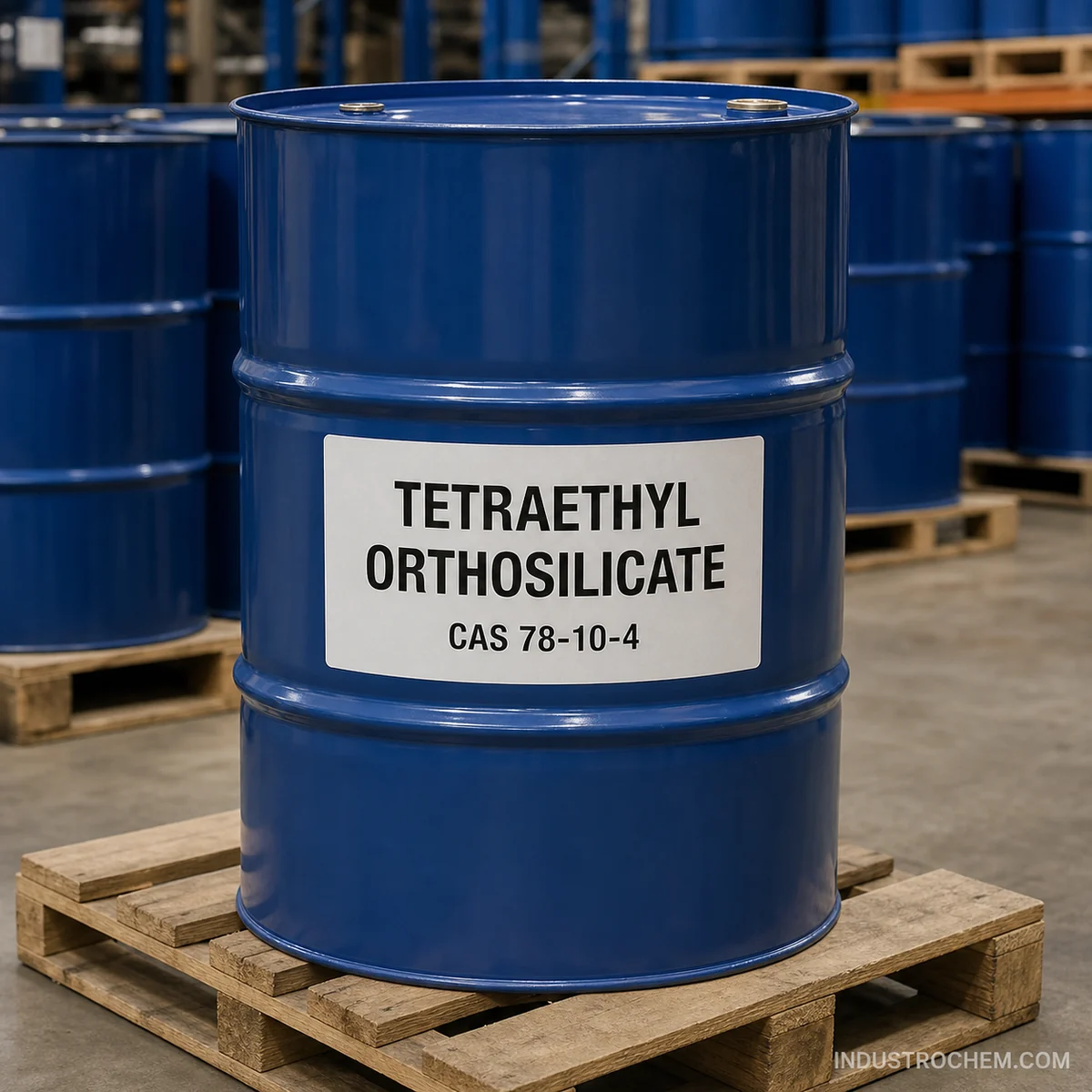
Tetraethyl Orthosilicate, identifiable by CAS 78‑10‑4, functions as a hydrolyzable ethyl ester of orthosilicic acid used primarily as a precursor for silicon dioxide in sol-gel processing. Chemically defined as Tetraethoxysilane, this colorless liquid serves as a binder in inorganic zinc-rich paints and a crosslinking agent for RTV silicone rubber. The substance, often referred to as TEOS or Ethyl Silicate in ceramic industries, acts as a hardening agent for stone consolidation and a source of high-purity silica in semiconductor manufacturing. We facilitate bulk supply of this silane intermediate with competitive factory pricing, capable of meeting customized specifications for hydrolysis levels, backed by comprehensive MSDS, TDS, COA documentation.
Tetraethyl Orthosilicate CAS 78‑10‑4
- CAS: 78-10-4
- Synonyms: TEOS, Ethyl silicate, Silicic acid tetraethyl ester, Tetraethoxysilane
- Molecular Formula: C8H20O4Si
- Grade: Industrial grade 99%
- Package: 200kg iron drum or 50kg plastic drum packaging
Product Description
Ethyl orthosilicate
It is also known as tetraethyl silicate
Chemical formulaC8H20O4Si
Molecular weight 208.33
CAS Accession No. 78-10-4
Characteristics: Colorless transparent liquid, slightly smelly.
Melting point (°C): -77
Boiling point (°C): 165~169
Relative density (water=1): 0.93
use
Used for precision casting, as a binder for sand molds; Metal surfaces treated with ethyl orthosilicate vapor are corrosion and water resistant. Ethyl orthosilicate can be used to permeate silicon on metal surfaces, and optical glass can be treated to improve light transmittance. The ultrafine silica powder produced after complete hydrolysis can be used to make phosphors. Ethyl orthosilicate is the raw material for silicone oil. Ethyl orthosilicate can also be used to make coatings that are resistant to heat and chemicals. In Japan, 90% ethyl orthosilicate is used as a base for anti-corrosion coatings (zinc-rich paints).
FAQ - Technical & Supply Chain
-
Q:
Are tetraethyl orthosilicate and ethyl silicate the same substance?
A: Yes. Ethyl silicate and tetraethyl orthosilicate are commonly used names for the same chemical compound corresponding to CAS 78‑10‑4. -
Q:
What role does TEOS commonly play in industrial processes?
A: It is commonly applied as a silica precursor that forms silicon dioxide structures through controlled hydrolysis and condensation reactions. -
Q:
What is the primary function of this silane in zinc-rich coatings?
A: Tetraethyl Orthosilicate is typically applied as a binder in inorganic zinc-rich primers, where it hydrolyzes to form a silica matrix that adheres the zinc dust to the substrate.
Documents and Product Support
For product review and sourcing evaluation, supporting documents can be coordinated according to the product type, inquiry stage, and order requirements.
- COA for batch-based quality reference
- TDS for key physical and chemical information
- SDS / MSDS for handling, storage, and safety reference
- Packing information for sample, trial, and bulk orders
- Technical communication based on application and specification requirements
Information to Confirm Before Quotation
Clear sourcing information helps reduce specification mismatch and allows a more accurate quotation before sample or bulk order discussion.
- Product name and CAS number
- Application or intended end use
- Required purity, grade, or specification
- Sample quantity, trial order, or bulk demand
- Preferred packing form or net weight
- Destination country or port
- Required documents or compliance expectations
Packaging, Storage, and Handling Notes
Packaging form, storage conditions, shelf life, and shipment arrangements should be confirmed according to the product characteristics, package size, and destination requirements.
Before order confirmation, buyers are advised to review the corresponding product documents and confirm whether any special storage, labeling, or handling requirements apply.
Sample, Bulk Order and Repeat Supply Support
Support can be arranged for sample discussion, bulk supply planning, packaging confirmation, and routine sourcing communication based on the actual product and order requirements.
For repeat-use formulations or long-term procurement plans, buyers may discuss specification consistency, packaging preferences, delivery expectations, and document coordination in advance.


