



Sodium Secondary Alkyl Sulfonate (SAS) is a C14-17 secondary alkane sulfonate sodium-salt surfactant. It may be evaluated for detergent, wetting-agent, and industrial cleaning formulations. For an RFQ, state the intended use, required specification, quantity, packaging, destination, and document needs.
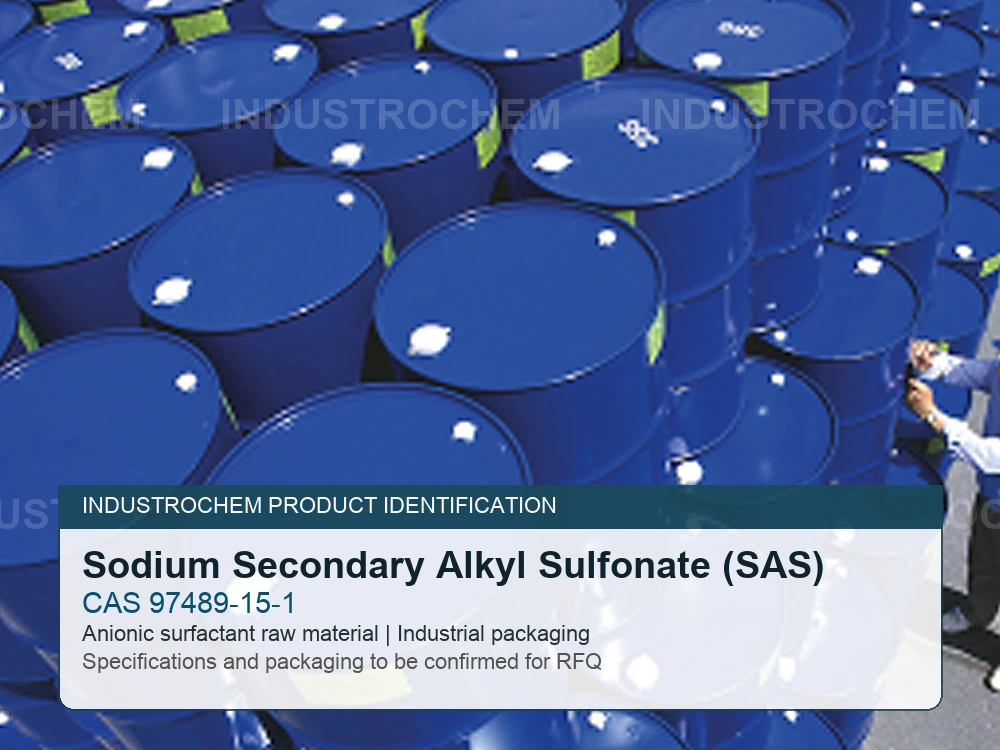
Sodium Secondary Alkyl Sulfonate (SAS) CAS 97489-15-1
- CAS: 97489-15-1
- Synonyms: Sulfonic acids, C14-17-sec-alkane, sodium salts; Secondary Alkane Sulfonate; SAS; Sodium Paraffin Sulfonate
- Einecs: 307-055-2
- Molecular Formula: Not a fixed molecular formula
- Grade: Confirm the current product-specific specification.
- Package: Confirm packaging requirements for the proposed material and destination.
Product Description
Sodium Secondary Alkyl Sulfonate (SAS) is a C14-17 secondary alkane sulfonate sodium-salt surfactant.
Synonyms: Sulfonic acids, C14-17-sec-alkane, sodium salts; Secondary Alkane Sulfonate; SAS; Sodium Paraffin Sulfonate.
CAS: 97489-15-1.
EINECS / EC: 307-055-2.
Molecular formula: Not a fixed molecular formula.
Confirm composition, active matter, appearance, pH, salt content, application, quantity, packaging, and SDS before purchase.
It may be evaluated for detergent, wetting-agent, and industrial cleaning formulations.
Confirm the current product-specific specification.
Confirm packaging requirements for the proposed material and destination.
Document requirements should be confirmed from the current specification, SDS, COA, or other product-specific files.
Regulated-use suitability must be confirmed separately with current product-specific documentation.
The page is an RFQ entry point and does not state stock, price, MOQ, or fixed lead time.
For an RFQ, state the intended use, required specification, quantity, packaging, destination, and document needs.
FAQ - Technical & Supply Chain
-
Q:
What is Sodium Secondary Alkyl Sulfonate CAS 97489-15-1?
A: It is an anionic surfactant mixture made from C14-17 secondary alkanesulfonic acids as sodium salts. It is also known as secondary alkane sulfonate, sodium paraffin sulfonate or by the INCI name Sodium C14-17 Sec-Alkyl Sulfonate, and is not a single fixed molecule. -
Q:
What commercial forms and active-matter levels are available?
A: SAS is commonly supplied as aqueous solutions such as 30% or 60% active matter, and as high-active paste or granule forms around 90% or more. Form, active-matter basis and chain distribution should be stated because they change appearance, pumpability and dosing. -
Q:
Why choose SAS over a conventional primary alkyl sulfonate?
A: The sulfonate group is distributed mainly on secondary carbon atoms of the C14-17 chain, which gives useful hard-water tolerance and stability in alkaline, high-temperature cleaning systems. It is commonly used where strong detergency, penetration and low residue are required. -
Q:
What are the main applications of SAS?
A: Typical uses include laundry and dishwashing detergents, hard-surface cleaners, textile pretreatment and scouring, metal degreasing and cleaning, leather processing, and paper deinking or emulsification. The grade and foam profile should be selected for the specific formulation. -
Q:
What should be confirmed before ordering SAS?
A: Confirm CAS 97489-15-1, active-matter content, C-chain range, physical form, pH at a stated dilution, water and salt content, and packaging. For bulk or paste grades, also confirm viscosity, temperature range and unloading requirements.
Ordering & Documentation
Key information for document requests, quotations, and supply planning.
Documents
Tell us which documents your procurement team needs. Before an order, we will check whether the quoted source can provide them for the offered lot.
Quotation
Send the CAS number, grade, quantity, packing preference and destination.
Sample & Supply
Ask whether samples, trial quantities or repeat orders are possible. We will check each request against the sourced product and current offer.
Storage & Shipping
Product-specific conditions are confirmed before order.