



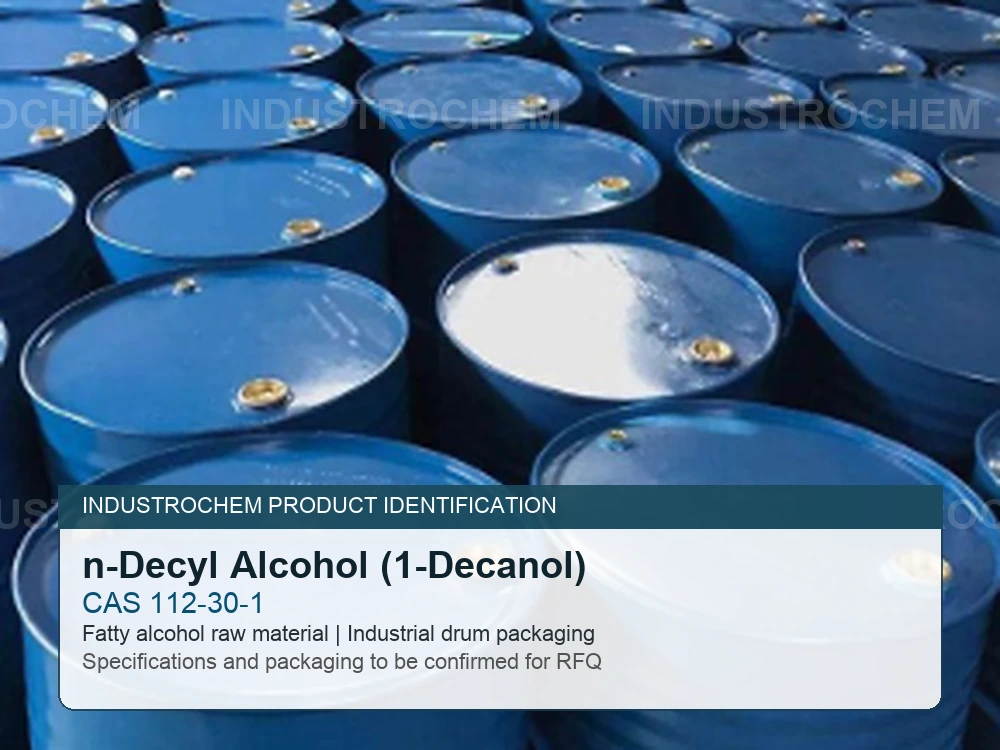
n-Decyl Alcohol, also called 1-Decanol, is a straight-chain C10 fatty alcohol identified by CAS 112-30-1. It may be evaluated for surfactant intermediates, ester synthesis, lubricant additives, and solvent-related formulations. For an RFQ, state the intended use, required specification, quantity, packaging, destination, and document needs.
n-Decyl Alcohol (1-Decanol) CAS 112-30-1
- CAS: 112-30-1
- Synonyms: 1-Decanol; Decan-1-ol; Capric Alcohol; Alcohol C10; Primary Decyl Alcohol
- Einecs: 203-956-9
- Molecular Formula: C₁₀H₂₂O
- Grade: Confirm the current product-specific specification.
- Package: Confirm packaging requirements for the proposed material and destination.
Product Description
n-Decyl Alcohol, also called 1-Decanol, is a straight-chain C10 fatty alcohol identified by CAS 112-30-1.
Synonyms: 1-Decanol; Decan-1-ol; Capric Alcohol; Alcohol C10; Primary Decyl Alcohol.
CAS: 112-30-1.
EINECS / EC: 203-956-9.
Molecular formula: C₁₀H₂₂O.
Common commercial form is a colorless to pale yellow liquid.
It may be evaluated for surfactant intermediates, ester synthesis, lubricant additives, and solvent-related formulations.
Confirm the current product-specific specification.
Confirm packaging requirements for the proposed material and destination.
Document requirements should be confirmed from the current specification, SDS, COA, or other product-specific files.
Regulated-use suitability must be confirmed separately with current product-specific documentation.
The page is an RFQ entry point and does not state stock, price, MOQ, or fixed lead time.
For an RFQ, state the intended use, required specification, quantity, packaging, destination, and document needs.
FAQ - Technical & Supply Chain
-
Q:
Is n-Decyl Alcohol the same as 1-Decanol?
A: Yes. n-Decyl Alcohol, 1-Decanol, decan-1-ol, capric alcohol and Alcohol C10 all refer to the straight-chain primary C10 alcohol CAS 112-30-1. Keep the n- or 1- prefix to distinguish it from branched decyl alcohol isomers. -
Q:
What are the key physical properties of 1-Decanol?
A: It is normally a colorless to pale yellow viscous liquid with a mild fatty-alcohol odor. Its melting point is about 5-7 deg C, density is about 0.829 g/cm³ at 20 deg C, and boiling point is about 231 deg C, so it can solidify in cool storage. -
Q:
Which specifications should be checked for n-Decyl Alcohol?
A: Confirm GC purity, water content, color, acid value, distillation range and higher or lower alcohol homolog limits. Common high-purity material is about 99% or higher with low water, low acid value and light APHA color. -
Q:
What are the main uses of n-Decyl Alcohol?
A: It is used to make nonionic surfactants and emulsifiers, decyl esters and cold-resistant plasticizers, fragrance or personal-care ingredients, lubricant additives and specialty intermediates. The required homolog and impurity profile depends on the downstream chemistry. -
Q:
What should be considered for storage and bulk handling?
A: Keep containers tightly closed in a cool, ventilated area away from heat and oxidizers. Because 1-decanol may solidify around 5-7 deg C, drums or tanks may need gentle warming before transfer; confirm moisture control, packaging and unloading before dispatch.
Ordering & Documentation
Key information for document requests, quotations, and supply planning.
Documents
Tell us which documents your procurement team needs. Before an order, we will check whether the quoted source can provide them for the offered lot.
Quotation
Send the CAS number, grade, quantity, packing preference and destination.
Sample & Supply
Ask whether samples, trial quantities or repeat orders are possible. We will check each request against the sourced product and current offer.
Storage & Shipping
Product-specific conditions are confirmed before order.