










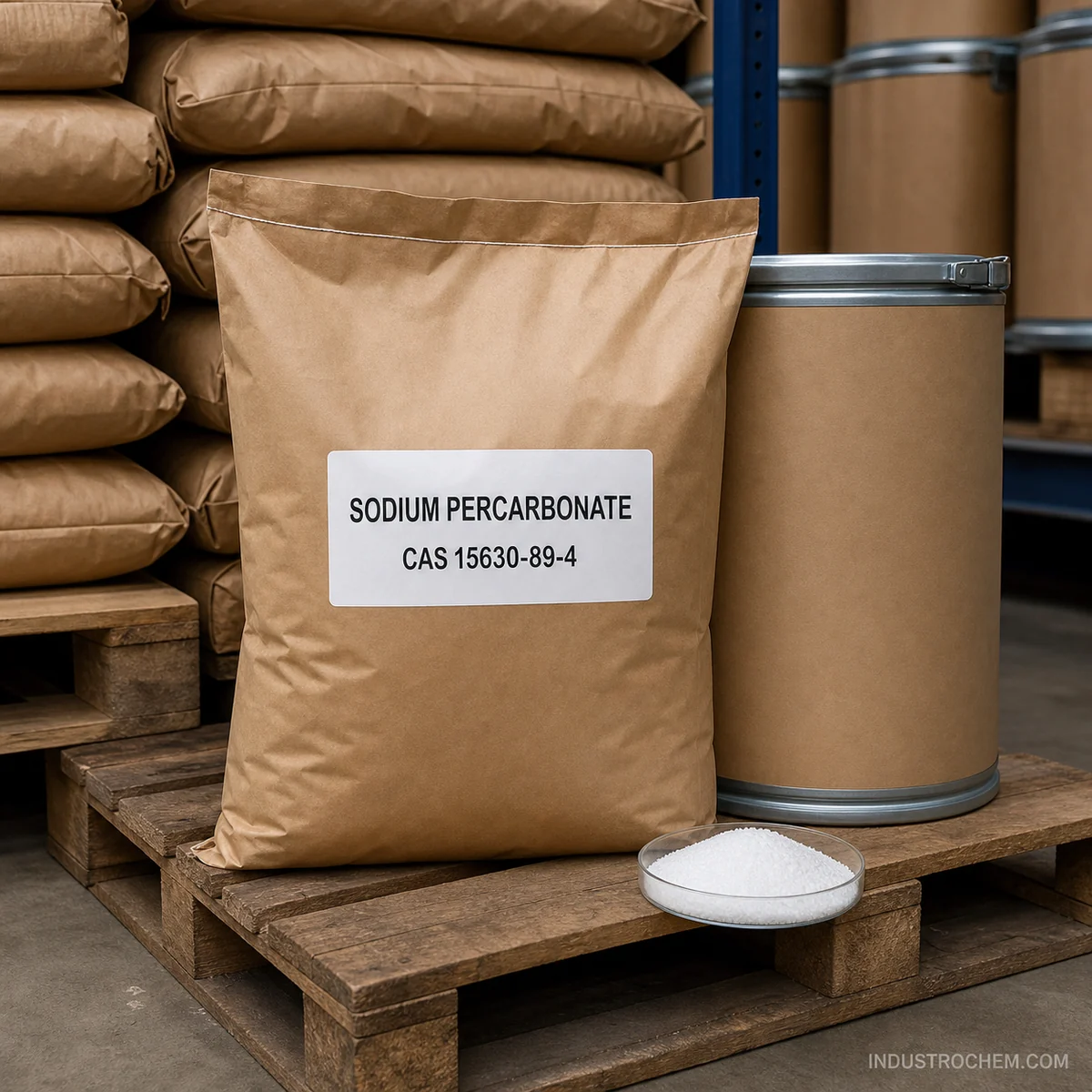
Sodium Percarbonate, identifiable by CAS 15630‑89‑4, functions as a free-flowing addition compound of sodium carbonate and hydrogen peroxide, serving as a concentrated source of active oxygen in industrial detergent manufacturing. Technically defined as Sodium Carbonate Peroxyhydrate or Sodium Carbonate Peroxide, this inorganic salt decomposes in water to release oxygen, providing powerful bleaching and stain removal properties in powder laundry detergents and automatic dishwashing tablets. The substance, often referred to as SPC in formulation protocols, acts simultaneously as an oxidative agent and an alkalinity source, stabilizing non-chlorine bleach systems used in textile processing and chemical synthesis. We facilitate bulk supply of this industrial material with competitive factory pricing, capable of meeting customized specifications for particle size distribution or coating types, backed by comprehensive MSDS, TDS, COA documentation.
Sodium Percarbonate CAS 15630‑89‑4
- CAS: 15630-89-4
- Synonyms: Sodium carbonate peroxyhydrate, Sodium peroxycarbonate, Oxygen bleach, Solid hydrogen peroxide
- Molecular Formula: CH5NaO5
- Grade: Industrial grade 99%
- Package: 200kg iron drum or 50kg plastic drum packaging
Product Description
Sodium percarbonate is referred to as SPC, commonly known as solid hydrogen peroxide, also known as sodium peroxycarbonate and solid hydrogen peroxide, which is an additive compound of hydrogen peroxide and sodium carbonate, which decomposes to produce oxygen, water and sodium carbonate. Sodium percarbonate not only has the function of liquid hydrogen peroxide, but also quickly decomposes and releases oxygen at lower water temperatures, realizing the functions of bleaching, decontamination, sterilization and odor removal. It is widely used in washing, printing and dyeing, textile, papermaking, medicine and hygiene, household and personal care formulation and other fields.
Product name: Sodium percarbonate
CAS Number: 15630-89-4
Molecular formula: CH5NaO5
Molecular Weight: 120.04
Appearance: White granular powder
PH: 10.5
Preparation method: Dry production process – sodium peroxide crystals are prepared by spraying hydrogen peroxide solution on anhydrous sodium carbonate on a fluid bed with hot air boiling. Although the production process of this method is simple, it is rarely used in industry due to poor product stability, low reactive oxygen content, strict production technology and process conditions, and difficult operation. Wet production process – react the aqueous hydrogen peroxide solution with sodium carbonate in the presence of stabilizer, control the reaction temperature below 5 °C, and then add salt precipitant to make sodium peroxycarbonate crystallized, separated by centrifugation, and dried by air flow, that is, the finished sodium peroxycarbonate is obtained. The products produced by this method have good stability, mature technology, and are widely used in industry. At present, there are spray methods, low-temperature crystallization and solvent methods for production.
FAQ - Technical & Supply Chain
-
Q:
What is the typical functional role of sodium percarbonate in formulations?
A: It is typically applied as a solid oxygen‑releasing agent that provides controlled oxidative or bleaching action in aqueous process systems. -
Q:
Is this material suitable for liquid detergent formulations?
A: Sodium Percarbonate is typically intended for dry powder formulations, tablets, and agglomerates, as it rapidly decomposes and loses active oxygen stability when dissolved in aqueous liquid systems.
Documents and Product Support
For product review and sourcing evaluation, supporting documents can be coordinated according to the product type, inquiry stage, and order requirements.
- COA for batch-based quality reference
- TDS for key physical and chemical information
- SDS / MSDS for handling, storage, and safety reference
- Packing information for sample, trial, and bulk orders
- Technical communication based on application and specification requirements
Information to Confirm Before Quotation
Clear sourcing information helps reduce specification mismatch and allows a more accurate quotation before sample or bulk order discussion.
- Product name and CAS number
- Application or intended end use
- Required purity, grade, or specification
- Sample quantity, trial order, or bulk demand
- Preferred packing form or net weight
- Destination country or port
- Required documents or compliance expectations
Packaging, Storage, and Handling Notes
Packaging form, storage conditions, shelf life, and shipment arrangements should be confirmed according to the product characteristics, package size, and destination requirements.
Before order confirmation, buyers are advised to review the corresponding product documents and confirm whether any special storage, labeling, or handling requirements apply.
Sample, Bulk Order and Repeat Supply Support
Support can be arranged for sample discussion, bulk supply planning, packaging confirmation, and routine sourcing communication based on the actual product and order requirements.
For repeat-use formulations or long-term procurement plans, buyers may discuss specification consistency, packaging preferences, delivery expectations, and document coordination in advance.


