










Chemical products
  • 1,3-Propanediol (PDO) CAS 504-63-2

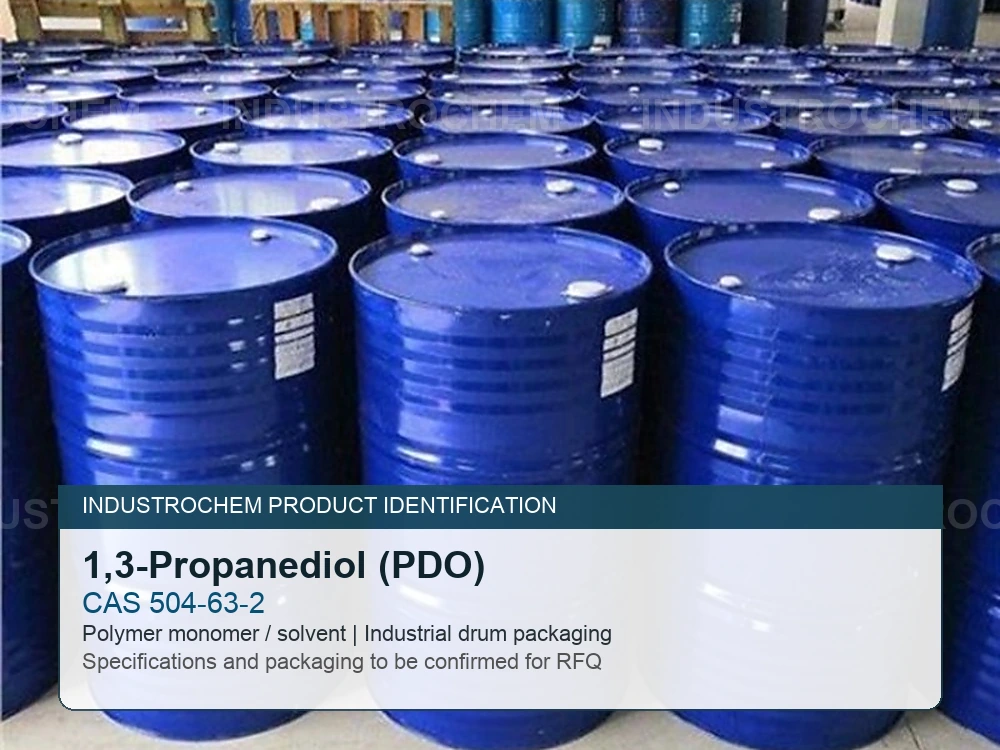
1,3-Propanediol (PDO) CAS 504-63-2

1,3-Propanediol (PDO) is a linear aliphatic diol identified by CAS 504-63-2. It is mainly evaluated as a polyester monomer, solvent, and intermediate; do not confuse it with 1,2-propanediol. For an RFQ, state the intended use, required specification, quantity, packaging, destination, and document needs.

  • CAS: 504-63-2
  • Synonyms: Propane-1,3-diol; Trimethylene Glycol; 1,3-Dihydroxypropane; PDO; 1,3-Propylene Glycol
  • Einecs: 207-997-3
  • Molecular Formula: C₃H₈O₂
  • Grade: Confirm the current product-specific specification.
  • Package: Confirm packaging requirements for the proposed material and destination.
Request a quote
Share:

Product Description

1,3-Propanediol (PDO) is a linear aliphatic diol identified by CAS 504-63-2.

Synonyms: Propane-1,3-diol; Trimethylene Glycol; 1,3-Dihydroxypropane; PDO; 1,3-Propylene Glycol.

CAS: 504-63-2.

EINECS / EC: 207-997-3.

Molecular formula: C₃H₈O₂.

Common commercial form is a colorless liquid; confirm bio-based or synthetic origin only if it matters to the buyer’s specification.

It is mainly evaluated as a polyester monomer, solvent, and intermediate; do not confuse it with 1,2-propanediol.

Confirm the current product-specific specification.

Confirm packaging requirements for the proposed material and destination.

Document requirements should be confirmed from the current specification, SDS, COA, or other product-specific files.

Regulated-use suitability must be confirmed separately with current product-specific documentation.

The page is an RFQ entry point and does not state stock, price, MOQ, or fixed lead time.

For an RFQ, state the intended use, required specification, quantity, packaging, destination, and document needs.

FAQ - Technical & Supply Chain

  • Q:

    Is 1,3-Propanediol the same as propylene glycol?

    A: No. 1,3-Propanediol, also called trimethylene glycol or PDO, has the formula C₃H₈O₂ and CAS 504-63-2, with hydroxyl groups at positions 1 and 3. Propylene glycol is 1,2-propanediol with a different structure, CAS number and property profile.
  • Q:

    What are the key physical properties of 1,3-Propanediol?

    A: It is typically a colorless to light yellow liquid with a melting point around -27 deg C, boiling point about 214 deg C and density about 1.05 g/cm³. It is miscible with water and many polar organic solvents.
  • Q:

    Which specifications should be confirmed for PDO?

    A: Confirm assay, water content, color, density, distillation range and carbonyl or low-boiling impurity limits. Common commercial material is about 99% or higher, but polyester, pharmaceutical and solvent uses can require different impurity controls.
  • Q:

    What are the main uses of 1,3-Propanediol?

    A: Its largest industrial use is as a monomer for polytrimethylene terephthalate and related polyesters. It is also used in polyurethane or copolyester systems, solvents, pharmaceutical intermediates, cosmetics and personal-care formulations, and specialty synthesis.
  • Q:

    Should the origin of 1,3-Propanediol be specified?

    A: PDO is available from both synthetic and bio-based routes. If renewable content, traceability or a specific supplier process is required, state that preference because otherwise the quotation will not define origin and the same CAS 504-63-2 may cover either source.

Ordering & Documentation

Key information for document requests, quotations, and supply planning.

Documents

COA, TDS, SDS/MSDS and packing details are available on request.

Quotation

Send the CAS number, grade, quantity, packing preference and destination.

Sample & Supply

Support is available for samples, trial orders, bulk and repeat supply.

Storage & Shipping

Product-specific conditions are confirmed before order.

Contact Form

Use our contact form to send us your questions, suggestions or comments. We will respond as soon as possible.
For a quotation, please include the product name or CAS number, quantity, grade or application, and destination country or port. Tell us if you need a sample, COA, TDS or SDS.