










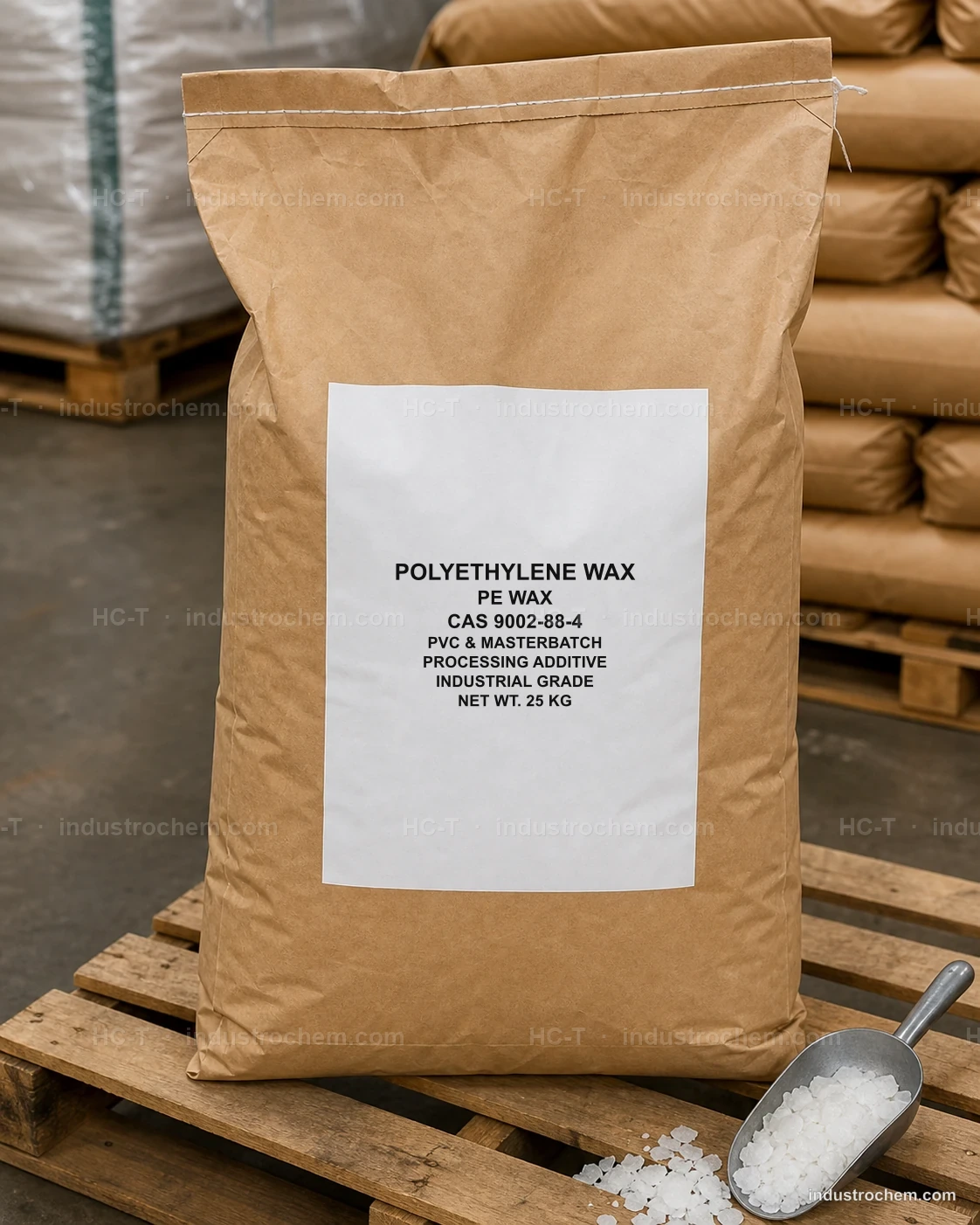
Polyethylene Wax, commonly abbreviated PE Wax, CAS 9002-88-4, is a low-molecular-weight wax supplied for PVC processing, masterbatch, coatings and hot-melt formulations. Confirm the required grade, then request a quotation with COA/TDS/SDS for bulk supply.
Polyethylene Wax (PE Wax) CAS 9002-88-4
- CAS: 9002-88-4
- Synonyms: Polyethylene wax; PE wax; Low molecular weight polyethylene wax
- Einecs: Not specified (polymeric product)
- Molecular Formula: (C2H4)n
- Grade: Industrial wax grade; choose by drop point, viscosity, density and application profile
- Package: 25 kg bags for flakes, powder or granules; larger packs available subject to agreed grade and shipment requirements
Product Description
Polyethylene Wax (PE Wax) CAS 9002-88-4 is a low-molecular-weight polyethylene homopolymer with molecular formula (C2H4)n.
Synonyms: Polyethylene wax; PE wax; low molecular weight polyethylene wax.
CAS: 9002-88-4.
Molecular formula: (C2H4)n.
It is supplied as white powder, flakes, granules or micronized powder.
It is used mainly as a lubricant, dispersion carrier and surface modifier in plastics, coatings, inks and adhesives.
It has a sharp melting range and low melt viscosity compared with high-molecular-weight polyethylene resin.
It is used as an external lubricant in PVC extrusion and moulding.
It is used as a pigment carrier and wetting agent in masterbatches, and as a matting, anti-scratch or slip additive in coatings and printing inks.
It also adjusts viscosity and set time in hot-melt adhesives and raises hardness or melting point in candle wax blends.
During PVC compounding, PE wax migrates to the polymer-metal interface and reduces melt friction, extruder torque and die build-up.
Grades are selected by drop point, viscosity and physical form.
For purchasing, compare physical form, drop point or melting range, melt viscosity, density, penetration, colour and ash; for oxidized grades compare acid value.
Keep containers closed and follow the current SDS for storage and handling.
Use suitable PPE and exposure controls when handling the material.
Confirm physical form, drop point, viscosity and density on the COA.
Confirm grade, packaging, and specification as required.
The page is an RFQ entry point and does not state stock, price, MOQ, or fixed lead time.
For an RFQ, state the intended application, required grade, quantity, packaging, destination, and document needs.
FAQ - Technical & Supply Chain
-
Q:
What is Polyethylene Wax (PE Wax) CAS 9002-88-4?
A: Polyethylene wax, abbreviated PE wax, is a low-molecular-weight polyethylene homopolymer supplied as white powder, flakes, granules or micronized powder. It has CAS 9002-88-4 and is used mainly as a lubricant, dispersion carrier and surface modifier in plastics, coatings, inks and adhesives. -
Q:
Why is PE wax described as low-molecular-weight polyethylene?
A: PE wax is made from relatively short polyethylene chains, typically with a molecular weight in the range of about 1,500-8,000 g/mol depending on the grade. This gives it a sharp melting range and low melt viscosity compared with high-molecular-weight polyethylene resin, which is what makes it useful as a processing aid. -
Q:
What are the main applications of PE wax?
A: PE wax is used as an external lubricant in PVC extrusion and moulding, a pigment carrier and wetting agent in masterbatches, and a matting, anti-scratch or slip additive in coatings and printing inks. It also adjusts viscosity and set time in hot-melt adhesives and raises hardness or melting point in candle wax blends. -
Q:
How does PE wax work as a PVC lubricant?
A: During PVC compounding, PE wax migrates to the polymer-metal interface and reduces melt friction, extruder torque and die build-up. This helps improve throughput, surface finish and release without acting as the primary internal plasticizer. -
Q:
Which specification parameters should be compared between PE wax grades?
A: Compare physical form, drop point or melting range, melt viscosity at a stated temperature, density, penetration, colour and ash. For oxidized grades also compare acid value, because that functional content changes compatibility and performance in PVC, coatings and inks. -
Q:
Can PE wax replace oxidized polyethylene wax?
A: Not automatically. Oxidized polyethylene wax contains polar oxygen-containing groups, giving it different compatibility and often a measurable acid value. A standard non-polar PE wax may not provide the same wetting, dispersion or adhesion in formulations that were designed around an oxidized grade.
Ordering & Documentation
Key information for document requests, quotations, and supply planning.
Documents
Tell us which documents your procurement team needs. Before an order, we will check whether the quoted source can provide them for the offered lot.
Quotation
Send the CAS number, grade, quantity, packing preference and destination.
Sample & Supply
Ask whether samples, trial quantities or repeat orders are possible. We will check each request against the sourced product and current offer.
Storage & Shipping
Product-specific conditions are confirmed before order.