










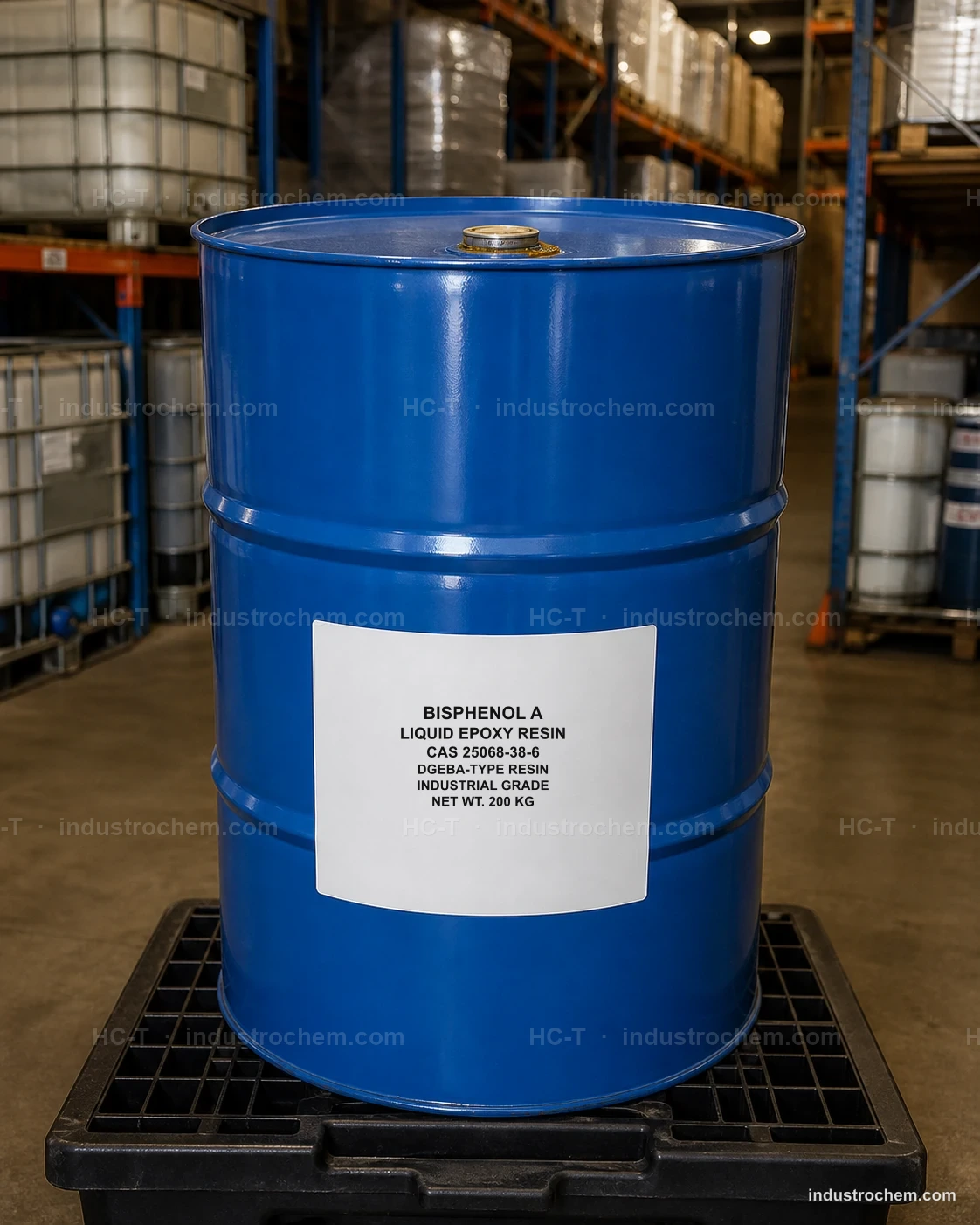
Bisphenol A Liquid Epoxy Resin, a DGEBA-type epoxy resin, CAS 25068-38-6, is an epoxy binder supplied for industrial coatings, adhesives, castings and composites. Confirm the required grade, then request a quotation with COA/TDS/SDS for bulk supply.
Bisphenol A Liquid Epoxy Resin (DGEBA-type epoxy resin) CAS 25068-38-6
- CAS: 25068-38-6
- Synonyms: Bisphenol A liquid epoxy resin; Bisphenol A-epichlorohydrin resin; DGEBA-type epoxy resin
- Einecs: Not specified (oligomeric epoxy resin)
- Molecular Formula: Not specified (oligomeric epoxy resin)
- Grade: Industrial liquid epoxy resin; epoxy equivalent weight and viscosity selected for the formulation
- Package: Steel drums or IBCs for liquid resin grades; final pack and storage conditions confirmed for the shipment
Product Description
Bisphenol A Liquid Epoxy Resin (DGEBA-type epoxy resin) CAS 25068-38-6 is an oligomeric thermosetting resin based on bisphenol A diglycidyl ether.
Synonyms: Bisphenol A liquid epoxy resin; bisphenol A-epichlorohydrin resin; DGEBA-type epoxy resin.
CAS: 25068-38-6.
Molecular formula: Not specified (oligomeric epoxy resin).
It is supplied as a clear to pale-yellow viscous liquid.
It cures with hardeners such as amines or anhydrides to form a hard, adherent network.
Epoxy equivalent weight, or EEW, sets the hardener demand for complete cure.
It is used in protective and marine coatings, industrial paints, concrete floor coatings, structural adhesives and potting compounds.
It also serves as a base resin in printed-circuit-board laminates, civil-engineering grouts and anchoring systems.
BADGE is the pure difunctional monomer with CAS 1675-54-3; commercial liquid resin CAS 25068-38-6 is its oligomeric distribution.
Grades are selected by epoxy equivalent weight and viscosity.
Low-viscosity and standard liquid grades can differ in processing behaviour even with the same CAS number.
For purchasing, compare EEW, viscosity at 25 C, colour, density, hydrolyzable or total chlorine and reactivity with the hardener.
Keep containers closed and follow the current SDS for storage conditions.
Use suitable PPE and exposure controls when handling the resin.
Confirm EEW, viscosity, colour and density on the COA.
Confirm grade, packaging, and specification as required.
The page is an RFQ entry point and does not state stock, price, MOQ, or fixed lead time.
For an RFQ, state the intended application, required grade, quantity, packaging, destination, and document needs.
FAQ - Technical & Supply Chain
-
Q:
What is Bisphenol A Liquid Epoxy Resin CAS 25068-38-6?
A: Bisphenol A liquid epoxy resin is an oligomeric thermosetting resin based on bisphenol A diglycidyl ether chemistry, commonly called DGEBA. It has CAS 25068-38-6 and is supplied as a clear to pale-yellow viscous liquid that cures with hardeners such as amines or anhydrides to form a hard, adherent network. -
Q:
Why is epoxy equivalent weight important for this resin?
A: Epoxy equivalent weight, or EEW, is the grams of resin containing one equivalent of epoxide groups, and it directly sets the hardener demand for a complete cure. Matching EEW to the curing agent and formulation avoids incorrect stoichiometry that can reduce hardness, adhesion, chemical resistance and final crosslink density. -
Q:
What are the main applications of bisphenol A liquid epoxy resin?
A: It is used in protective and marine coatings, industrial paints, concrete floor coatings, structural adhesives, potting and encapsulation compounds, and composite laminates. It also serves as a base resin in printed-circuit-board laminates, civil-engineering grouts and anchoring systems. -
Q:
How does DGEBA liquid resin relate to the BADGE monomer?
A: BADGE is bisphenol A diglycidyl ether, the pure difunctional monomer with its own CAS 1675-54-3. Commercial liquid epoxy resin CAS 25068-38-6 is the oligomeric polymer built on that BADGE backbone, so it is a distribution of related molecules rather than a single pure compound. -
Q:
Which specification parameters should be compared between liquid epoxy grades?
A: Compare epoxy equivalent weight, viscosity at 25 deg C, colour, density, hydrolyzable or total chlorine and, where relevant, gel time or reactivity with the chosen hardener. Low-viscosity and standard liquid grades can have quite different processing behaviour even when their CAS number is the same. -
Q:
Are all bisphenol A epoxy resin grades interchangeable?
A: No. Liquid, semi-solid and advanced solid grades differ in molecular-weight distribution, epoxy equivalent weight, viscosity and residual limits, which changes mixing, wet-out and final cured properties. The resin must be selected together with the curing agent and target application.
Ordering & Documentation
Key information for document requests, quotations, and supply planning.
Documents
Tell us which documents your procurement team needs. Before an order, we will check whether the quoted source can provide them for the offered lot.
Quotation
Send the CAS number, grade, quantity, packing preference and destination.
Sample & Supply
Ask whether samples, trial quantities or repeat orders are possible. We will check each request against the sourced product and current offer.
Storage & Shipping
Product-specific conditions are confirmed before order.