










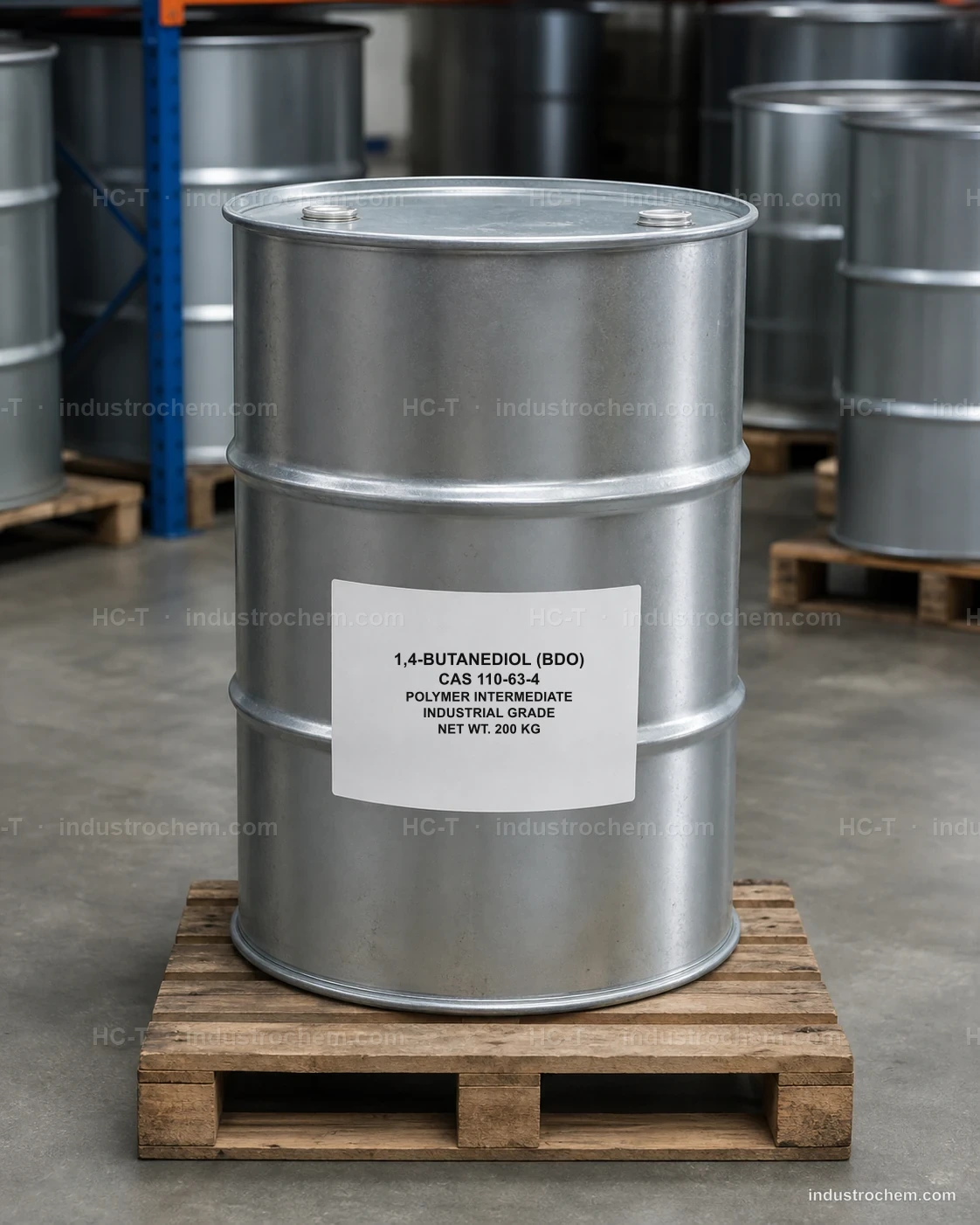
1,4-Butanediol, commonly abbreviated BDO, CAS 110-63-4, is a bifunctional intermediate supplied for polyesters, polyurethanes, solvents and technical plastics. Confirm the required grade, then request a quotation with COA/TDS/SDS for bulk supply.
1,4-Butanediol (BDO) CAS 110-63-4
- CAS: 110-63-4
- Synonyms: 1,4-Butanediol; BDO; Butane-1,4-diol; 1,4-Butylene glycol
- Einecs: 203-786-5
- Molecular Formula: C4H10O2
- Grade: Industrial diol grade; assay, water and colour limits selected for the polymer or process route
- Package: Steel drums, IBCs or bulk liquid delivery; use temperature-controlled logistics where needed for the supplied product
Product Description
1,4-Butanediol (BDO) CAS 110-63-4 is butane-1,4-diol, with EC 203-786-5 and molecular formula C4H10O2.
Synonyms: 1,4-Butanediol; BDO; butane-1,4-diol; 1,4-butylene glycol.
CAS: 110-63-4.
Molecular formula: C4H10O2.
It is supplied as a clear, colourless, water-miscible liquid that can solidify near its melting point of about 20 C.
It is a key monomer for polybutylene terephthalate engineering plastic and a chain extender in polyurethane systems.
It is also used to make spandex-related intermediates, tetrahydrofuran, gamma-butyrolactone and polybutylene succinate.
In PBT, BDO reacts with terephthalic acid or dimethyl terephthalate to form the butylene repeat unit.
In polyurethane systems, its two hydroxyl groups act as a short-chain diol or chain extender influencing hard-segment structure and modulus.
It is also used as an industrial solvent and chemical intermediate.
Because its melting point is close to ambient, it may partially freeze during cool storage or transport and need gentle warming.
Industrial grades are selected by assay, water and colour.
For purchasing, compare assay or purity, water, colour, density, acidity or carbonyl impurities and trace metals.
Keep containers closed and use temperature-controlled logistics where needed.
Use suitable PPE and exposure controls when handling the material.
Confirm assay, water, colour and acidity on the COA.
Confirm grade, packaging, and specification as required.
The page is an RFQ entry point and does not state stock, price, MOQ, or fixed lead time.
For an RFQ, state the intended application, required grade, quantity, packaging, destination, and document needs.
FAQ - Technical & Supply Chain
-
Q:
What is 1,4-Butanediol (BDO) CAS 110-63-4?
A: 1,4-Butanediol, abbreviated BDO, is a linear bifunctional C4 diol with CAS 110-63-4 and molecular formula C4H10O2. It has a molecular weight of about 90.12 g/mol and is supplied as a clear, colourless, water-miscible liquid that can solidify near its melting point of about 20 deg C. -
Q:
Why can BDO arrive partly solid at room temperature?
A: BDO has a melting point of about 19-20 deg C, very close to normal ambient conditions. During cool storage or transport it can therefore partially freeze, and it may need gentle warming or controlled-temperature logistics before it is pumped or metered. -
Q:
What are the main applications of BDO?
A: BDO is a key monomer for polybutylene terephthalate engineering plastic and is used as a chain extender in polyurethane elastomers, coatings, adhesives, sealants and foams. It is also used to make spandex-related intermediates, tetrahydrofuran, gamma-butyrolactone, polybutylene succinate and selected polyester resins. -
Q:
How is BDO used in PBT and polyurethane systems?
A: In PBT, BDO reacts with terephthalic acid or dimethyl terephthalate to form the butylene repeat unit of the polyester. In polyurethane systems, its two hydroxyl groups act as a short-chain diol component or chain extender that influences hard-segment structure, modulus and final mechanical properties. -
Q:
Which specification parameters should be compared between BDO grades?
A: Compare assay or purity, water, colour, density, acidity or carbonyl-related impurities and any trace metals that can affect polymer colour or catalyst performance. High-purity or pharmaceutical grades may have tighter limits than standard industrial diol. -
Q:
Can BDO be replaced by 1,6-hexanediol?
A: No, not as a direct substitute. Both are linear diols, but the longer six-carbon chain in 1,6-hexanediol changes reaction rate, crystallinity, flexibility and polymer physical properties, so the downstream polyester or polyurethane formulation would need to be redesigned.
Ordering & Documentation
Key information for document requests, quotations, and supply planning.
Documents
Tell us which documents your procurement team needs. Before an order, we will check whether the quoted source can provide them for the offered lot.
Quotation
Send the CAS number, grade, quantity, packing preference and destination.
Sample & Supply
Ask whether samples, trial quantities or repeat orders are possible. We will check each request against the sourced product and current offer.
Storage & Shipping
Product-specific conditions are confirmed before order.