










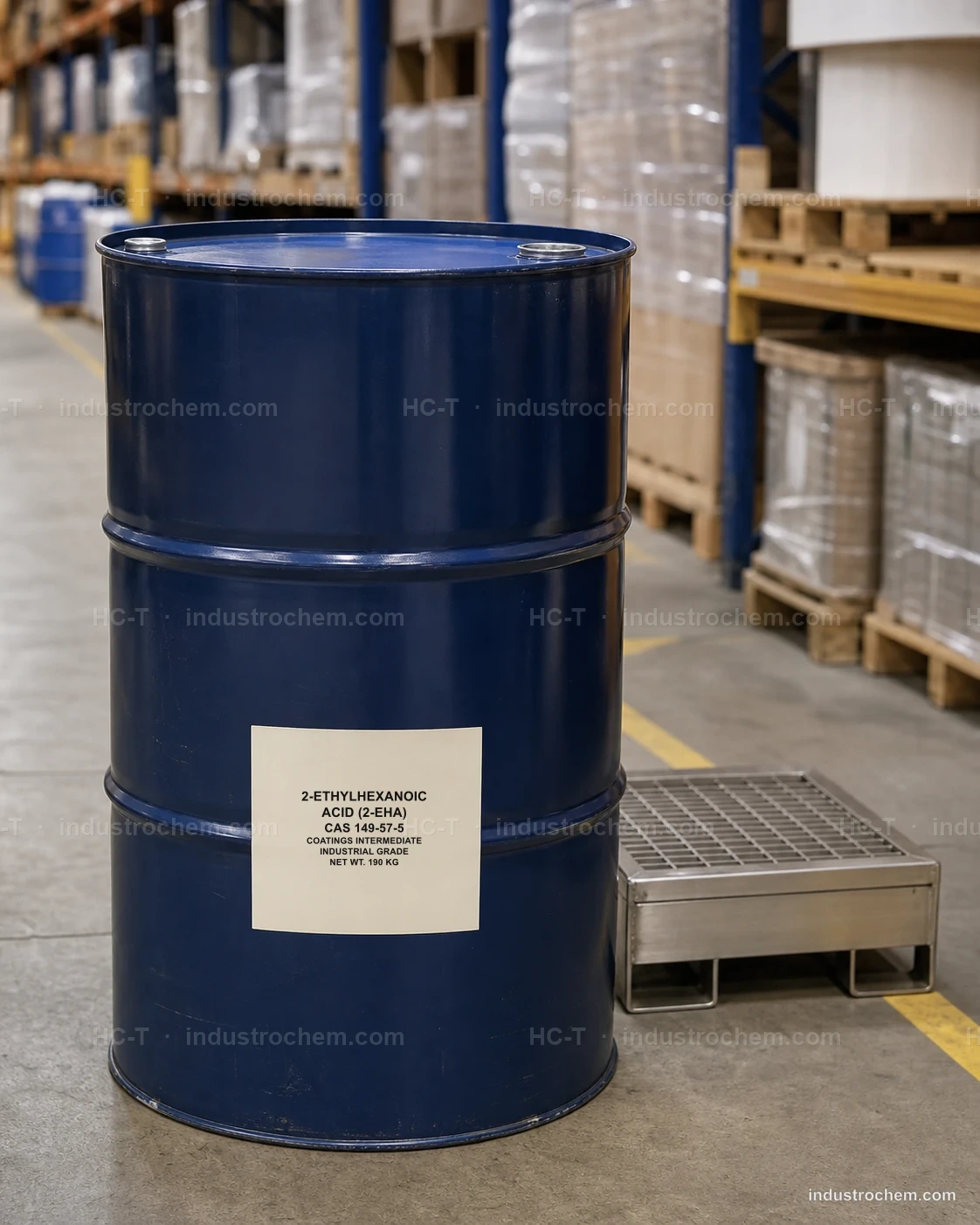
2-Ethylhexanoic Acid, commonly abbreviated 2-EHA, CAS 149-57-5, is a monocarboxylic-acid intermediate supplied for metal carboxylates, alkyd resins and synthetic esters. Confirm the required grade, then request a quotation with COA/TDS/SDS for bulk supply.
2-Ethylhexanoic Acid (2-EHA) CAS 149-57-5
- CAS: 149-57-5
- Synonyms: 2-Ethylhexanoic acid; 2-EHA; Ethylhexanoic acid; 2-Ethylcaproic acid
- Einecs: 205-743-6
- Molecular Formula: C8H16O2
- Grade: Industrial monocarboxylic acid grade; purity, water and colour confirmed for the process
- Package: Steel drums, IBCs or bulk liquid delivery, subject to agreed product and destination requirements
Product Description
2-Ethylhexanoic Acid (2-EHA) CAS 149-57-5 is 2-ethylcaproic acid, with EC 205-743-6 and molecular formula C8H16O2.
Synonyms: 2-Ethylhexanoic acid; 2-EHA; ethylhexanoic acid; 2-ethylcaproic acid.
CAS: 149-57-5.
Molecular formula: C8H16O2.
It is normally supplied as a colourless to pale liquid with a mild characteristic odour.
It is a branched C8 monocarboxylic acid used to make metal carboxylates, ester lubricants, resin modifiers and polymer-processing auxiliaries.
The branched 2-ethylhexyl group gives carboxylate derivatives good solubility in non-polar solvents and organic media.
It is used to make oil-soluble metal soaps for paint driers, alkyd resin catalysts and PVC stabilizers.
It is also used in PVB plasticizers, synthetic lubricant esters, coolant corrosion inhibitors and selected fragrance or pharmaceutical intermediates.
In coatings, its cobalt or manganese carboxylates catalyse the oxidative drying of alkyd paints.
In PVC processing, its metal salts act as heat stabilizers during compounding and thermal processing.
Industrial grades are controlled by purity, water and colour.
For purchasing, compare assay or purity, colour, water, acid value, density and trace metal or oxidation-related impurities.
Keep containers closed and follow the current SDS for storage and transport classification.
Use suitable PPE and exposure controls when handling the material.
Confirm purity, water, colour and acid value on the COA.
Confirm grade, packaging, and specification as required.
The page is an RFQ entry point and does not state stock, price, MOQ, or fixed lead time.
For an RFQ, state the intended application, required grade, quantity, packaging, destination, and document needs.
FAQ - Technical & Supply Chain
-
Q:
What is 2-Ethylhexanoic Acid (2-EHA) CAS 149-57-5?
A: 2-Ethylhexanoic Acid, abbreviated 2-EHA, is a branched C8 monocarboxylic acid with CAS 149-57-5 and molecular formula C8H16O2. Its molecular weight is about 144.21 g/mol, and it is normally supplied as a colourless to pale liquid with a mild characteristic odour. -
Q:
Why is 2-EHA used to make oil-soluble metal soaps?
A: The branched 2-ethylhexyl group gives the carboxylate derivatives good solubility in non-polar solvents and organic media. This makes 2-EHA especially useful for preparing cobalt, manganese, zinc, tin and other metal salts that must dissolve readily in coatings, lubricants and plastic formulations. -
Q:
What are the main applications of 2-EHA?
A: 2-EHA is used to make metal soaps for paint driers, alkyd resin catalysts and PVC stabilizers, and as a raw material for PVB plasticizers and synthetic lubricant esters. It is also used in automotive coolant corrosion inhibitors, emollients, acid chlorides, polymer catalysts, wood preservatives and selected fragrance or pharmaceutical intermediates. -
Q:
How is 2-EHA used in paint driers and PVC stabilizers?
A: In coatings, 2-EHA is converted into oil-soluble cobalt, manganese or other metal carboxylates that catalyse the oxidative drying of alkyd paints. In PVC processing, its metal salts act as heat stabilizers that help protect the polymer from dehydrochlorination during compounding and thermal processing. -
Q:
Which specification parameters should be compared between 2-EHA grades?
A: Compare assay or purity, colour, water, acid value, density and any trace metal or oxidation-related impurities. The required purity and colour often depend on whether the acid is used for a sensitive ester, a paint-drier metal soap or an industrial intermediate. -
Q:
Is 2-EHA the same as octanoic acid?
A: No. 2-EHA is the branched 2-ethyl-substituted C8 acid, while octanoic acid is the straight-chain C8 carboxylic acid. The branched structure of 2-EHA gives its metal salts and esters different oil solubility, viscosity and derivative properties, so the two are not direct replacements.
Ordering & Documentation
Key information for document requests, quotations, and supply planning.
Documents
Tell us which documents your procurement team needs. Before an order, we will check whether the quoted source can provide them for the offered lot.
Quotation
Send the CAS number, grade, quantity, packing preference and destination.
Sample & Supply
Ask whether samples, trial quantities or repeat orders are possible. We will check each request against the sourced product and current offer.
Storage & Shipping
Product-specific conditions are confirmed before order.