






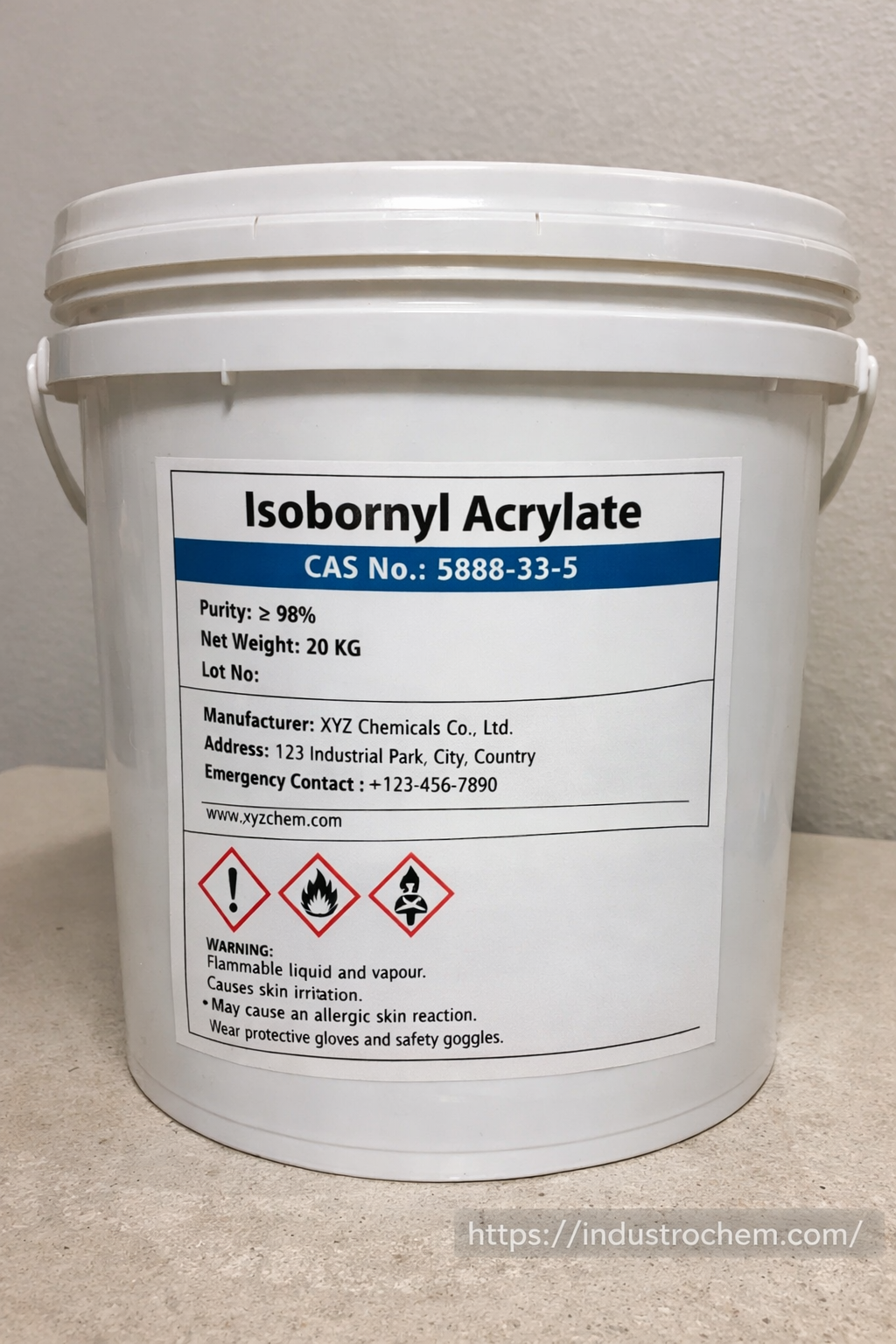
Isobornyl Acrylate CAS 5888-33-5 is a functional acrylate monomer commonly used in UV-curable and radiation-curable formulation systems where reactive dilution, hardness development, and formulation balance are required. It is widely selected for coatings, inks, adhesives, and related resin applications that require a monofunctional acrylate with good compatibility in polymerizable systems. Where a multifunctional acrylate crosslinking component is specified, Trimethylolpropane Triacrylate (TMPTA) is a related material to assess within the full curing package. As a supplier and manufacturer, we support bulk supply, standard packaging, and document support including COA, TDS, and SDS / MSDS. Sample discussion, grade selection, and formulation-oriented sourcing support can be arranged based on project requirements. Final suitability should be confirmed according to curing system, formulation design, and end-use performance targets.
Isobornyl Acrylate CAS 5888-33-5
- CAS: 5888-33-5
- Synonyms: Acrylic Acid Isobornyl Ester; IBOA; Exo-1,7,7-trimethylbicyclo[2.2.1]hept-2-yl acrylate
- Einecs: 227-561-6
- Molecular Formula: C13H20O2
- Grade: Industrial Grade / Fine Chemical Grade
- Package: Common export packing includes 25 kg drum and 200 kg drum; customized packing can be arranged
Product Description
Typical Applications
Isobornyl Acrylate CAS 5888-33-5 is commonly used in:
- UV-curable coatings
- radiation-curable inks
- adhesive and sealant formulations
- specialty resin and polymer systems
- coating and ink systems where reactive dilution and performance balance are required
Application suitability should be confirmed through formulation testing based on curing conditions, resin selection, viscosity target, and final film-performance requirements. Commercial references also associate this substance with paints, coatings, adhesives, sealants, inks, and related materials.
Functional Role
In formulation systems, Isobornyl Acrylate is commonly selected for functions such as:
- reactive dilution
- monomer incorporation in curable systems
- viscosity adjustment within polymerizable formulations
- hardness and performance balance in cured films
- compatibility support in acrylate-based systems
Industry references describe it specifically as a mono-functional reactive diluent that polymerizes under free-radical conditions, with use in coatings and inks.
In UV-curable formulations requiring a hydroxy-functional reactive monomer rather than a hydrophobic reactive diluent, 2-Hydroxyethyl Acrylate is a separate acrylate monomer to evaluate.
Packaging
Available in standard packaging for bulk supply.
Packaging options can be discussed based on order quantity, inhibitor system, transport requirements, and project needs.
Storage
Store in tightly closed original containers in a cool, dry, and well-ventilated area.
Because public supplier references show commercial grades commonly stabilized with inhibitor, storage and handling should follow the applicable SDS and product documentation to maintain stability during transport and use.
Documents Available
Documents for Isobornyl Acrylate CAS 5888-33-5 can be supported upon request, including:
- COA
- TDS
- SDS / MSDS
Public product pages for this material also show routine availability of technical and safety documentation.
Supply Ability / Custom Support
We supply Isobornyl Acrylate CAS 5888-33-5 for customers involved in UV materials, coatings, inks, adhesives, and specialty resin sourcing projects. Support can be discussed for:
- bulk supply
- standard packaging
- sample evaluation
- inhibitor and grade discussion
- document coordination
- formulation-oriented sourcing support
Final grade selection should be based on the curing process, resin system, and performance requirements of the target application.
FAQ - Technical & Supply Chain
-
Q:
What is Isobornyl Acrylate CAS 5888-33-5?
A: Isobornyl Acrylate, commonly abbreviated IBOA, is a monofunctional acrylate monomer with CAS 5888-33-5, EC 227-561-6, and molecular formula C13H20O2. It is supplied as a clear to pale liquid raw material for free-radical curing systems. Confirm the offered inhibitor system, purity, and grade before selection. -
Q:
Where is Isobornyl Acrylate mainly used?
A: It is mainly used in UV/EB-curable coatings, radiation-curable inks, adhesives, sealants, and acrylate-based resin formulations. IBOA is selected as a reactive diluent and hardness-building monomer rather than as a finished resin. Final suitability should be confirmed in the target formulation and curing process. -
Q:
Why is Isobornyl Acrylate used as a reactive diluent?
A: IBOA lowers formulation viscosity while participating in free-radical polymerization, so it can reduce solvent demand and contribute film hardness. Because it is monofunctional, it affects cure balance differently from multifunctional monomers. The optimal loading depends on resin type, cure conditions, viscosity target, and required mechanical properties. -
Q:
What specifications should be checked for Isobornyl Acrylate?
A: Key items include appearance, purity or assay, acid value, moisture, color, viscosity, density, refractive index, and inhibitor content. Commercial grades are commonly stabilized with MEHQ, so confirm the inhibitor level and grade-specific storage stability before ordering. -
Q:
How should Isobornyl Acrylate be stored and handled?
A: Store it in tightly closed original containers in a cool, dry, well-ventilated area away from heat, ignition sources, direct sunlight, and strong oxidizers. Maintain the recommended inhibitor and oxygen protection, use appropriate PPE, and follow the supplied safety and handling information for the selected grade.
Ordering & Documentation
Key information for document requests, quotations, and supply planning.
Documents
COA, TDS, SDS/MSDS and packing details are available on request.
Quotation
Send the CAS number, grade, quantity, packing preference and destination.
Sample & Supply
Support is available for samples, trial orders, bulk and repeat supply.
Storage & Shipping
Product-specific conditions are confirmed before order.


