










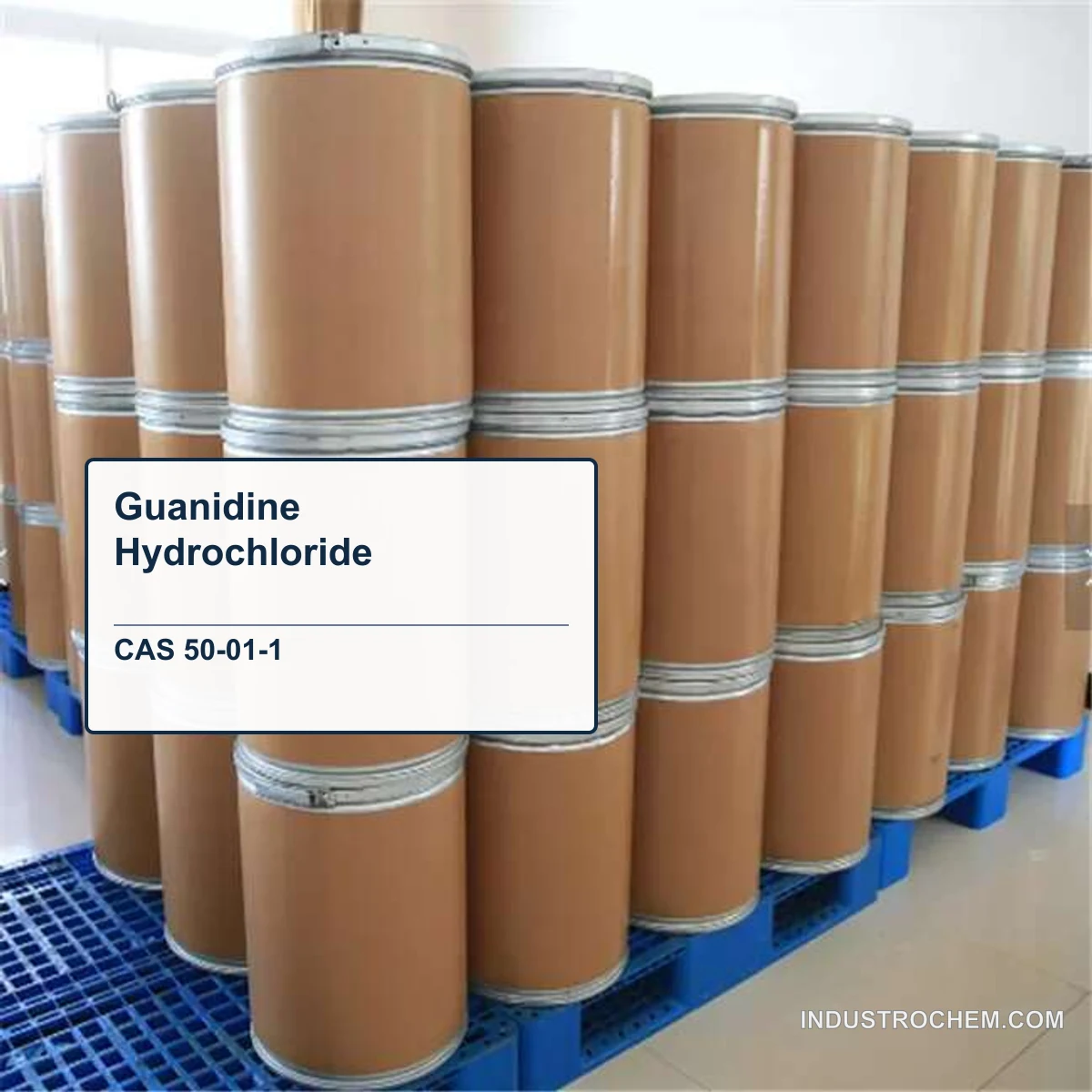
Guanidine Hydrochloride CAS 50-01-1 is a guanidine salt used as a chaotropic reagent and chemical synthesis intermediate where the intended use is supported by current documentation. Confirm grade, assay, impurities, application boundary, quantity, packaging, destination, and required documents before quotation.
Guanidine Hydrochloride CAS 50-01-1
- CAS: 50-01-1
- Synonyms: Guanidine hydrochloride, Guanidinium chloride, Guanidine monohydrochloride, Aminoformamidine hydrochloride, Guanidinium HCl
- Einecs: 200-002-3
- Molecular Formula: CH₆ClN₃
- Grade: Confirm the current product-specific specification.
- Package: Confirm packaging requirements with quantity, destination, and handling needs.
Product Description
Guanidine Hydrochloride is a guanidine salt identified by CAS 50-01-1.
Synonyms: Guanidine hydrochloride; Guanidinium chloride; Guanidine monohydrochloride; Aminoformamidine hydrochloride; Guanidinium HCl.
CAS: 50-01-1.
EINECS / EC: 200-002-3.
Molecular formula: CH₆ClN₃.
Confirm grade, assay, related impurities, melting range, application, quantity, packaging, and documents before purchase.
It is mainly evaluated as a chaotropic reagent and chemical synthesis intermediate where the intended use is supported by current documentation.
Confirm the current product-specific specification.
Confirm packaging requirements with quantity, destination, and handling needs.
Document requirements should be confirmed from the current specification, SDS, COA, or other product-specific files.
Regulated-use suitability must be confirmed separately with current product-specific documentation.
The page is an RFQ entry point and does not state stock, price, MOQ, or fixed lead time.
For an RFQ, state the intended use, required specification, quantity, packaging, destination, and document needs.
FAQ - Technical & Supply Chain
-
Q:
Are Guanidine Hydrochloride, Guanidinium chloride and Guanidine HCl the same?
A: Yes. These names refer to the same CAS 50-01-1 identity, with the formula commonly written as CH₆ClN₃ or CH₆N₃·Cl and a molecular weight of about 95.53. Still state the CAS number and required grade because technical, synthesis and molecular-biology grades are not automatically interchangeable. -
Q:
Why is Guanidine Hydrochloride used in RNA isolation and protein work?
A: Guanidine Hydrochloride is a strong chaotropic agent that helps dissociate nucleoproteins, inhibit RNase and denature proteins. This makes it useful for RNA extraction from cell extracts, solubilizing insoluble or denatured proteins such as inclusion bodies, and protein refolding studies. -
Q:
Which specifications should be compared for Guanidine Hydrochloride?
A: Confirm appearance, assay and method, melting range, water or loss on drying, pH of a stated solution, related amine impurities and residue on ignition. Typical high-purity material is a white crystalline powder with assay about 99.5% or higher and a melting range near 181-185 °C, but exact limits depend on grade. -
Q:
Can a technical grade replace molecular-biology or pharmaceutical grade?
A: No. A CAS match does not establish compendial, GMP or molecular-biology suitability. RNA isolation and sensitive protein work generally require a low-absorbance, high-purity grade with controlled impurity limits, so confirm the intended application before accepting a grade. -
Q:
How should Guanidine Hydrochloride be stored and handled?
A: Store in tightly closed, moisture-protective containers in a cool, dry, ventilated area. Avoid dust generation, keep away from strong oxidizers and incompatible materials, and use appropriate PPE. Long-term storage may require an inert atmosphere; confirm the current safety information for spill, fire and occupational-hygiene controls.
Ordering & Documentation
Key information for document requests, quotations, and supply planning.
Documents
Tell us which documents your procurement team needs. Before an order, we will check whether the quoted source can provide them for the offered lot.
Quotation
Send the CAS number, grade, quantity, packing preference and destination.
Sample & Supply
Ask whether samples, trial quantities or repeat orders are possible. We will check each request against the sourced product and current offer.
Storage & Shipping
Product-specific conditions are confirmed before order.