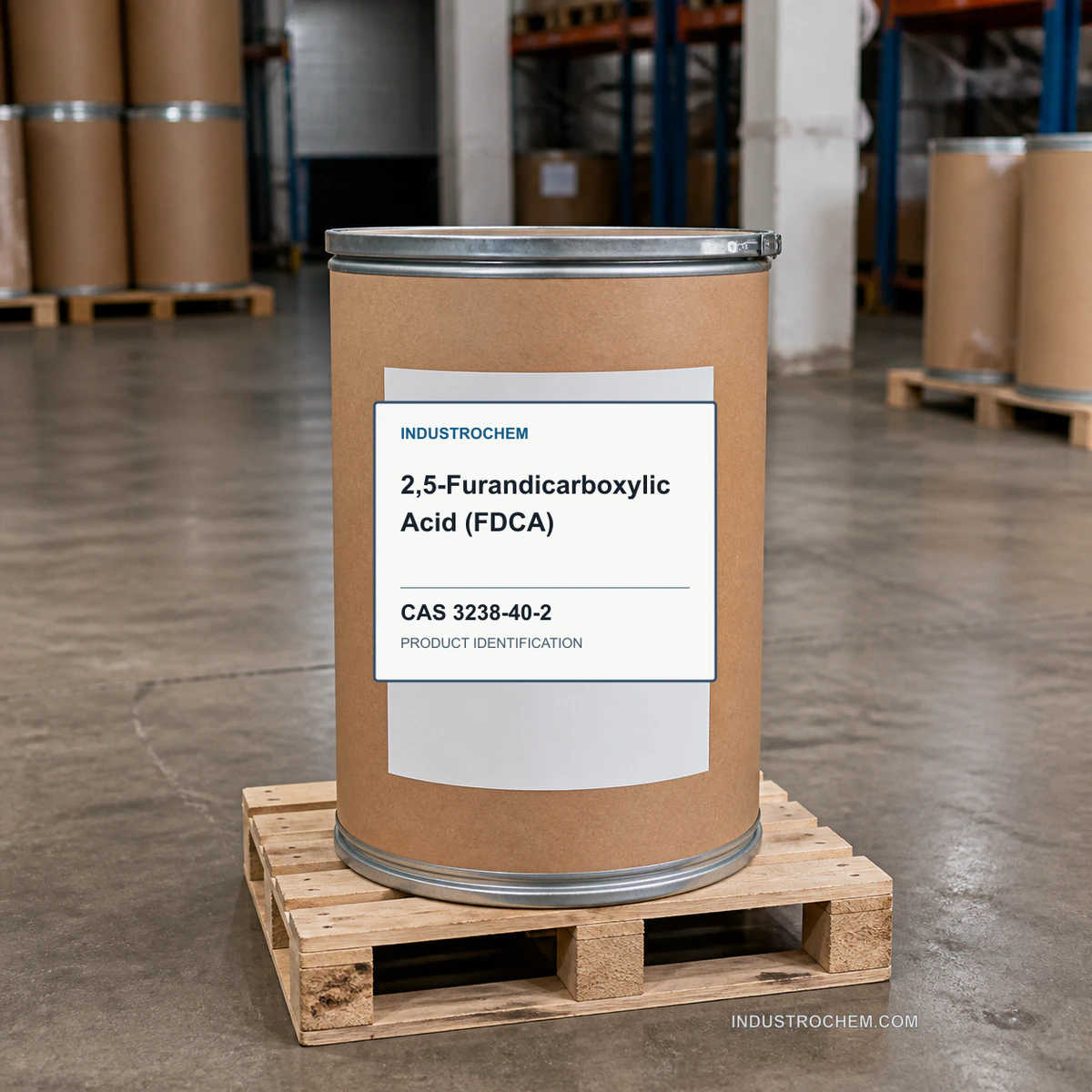
2,5-Furandicarboxylic Acid (FDCA) is a furan dicarboxylic acid used as a monomer candidate in polymer-development work. Confirm product-specific physical form, purity-related limits, and handling requirements before evaluation.
2,5-Furandicarboxylic Acid (FDCA) CAS 3238-40-2
- CAS: 3238-40-2
- Synonyms: FDCA; 2,5-Furandicarboxylic acid; Furan-2,5-dicarboxylic acid
- Einecs: 221-800-8
- Molecular Formula: C₆H₄O₅
- Grade: Confirm the current product-specific specification.
- Package: Confirm packaging with the requested quantity and destination requirements.
Product Description
2,5-Furandicarboxylic Acid (FDCA) is a furan dicarboxylic acid identified by CAS 3238-40-2 and EC/EINECS 221-800-8.
Synonyms: FDCA; 2,5-Furandicarboxylic acid; Furan-2,5-dicarboxylic acid.
CAS: 3238-40-2.
Molecular formula: C₆H₄O₅.
Molecular weight: 156.09 g/mol.
EC number: 221-800-8.
FDCA is a white to off-white solid.
It is evaluated as a bio-based or platform diacid monomer, including for polyesters and other condensation polymers.
Polymerization can be sensitive to impurities and moisture, so the batch analysis should state analytical methods and limits.
Confirm assay, appearance, moisture, color, related furan or diacid impurities, ash, and metals.
Confirm the current product-specific specification.
Confirm packaging with the requested quantity and destination requirements.
Document requirements should be confirmed from the current specification, SDS, COA, or other product-specific files.
Regulated-use suitability must be confirmed separately with current product-specific documentation.
The page is an RFQ entry point and does not state stock, price, MOQ, or fixed lead time.
For an RFQ, state the intended use, required specification, quantity, packaging, destination, and document needs.
FAQ - Technical & Supply Chain
-
Q:
Does FDCA identify the material under CAS 3238-40-2?
A: Yes. FDCA is the recognized abbreviation for 2,5-Furandicarboxylic Acid, also called furan-2,5-dicarboxylic acid, under CAS 3238-40-2. The RFQ should state the CAS number and required polymer-grade or development-grade quality. -
Q:
Which specifications matter for FDCA polymer work?
A: Confirm assay, appearance, moisture, color, related furan impurities or diacid impurities, ash and metals. Polymerization can be sensitive to impurities and moisture, so the batch analysis and technical data should state the analytical methods and limits. -
Q:
What is 2,5-Furandicarboxylic Acid used for?
A: FDCA is evaluated as a bio-based or platform diacid monomer, including for polyesters and other condensation polymers. The intended polymer, catalyst system and required purity should be stated. -
Q:
How should FDCA be stored and handled?
A: Store in tightly closed, moisture-protective containers in a cool, dry, ventilated area. Avoid dust generation, strong oxidizers and prolonged exposure to humid air, use appropriate PPE and follow the current safety information. -
Q:
What are the key physical properties of 2,5-Furandicarboxylic Acid?
A: FDCA is a white to off-white solid with formula C₆H₄O₅ and molar mass about 156.09 g/mol. It typically melts above 300 °C, often near 320-345 °C with decomposition, has density about 1.73-1.74 g/cm³, and low water solubility around 0.9-1 g/L at 18-20 °C.
Ordering & Documentation
Key information for document requests, quotations, and supply planning.
Documents
Tell us which documents your procurement team needs. Before an order, we will check whether the quoted source can provide them for the offered lot.
Quotation
Send the CAS number, grade, quantity, packing preference and destination.
Sample & Supply
Ask whether samples, trial quantities or repeat orders are possible. We will check each request against the sourced product and current offer.
Storage & Shipping
Product-specific conditions are confirmed before order.