






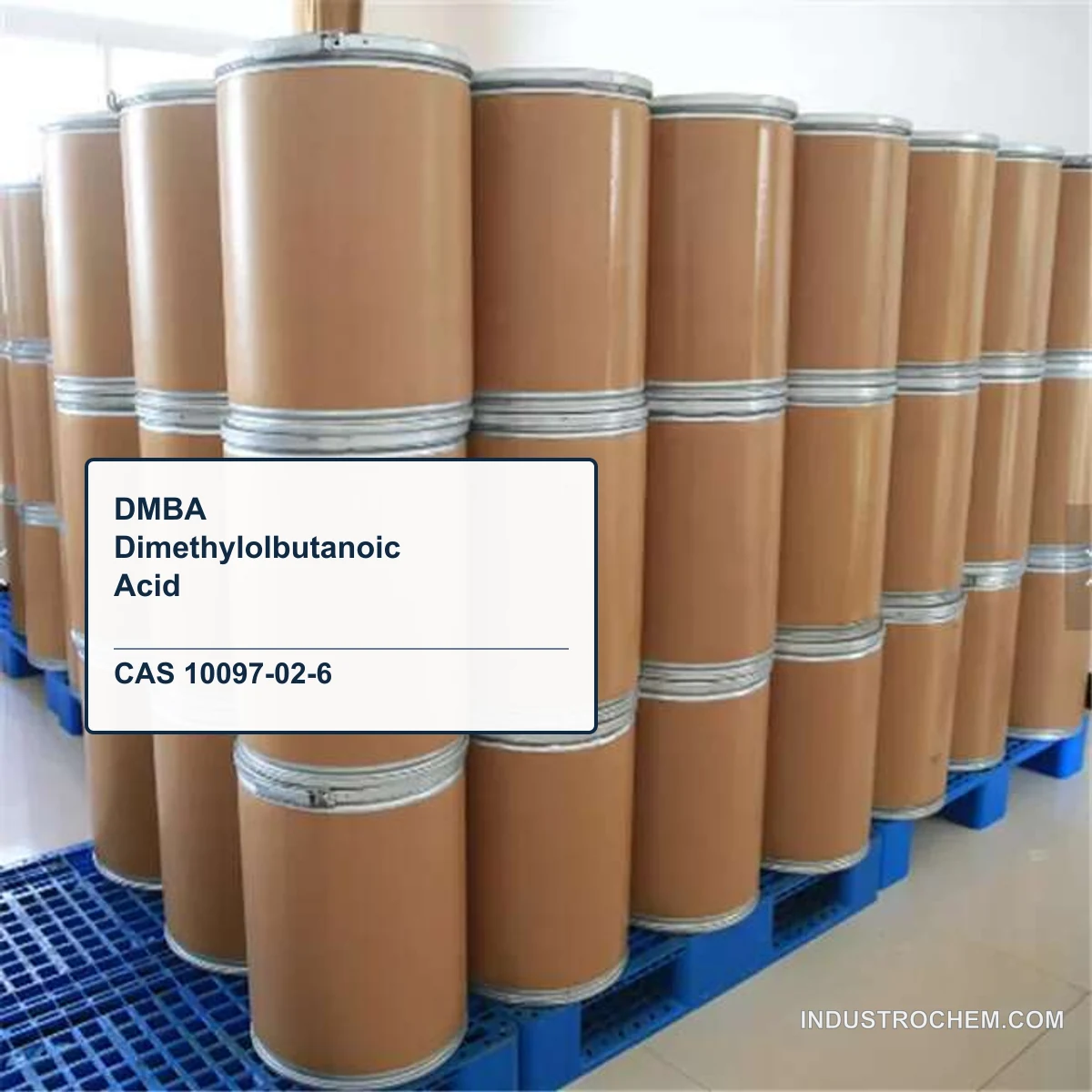
2,2-Bis(hydroxymethyl)butyric Acid (DMBA) CAS 10097-02-6 is a diol-acid monomer used as a hydrophilic chain extender for waterborne polyurethane and polyester resin systems. Confirm assay, melting range, acid value, application, required documents, quantity, packaging, and destination before quotation.
2,2-Bis(hydroxymethyl)butyric Acid (DMBA) CAS 10097-02-6
- CAS: 10097-02-6
- Synonyms: 2,2-Bis(hydroxymethyl)butyric acid, Dimethylolbutanoic acid, DMBA, 2,2-Dimethylolbutyric acid
- Molecular Formula: C₆H₁₂O₄
- Grade: Confirm the current product-specific specification.
- Package: Confirm packaging requirements with quantity, destination, and handling needs.
Product Description
Technical Specifications (TDS)
The following data represents our standard export specifications, compliant with major Chinese manufacturing standards.
| Test Item | Specification | Test Method |
| Appearance | White crystalline powder | Visual |
| Purity (Assay) | ≥ 99.0% | HPLC |
| Melting Point | 108.0 – 115.0°C | Capillary Method |
| Moisture Content | ≤ 0.50% | Karl Fischer |
| Ash Content | ≤ 0.05% | Gravimetric |
| Hydroxyl Value | 725 – 750 mg KOH/g | Titration |
| Acid Value | 370 – 385 mg KOH/g | Titration |
| Iron (Fe) | ≤ 10 ppm | ICP-OES |
| Solubility | Soluble in Water, Acetone, NMP | — |
Applications
DMBA is engineered to improve the stability, mechanical properties, and appearance of water-based polymer systems.
1. Waterborne Polyurethane (PUD)
- Role: Acts as the primary hydrophilic chain extender.
- Benefit: The ethyl group in DMBA improves the flexibility and hydrolysis resistance of the final film compared to the methyl group in DMPA. It allows for the production of solvent-free PUDs by lowering the process viscosity.
- End Uses: Leather finishing agents, textile coatings, water-based wood lacquers, and automotive basecoats.
2. Water-Soluble Polyesters & Alkyds
- Role: Functional monomer introducing carboxylic acid groups.
- Benefit: Enables water dispersibility without external surfactants, improving adhesion and chemical resistance.
3. Epoxy Resin Modification
- Role: Cross-linking agent.
- Benefit: Enhances the water compatibility of epoxy systems used in electro-deposition coatings (E-coat).
Quality Assurance (QA)
We understand that consistency is vital for polymer synthesis. Our manufacturing process adheres to strict quality control protocols:
- Batch-to-Batch Consistency: Every lot is tested using HPLC (High-Performance Liquid Chromatography) to ensure purity ≥ 99.0%.
- Impurity Control: We strictly monitor metal ion content (Fe, Na) to prevent catalytic interference during your polymerization process.
- Traceability: Full documentation, including Certificate of Analysis (COA) and chromatograms, is provided with every shipment. Our facility operates under ISO 9001:2015 management standards.
Storage, Handling & Safety
Storage Conditions:
- DMBA is hygroscopic (absorbs moisture from the air). It must be stored in tightly sealed original packaging.
- Keep in a cool (< 30°C), dry, and well-ventilated area, away from direct sunlight and heat sources.
- Recommended shelf life is 24 months when stored properly.
Safety Precautions (PPE):
- Inhalation: Use a dust mask (N95/P2) to avoid inhaling fine powder.
- Skin/Eye Contact: Wear safety goggles and chemical-resistant gloves. DMBA acts as a mild acid; rinse immediately with plenty of water if contact occurs.
- Disposal: Dispose of contents/container in accordance with local/regional/national regulations.
- Refer to the Material Safety Data Sheet (MSDS) for comprehensive safety information.
FAQ - Technical & Supply Chain
-
Q:
What is DMBA CAS 10097-02-6?
A: DMBA is the abbreviation for 2,2-Bis(hydroxymethyl)butyric Acid, also called Dimethylolbutanoic Acid or 2,2-Dimethylolbutyric Acid. It is a diol-acid monomer with molecular formula C₆H₁₂O₄ and molecular weight about 148.16, supplied as a white crystalline solid or white powder. -
Q:
How does DMBA compare with DMPA?
A: Both are hydrophilic diol-acid chain extenders, but DMBA is 2,2-Bis(hydroxymethyl)butyric Acid while DMPA is 2,2-Bis(hydroxymethyl)propionic Acid. DMBA is generally reported to have better solubility in organic solvents and higher water solubility, which can improve processing and reduce or avoid organic solvent use in waterborne polyurethane systems. -
Q:
What is DMBA used for?
A: DMBA is used as a hydrophilic chain extender and functional monomer in waterborne polyurethane dispersions, waterborne polyester resins, waterborne epoxy systems, water-based coatings, adhesives, leather finishes and specialty inks. It introduces carboxylic acid and hydroxyl functionality that supports dispersion stability and film formation. -
Q:
Which specifications are commonly checked for DMBA?
A: Compare content or assay, melting range, water content, acid value, hydroxyl value, ash and residual formaldehyde. Typical commercial DMBA has content about 99% or higher, melting point about 108-115 °C, water 0.3% max, acid value about 374-378 mg KOH/g and hydroxyl value about 728-782 mg KOH/g. -
Q:
How should DMBA be stored?
A: Store DMBA in tightly closed, moisture-protective containers in a cool, dry, ventilated area, typically around 5-35 °C. Avoid dust generation, strong oxidizers and prolonged exposure to humid air; common packaging includes 25 kg cartons or bags with an inner moisture barrier.
Ordering & Documentation
Key information for document requests, quotations, and supply planning.
Documents
Tell us which documents your procurement team needs. Before an order, we will check whether the quoted source can provide them for the offered lot.
Quotation
Send the CAS number, grade, quantity, packing preference and destination.
Sample & Supply
Ask whether samples, trial quantities or repeat orders are possible. We will check each request against the sourced product and current offer.
Storage & Shipping
Product-specific conditions are confirmed before order.