










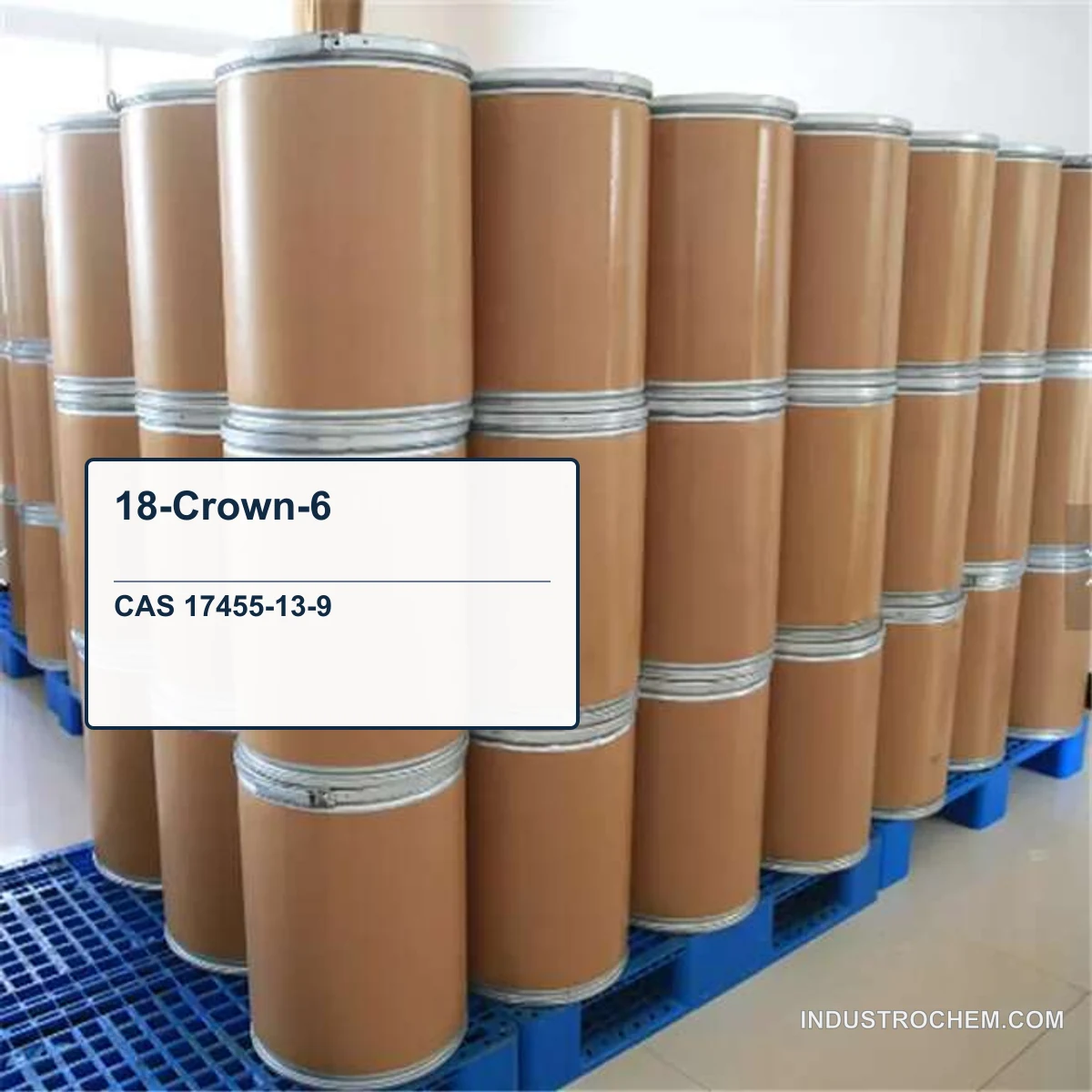
• 18-Crown-6 CAS 17455-13-9
  • 18-Crown-6 CAS 17455-13-9
  • 18-Crown-6 CAS 17455-13-9

18-Crown-6 CAS 17455-13-9

18-Crown-6 is a cyclic polyether classified as a crown ether, widely used as a phase transfer catalyst and complexing agent in organic and inorganic reaction systems. Through selective coordination with alkali metal cations, particularly potassium ions, it enhances ion solubility and facilitates reaction efficiency across biphasic systems. In industrial chemical processes, 18-Crown-6 is typically applied in phase transfer catalysis, specialty synthesis routes, and controlled reaction environments where ion transport and stabilization are required. For industrial sourcing, the material is available with competitive factory pricing, customized specifications, and supporting documentation including MSDS, TDS, COA, supplied for bulk supply.

  • CAS: 17455-13-9
  • Synonyms: Crownwhitextl, 18-Crown-6-ether
  • Einecs: 241-473-5
  • Molecular Formula: C12H24O6
  • Grade: Industrial grade 99%
  • Package: 200kg iron drum or 50kg plastic drum packing
Request a quote
Share:

Product Description

18-Crown-6
CAS No.: 17455-13-9
Molecular Formula: C12H24O6
Molecular Weight: 264.31536
EINECS Number: 241-473-5

Physical and chemical properties
Appearance and shape: colorless crystal
Density: 0.995
Melting point: 36-40°C
Boiling point: 395.8 ºC at 760 mmHg
Refractive index: 1.4577 (50 C)
Flash point: >110°C
Storage conditions: Store at 0-5°C
Sensitivity: hygroscopicity

Production method and use
It is usually prepared by the Wilhelm synthesis method, that is, the reaction of alkal salts with halogenated alkanes. Uses: One of the main characteristics of crown ether is that it can form stable complexes with various metal salts, ammonium salts, organic cationic compounds, etc. This property allows various salts to be dissolved in organic solvents. Crown ether can incorporate cationic chelators into the chelation, and at the same time, due to the outward-facing organic genes, complexes can be formed, and can also be soluble in non-polar organic solvents. At this time, the unsolvated anions exist in the solvent in the form of bare anions, so they are extremely active. Crown ether dissolves alkali metals and organoalkali metal compounds in organic solvents. Therefore, it has found a wide range of applications in organic synthesis, optical splitting, heavy metal chelating, separation, analysis, and physiological activity in medicine and biochemistry. For example, it is used as a phase transfer catalyst, so that many reactions that are difficult to react under traditional conditions or even do not occur can be carried out smoothly, such reactions have fast rates, simple conditions, easy operation and high yields. For example, the yield of benzoin’s condensation reaction in aqueous solution is extremely low, and if 7% crown ether is added to this aqueous solution, a yield of 78% benzoin can be obtained. This reaction can also be performed in benzene (or acetonitrile), and although potassium cyanide is insoluble in benzene, if 18-crown-6 is added, not only can the reaction occur, but the yield can be as high as 95%. Toxicity of 18-crown-6: The lethal oral dose in rats is 300 mg/kg. It is irritating to the eyes and skin.

FAQ - Technical & Supply Chain

  • Q:

    How is 18-Crown-6 chemically identified to ensure consistency with CAS 17455-13-9?

    A: 18-Crown-6 is identified by its cyclic polyether structure consisting of six ether oxygen atoms and an 18-membered ring. Industrial confirmation typically relies on CAS alignment, structural verification, and standard analytical consistency.
  • Q:

    Is 18-Crown-6 mainly used as a catalyst component or as a structural raw material in formulations?

    A: It is commonly applied as a phase transfer catalyst or ion-complexing component within reaction systems, rather than serving as a bulk structural raw material in end formulations.
Documents

Documents and Product Support

For product review and sourcing evaluation, supporting documents can be coordinated according to the product type, inquiry stage, and order requirements.

  • COA for batch-based quality reference
  • TDS for key physical and chemical information
  • SDS / MSDS for handling, storage, and safety reference
  • Packing information for sample, trial, and bulk orders
  • Technical communication based on application and specification requirements
Quotation

Information to Confirm Before Quotation

Clear sourcing information helps reduce specification mismatch and allows a more accurate quotation before sample or bulk order discussion.

  • Product name and CAS number
  • Application or intended end use
  • Required purity, grade, or specification
  • Sample quantity, trial order, or bulk demand
  • Preferred packing form or net weight
  • Destination country or port
  • Required documents or compliance expectations
Storage & Handling

Packaging, Storage, and Handling Notes

Packaging form, storage conditions, shelf life, and shipment arrangements should be confirmed according to the product characteristics, package size, and destination requirements.

Before order confirmation, buyers are advised to review the corresponding product documents and confirm whether any special storage, labeling, or handling requirements apply.

Supply Support

Sample, Bulk Order and Repeat Supply Support

Support can be arranged for sample discussion, bulk supply planning, packaging confirmation, and routine sourcing communication based on the actual product and order requirements.

For repeat-use formulations or long-term procurement plans, buyers may discuss specification consistency, packaging preferences, delivery expectations, and document coordination in advance.

Contact Form

Use our contact form to send us your questions, suggestions or comments. We will respond as soon as possible.