Chemical products
  •  Trioctylamine CAS 1116-76-3

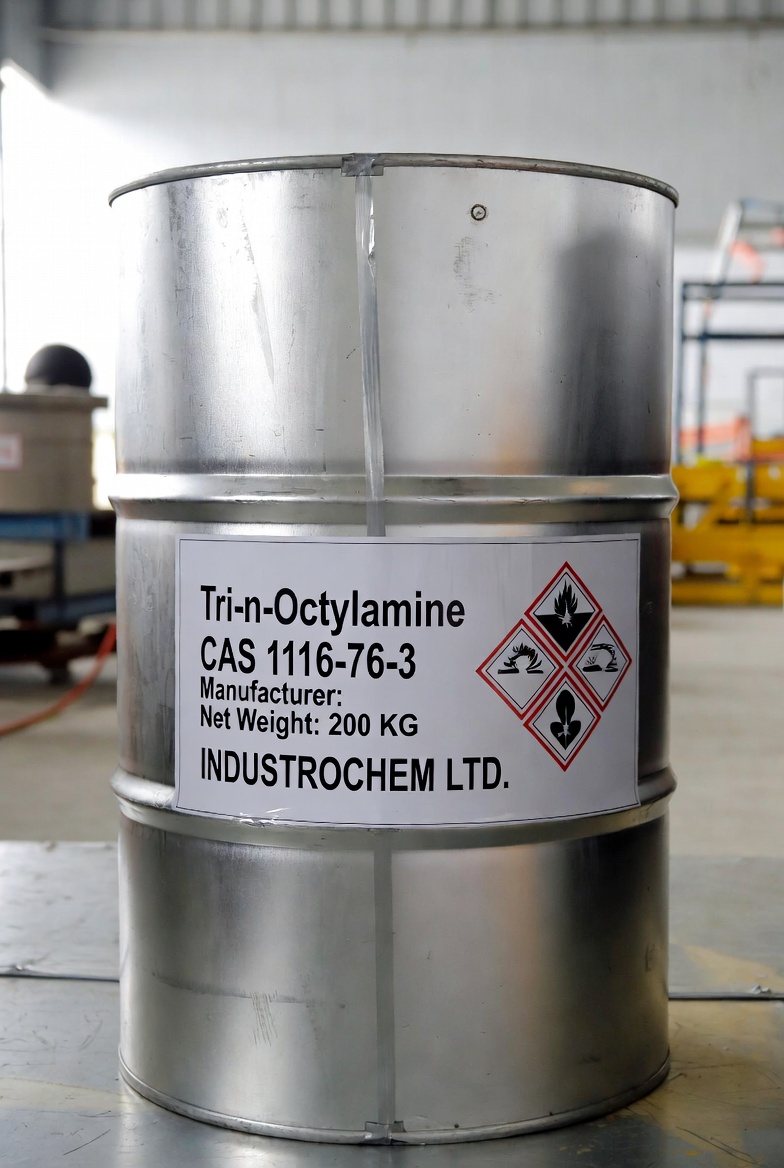
 Trioctylamine CAS 1116-76-3

Trioctylamine (CAS 1116-76-3) is a high-molecular-weight tertiary amine commonly supplied as a liquid for industrial applications requiring selective extraction, phase transfer, or amine-based reactivity. It is primarily used in hydrometallurgical solvent extraction systems, acid recovery processes, and as an intermediate in organic synthesis.

From a supply perspective, Trioctylamine is typically delivered in liquid form suitable for direct use in industrial formulations or processing systems. Standard export packaging is available, with documentation such as COA, TDS, and SDS provided to support procurement and handling requirements.

  • CAS: 1116-76-3
  • Synonyms: Tri-n-octylamine; TOA
  • Einecs: 214-242-1
  • Molecular Formula: C24H51N
  • Grade: Industrial / Technical grade
  • Package: Available in standard export liquid chemical packaging; packaging format can be arranged based on order volume and logistics requirements
Request a quote
Share:

Product Description

Physicochemical Properties

AppearanceColorless to pale yellow liquid
OdorAmine-like odor
Molecular WeightApprox. 353.7 g/mol
Boiling PointHigh boiling (>300°C, decomposition possible)
DensityApprox. 0.80–0.83 g/cm³ (at 20°C)
SolubilityInsoluble in water; soluble in organic solvents
Flash Point>150°C
Vapor PressureLow at ambient temperature

Typical Applications

  • Hydrometallurgical extraction: Used as an extractant in solvent extraction systems for recovery and separation of metals such as uranium, rare earth elements, and other metal ions.
  • Acid recovery systems: Applied in extraction of mineral acids (e.g., hydrochloric acid, sulfuric acid) from aqueous streams.
  • Chemical intermediate: Utilized in the synthesis of quaternary ammonium compounds and other amine derivatives.
  • Phase transfer and separation processes: Functions as an organic phase component in liquid-liquid extraction systems.

For related amine raw material pages, compare Octadecyldimethylamine, Triethylamine, and TMEDA.

Packaging

Trioctylamine is supplied as a liquid and is typically packed in clean, sealed drums or intermediate bulk containers (IBC) suitable for liquid chemical transport. Packaging materials are selected to ensure compatibility with amine-based substances and to prevent contamination during storage and handling.

For export supply, containers are prepared to maintain product integrity during long-distance transportation. Packaging arrangements may be adjusted based on order quantity and logistical requirements.

Storage

Store in a cool, well-ventilated area away from direct sunlight and sources of heat or ignition. Containers should be kept tightly closed to avoid contact with air and moisture. Proper handling procedures should be followed to maintain product stability and prevent contamination during storage and transfer.

FAQ - Technical & Supply Chain

  • Q:

    What is Trioctylamine CAS 1116-76-3?

    A: Trioctylamine, also called tri-n-octylamine or TOA, is a high-molecular-weight tertiary aliphatic amine with the formula C24H51N. It consists of three octyl chains attached to a central nitrogen atom, giving it strong hydrophobicity, low volatility, and good compatibility with organic solvents.
  • Q:

    Why is Trioctylamine used in uranium and rare earth solvent extraction?

    A: Its tertiary amine nitrogen forms reversible ion pairs with acidic metal complexes, allowing uranium, rare earth elements, and other metal ions to transfer from an aqueous phase into an organic phase. This acid-base extraction mechanism is widely used in hydrometallurgical separation and purification circuits.
  • Q:

    Is Trioctylamine soluble in water?

    A: No, Trioctylamine is practically insoluble in water and is designed for organic-phase or biphasic extraction systems. It is soluble in many organic solvents, which is why it functions as an extractant rather than an aqueous additive.
  • Q:

    What are the key physical specifications of Trioctylamine?

    A: Commercial Trioctylamine is typically a clear, colorless to pale yellow liquid with an amine odor, a density near 0.81-0.83 g/cm3, and a boiling point around 365-370 C. Its high molecular weight also contributes to low vapor pressure and reduced evaporation during industrial handling.
  • Q:

    Can Trioctylamine be regenerated and reused after extraction?

    A: Yes. The extracted acid or metal complex can be stripped from the loaded organic phase with an alkaline solution, which releases the target species and regenerates the amine for another extraction cycle. This reversibility is a key reason TOA is used in continuous solvent-extraction processes.

Ordering & Documentation

Key information for document requests, quotations, and supply planning.

Documents

COA, TDS, SDS/MSDS and packing details are available on request.

Quotation

Send the CAS number, grade, quantity, packing preference and destination.

Sample & Supply

Support is available for samples, trial orders, bulk and repeat supply.

Storage & Shipping

Product-specific conditions are confirmed before order.

Contact Form

Use our contact form to send us your questions, suggestions or comments. We will respond as soon as possible.