










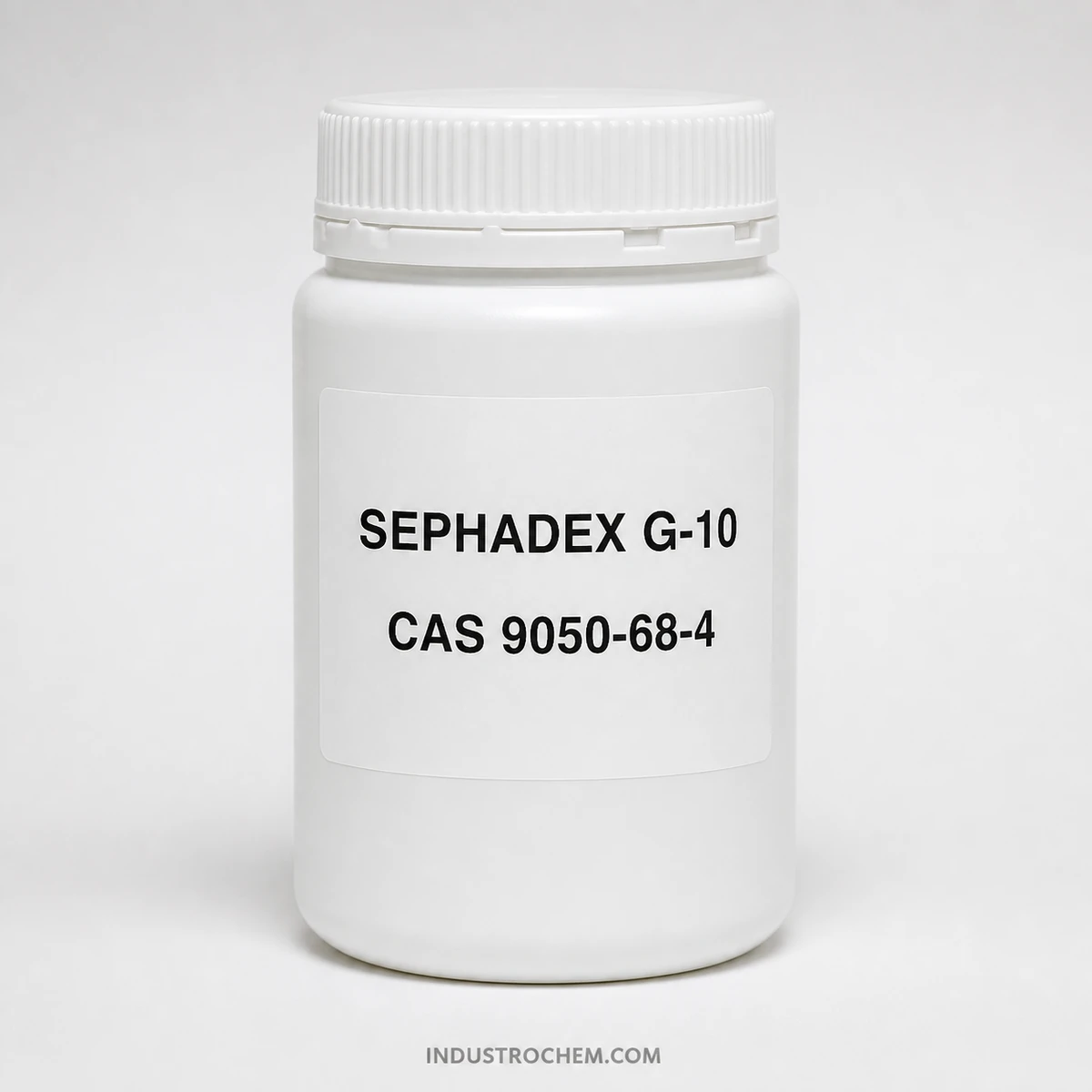
Sephadex G-10 is a cross-linked dextran–based industrial ingredient, gel filtration medium, and chromatography material designed for molecular size separation in aqueous systems. Identified by CAS 9050-94-6, its three-dimensional polymer network provides defined pore size distribution, enabling separation based on molecular exclusion rather than chemical interaction. In industrial and process-scale environments, it is typically applied in gel filtration chromatography, particularly for desalting and low-molecular-weight compound separation in formulated process streams. The material is supplied under competitive factory pricing, supports customized specifications, and is accompanied by MSDS, TDS, COA documentation for bulk supply.
Sephadex G-10 CAS 9050-94-6
- CAS: 9050-68-4
- Synonyms: Sephadex G10, Cross-linked dextran, Dextran gel, Gel filtration dextran
- Einecs: 243-442-1
- Molecular Formula: C₁₃H₁₀BrN₃O₂
- Grade: Industrial grade 99%
- Package: 200kg iron drum or 50kg plastic drum packaging
Product Description
Physicochemical properties
| Property | Description |
|---|---|
| Chemical Name | Sephadex G10 (Dextran Gel G10) |
| CAS Number | 9050-68-4 |
| Molecular Formula | C₁₃H₁₀BrN₃O₂ |
| Appearance | White or off-white spherical beads (dry form); swells to form a gel in aqueous solutions |
| Density | 1.7 ± 0.1 g/cm³ |
| Boiling Point | 461.1 ± 25.0 °C at 760 mmHg (Note: This value is likely for a specific component or impurity; dextran gels decompose before boiling) |
| Flash Point | 232.7 ± 23.2 °C |
| Refractive Index | 1.721 |
| Solubility | Insoluble in water and organic solvents; swells in water to form a gel |
| pH Stability | Stable over a wide pH range (typically pH 2-13) |
| Particle Size Range | 40-120 μm (common grade); other grades available (e.g., 200-500 μm) |
| Fractionation Range | Globular proteins: < 700 Da; linear molecules: < 700 Da (minimum exclusion limit) |
| Application | Gel filtration chromatography for desalting, buffer exchange, and purification of small biomolecules (peptides, small proteins, oligosaccharides) |
| Storage Conditions | Store at 4-30 °C in a dry, well-ventilated area; avoid exposure to moisture and direct sunlight |
Application Areas
Separation and purification: used for the separation and purification of peptides, proteins (molecular weight>700), and cephalosporin drugs.
Desalination and buffer replacement: Quickly remove salt, dye, and radiolabeled contaminants, suitable for small molecule biological samples.
Antibiotic analysis: detecting high molecular weight polymers of antibiotics such as cefoperazone sodium and penicillin
Storage conditions
Storage medium: It should be sealed with a 20% ethanol aqueous solution to prevent microbial growth and water evaporation.
Temperature control: It is recommended to refrigerate at 4-8 ℃ (freezing is prohibited), and store at room temperature with strict sealing.
Avoid oxidants: long-term contact with oxidants will damage the gel structure, so keep away from such substances
Safety precautions
Operating specifications: pH range: 2-13, avoid strong acids and bases (concentration<0.15 moles). Do not backwash in reverse to prevent damage to the column tail sieve plate.
Personal protection: It is recommended to wear goggles, gloves, and N95 masks during operation.
Sample processing: Filter with a 0.45 μ m filter membrane before use to avoid pigment or impurity clogging of column 4.
Swelling treatment: dry powder needs to be soaked in distilled water for 24 hours or swelled with hot water (not boiling) to remove floating gel fragments
FAQ - Technical & Supply Chain
-
Q:
Does Sephadex G-10 correspond to the same CAS number as cross-linked dextran?
A: Yes. Sephadex G-10 is a specific grade within the cross-linked dextran material category and corresponds to the same CAS-registered polymeric substance. -
Q:
Is Sephadex G-10 intended for process or industrial chromatography rather than analytical-only use?
A: Sephadex G-10 is commonly used in standardized gel filtration chromatography processes where defined molecular exclusion limits are required, including preparative and process-oriented separation systems.
Documents and Product Support
For product review and sourcing evaluation, supporting documents can be coordinated according to the product type, inquiry stage, and order requirements.
- COA for batch-based quality reference
- TDS for key physical and chemical information
- SDS / MSDS for handling, storage, and safety reference
- Packing information for sample, trial, and bulk orders
- Technical communication based on application and specification requirements
Information to Confirm Before Quotation
Clear sourcing information helps reduce specification mismatch and allows a more accurate quotation before sample or bulk order discussion.
- Product name and CAS number
- Application or intended end use
- Required purity, grade, or specification
- Sample quantity, trial order, or bulk demand
- Preferred packing form or net weight
- Destination country or port
- Required documents or compliance expectations
Packaging, Storage, and Handling Notes
Packaging form, storage conditions, shelf life, and shipment arrangements should be confirmed according to the product characteristics, package size, and destination requirements.
Before order confirmation, buyers are advised to review the corresponding product documents and confirm whether any special storage, labeling, or handling requirements apply.
Sample, Bulk Order and Repeat Supply Support
Support can be arranged for sample discussion, bulk supply planning, packaging confirmation, and routine sourcing communication based on the actual product and order requirements.
For repeat-use formulations or long-term procurement plans, buyers may discuss specification consistency, packaging preferences, delivery expectations, and document coordination in advance.
-2.jpg)


