










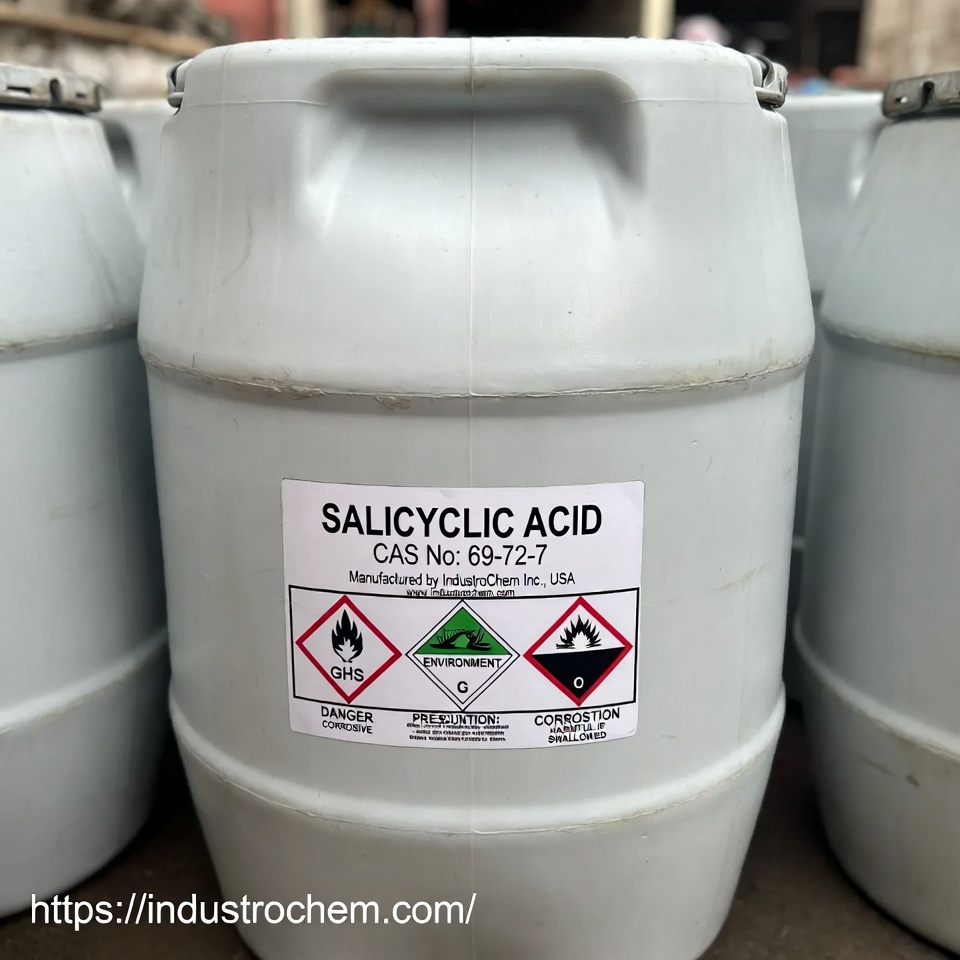
Salicylic Acid (2-hydroxybenzoic acid), CAS 69-72-7, is also known as o-hydroxybenzoic acid. It is an aromatic hydroxy acid used in chemical synthesis. Confirm the offered grade, assay, impurity limits, intended-use suitability, packaging and current documents.
Salicylic Acid CAS 69-72-7
- CAS: 69-72-7
- Synonyms: Salicylic acid; 2-Hydroxybenzoic acid; o-Hydroxybenzoic acid
- Einecs: 200-712-3
- Molecular Formula: C₇H₆O₃
- Grade: Confirm current product specification
- Package: Confirm packaging for the offered form
Product Description
Physicochemical properties
| Property | Description |
|---|---|
| CAS Number | 69-72-7 |
| Molecular Formula | C₇H₆O₃ |
| Molecular Weight | 138.12 g/mol |
| Appearance | White crystalline powder or needles |
| Odor | Faint phenolic odor |
| Solubility | Slightly soluble in water (0.2% at 20°C), freely soluble in ethanol, ether, and chloroform, soluble in hot benzene |
| Melting Point | 158-161°C |
| Boiling Point | 211°C (at 2.67 kPa) |
| Density | 1.44 g/cm³ (at 20°C) |
| pH (saturated solution) | 2.4 |
| Stability | Confirm stability and storage conditions in the current SDS. |
| Toxicity | Confirm hazards and exposure controls in the current SDS. |
Applications
1. Chemical Synthesis
- Aromatic acid intermediate
- Esterification and substitution chemistry
- Application-specific grade review
2. Formulation Review
- Confirm intended-use suitability and applicable requirements
- Confirm intended-use suitability and applicable requirements
- Confirm intended-use suitability and applicable requirements
3. Materials and Chemical Processing
- Intermediate for dyes, pigments and chemical synthesis
- Use suitability must be confirmed for the intended process
- Chemical synthesis and technical evaluation
Storage & Safety
Storage Conditions
- Follow the current SDS for the offered form.
- Follow the current SDS for the offered form.
- Follow the current SDS for the offered form.
Safety & Handling
- Follow the current SDS for hazard and exposure controls.
- Follow the current SDS for hazard and exposure controls.
- Follow the current SDS for hazard and exposure controls.
Recommended PPE
- PPE selection must follow the current SDS and site risk assessment.
- PPE selection must follow the current SDS and site risk assessment.
- PPE selection must follow the current SDS and site risk assessment.
- PPE selection must follow the current SDS and site risk assessment.
Quality Assurance
This page does not verify a specific Salicylic Acid grade, certificate, assay, packaging or shipment document. Request the current supplier specification for the offered material.
- Identity evidence for the offered material
- Applicable specification and analytical method
- Current technical and safety documentation
- Assay method for the offered material
- Relevant physical-property information
- No GMP, ISO or certificate claim is made without current evidence.
Confirm document availability for the exact offered material; this page is not a lot-specific COA, SDS or TDS.
FAQ - Technical & Supply Chain
-
Q:
Are Salicylic Acid and 2-Hydroxybenzoic Acid the same substance?
A: Yes. Both names identify the ortho-hydroxy isomer, CAS 69-72-7, formula C₇H₆O₃. They are not interchangeable with 3- or 4-hydroxybenzoic acid. Confirm the full name, CAS number and identity test when qualifying a new source or changing from a mixed or technical aromatic-acid stream. -
Q:
Which specifications should be agreed for Salicylic Acid?
A: Start with the intended technical, cosmetic, pharmaceutical or other grade and its governing standard. Agree assay, identification, melting range, water or loss on drying, residue on ignition, chloride, sulfate, iron, heavy metals, related substances and color as applicable. Review the batch COA using the stated methods rather than comparing purity labels alone. -
Q:
When do particle size and packaging matter for bulk Salicylic Acid?
A: Particle distribution can affect dissolution, dispersion, dust control and blending consistency, so specify mesh or laser-diffraction limits when the process is sensitive. Agree powder or crystal form, liner, net weight, palletization and moisture protection. Sample the delivered lot using a method appropriate to the package and particle segregation risk.
Ordering & Documentation
Key information for document requests, quotations, and supply planning.
Documents
Tell us which documents your procurement team needs. Before an order, we will check whether the quoted source can provide them for the offered lot.
Quotation
Send the CAS number, grade, quantity, packing preference and destination.
Sample & Supply
Ask whether samples, trial quantities or repeat orders are possible. We will check each request against the sourced product and current offer.
Storage & Shipping
Product-specific conditions are confirmed before order.