










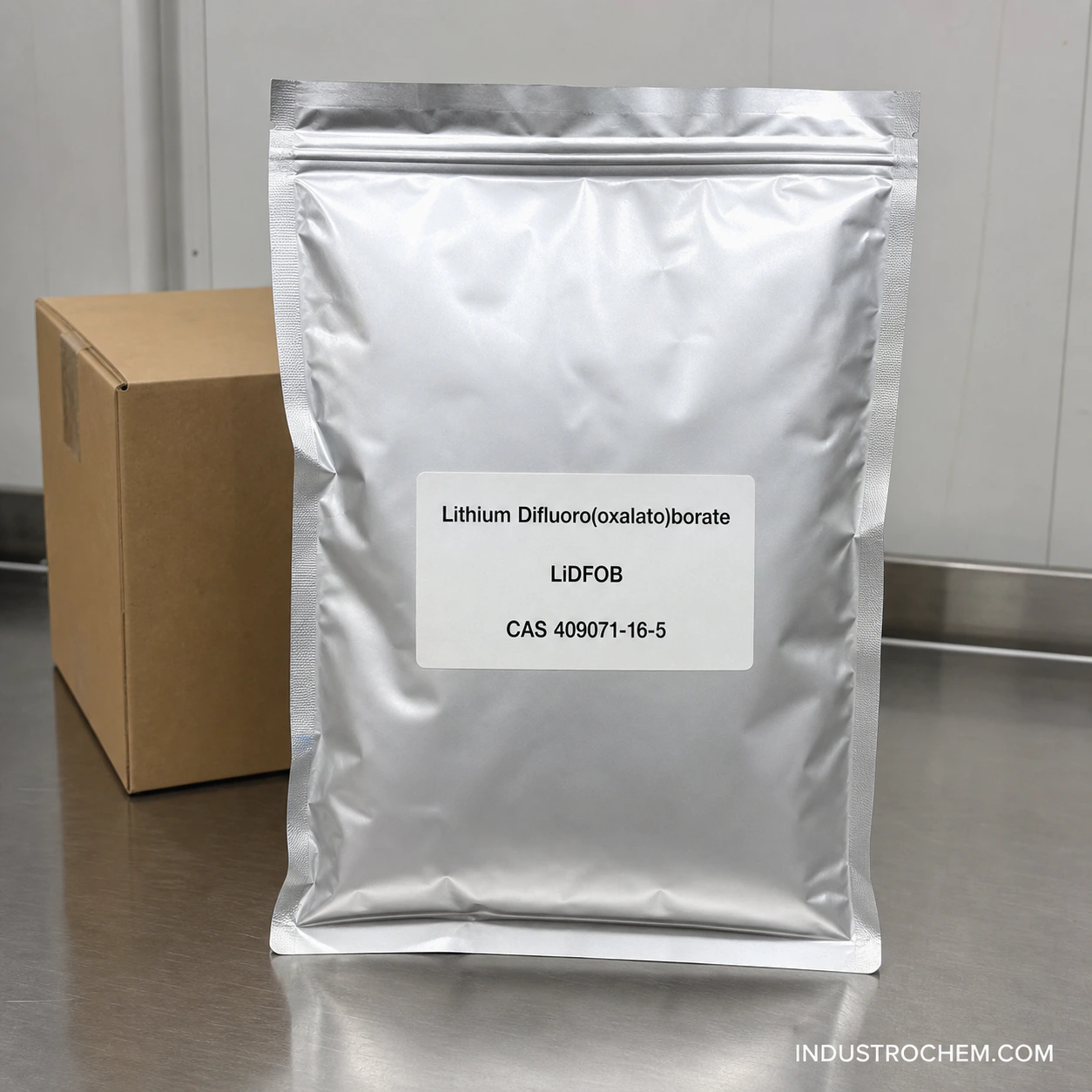
Lithium Difluoro(oxalato)borate (LiDFOB), CAS 409071-16-5, is a lithium salt with molecular formula C₂BF₂LiO₄, used in lithium-ion battery electrolytes. State moisture, impurity, electrolyte-formulation and packaging requirements when requesting a quotation.
Lithium Difluoro(oxalato)borate (LiDFOB) CAS 409071-16-5
- CAS: 409071-16-5
- Synonyms: Lithium Difluoro(oxalato)borate; LiDFOB
- Molecular Formula: C₂BF₂LiO₄
- Grade: Confirm the current product-specific specification.
- Package: Confirm packaging requirements for the proposed material and destination.
Product Description
Lithium Difluoro(oxalato)borate (LiDFOB)
Lithium Difluoro(oxalato)borate (LiDFOB) is a lithium salt identified by CAS 409071-16-5 and molecular formula C₂BF₂LiO₄.
CAS Number: 409071-16-5.
Molecular formula: C₂BF₂LiO₄.
Molar mass: 143.77 g/mol.
Physical form: confirm the current product-specific specification.
Confirm packaging requirements for the proposed material and destination.
LiDFOB may be evaluated in lithium-ion battery electrolyte formulation. Confirm required moisture and impurity limits, formulation context, and destination requirements before quotation.
FAQ - Technical & Supply Chain
-
Q:
Are LiDFOB, LiODFB and Lithium Difluoro(oxalato)borate the same material?
A: Yes. These names all identify CAS 409071-16-5 with formula LiBF2(C2O4), also written C2BF2LiO4. They should not be confused with LiBOB, LiBF4, lithium difluorophosphate or other lithium salts, so include the CAS number and intended electrolyte role in an inquiry. -
Q:
Why is LiDFOB used in lithium-ion battery electrolytes?
A: LiDFOB can function as an electrolyte additive or co-salt to influence electrode interface film formation, cycle performance and stability under certain conditions. It is not a complete electrolyte; the final solvent blend, concentration, electrode system and operating window determine its effect. -
Q:
Which specifications should be agreed for battery-grade LiDFOB?
A: Confirm assay, moisture, acidity or acid-related limits, insoluble matter and the required trace-metal or ionic impurity profile. Battery-grade material is commonly specified at 99.9% or higher assay with tightly controlled moisture, so request the analytical method and acceptance limits. -
Q:
How moisture-sensitive is LiDFOB, and how should it be stored?
A: LiDFOB is strongly hygroscopic and readily soluble in water, so moisture ingress can change its composition and battery performance. Store it cool, dry and tightly closed, ideally under dry inert gas, and minimize exposure to humid air during sampling and transfer. -
Q:
What are the key physical properties of LiDFOB?
A: LiDFOB is normally a white crystalline powder with molecular weight about 143.77 g/mol. Reported data commonly include a melting point around 265-271 C and density around 2.01-2.12 g/cm3, with strong hygroscopicity and ready solubility in water and carbonate, ether, and gamma-butyrolactone solvents.
Ordering & Documentation
Key information for document requests, quotations, and supply planning.
Documents
Tell us which documents your procurement team needs. Before an order, we will check whether the quoted source can provide them for the offered lot.
Quotation
Send the CAS number, grade, quantity, packing preference and destination.
Sample & Supply
Ask whether samples, trial quantities or repeat orders are possible. We will check each request against the sourced product and current offer.
Storage & Shipping
Product-specific conditions are confirmed before order.