










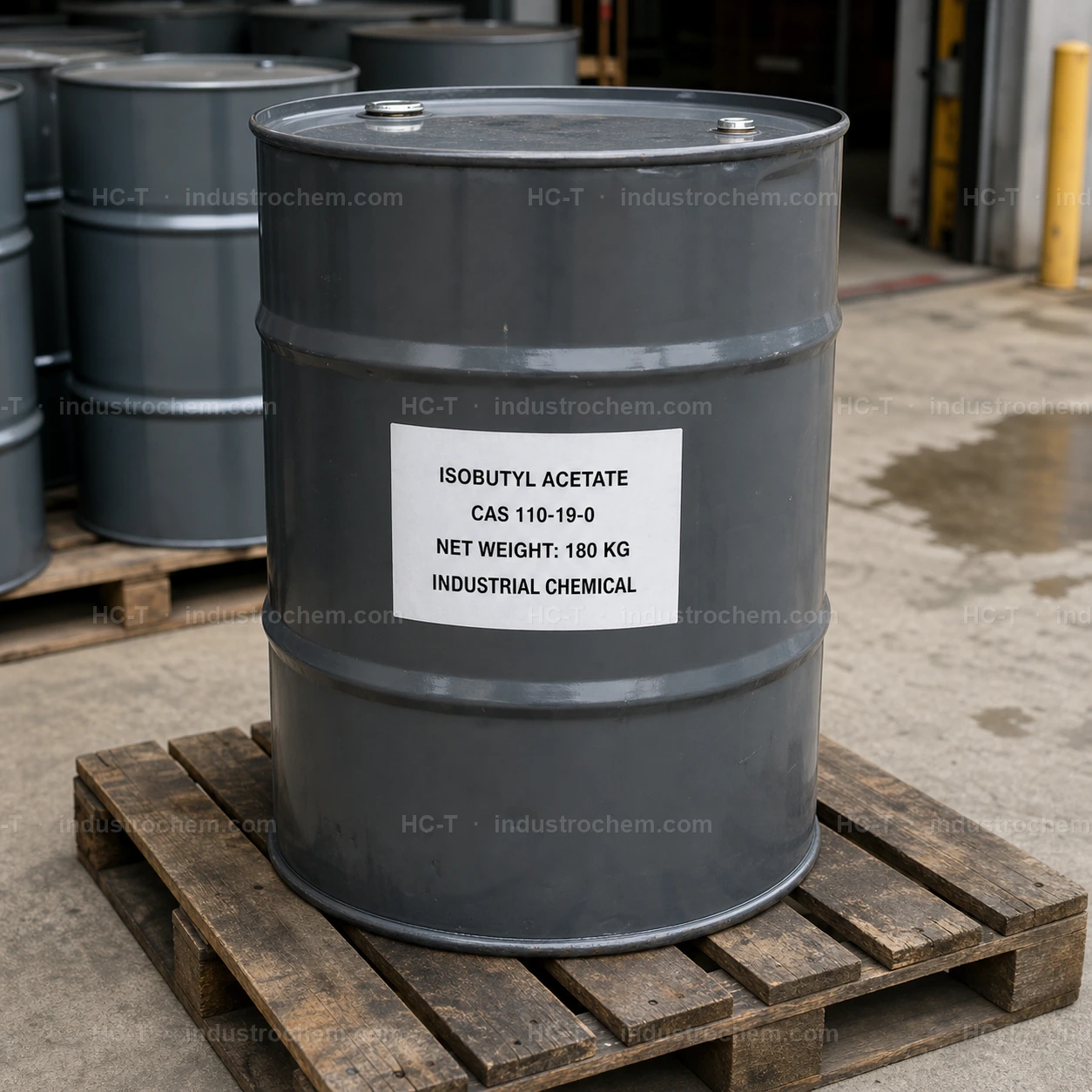
Isobutyl Acetate, also known as 2-methylpropyl acetate, CAS 110-19-0, is an ester solvent supplied for coatings, printing inks, adhesives and process applications. Confirm the required grade, then request a quotation with COA/TDS/SDS for bulk supply.
Isobutyl Acetate CAS 110-19-0
- CAS: 110-19-0
- Synonyms: Isobutyl acetate; 2-Methylpropyl acetate; Isobutyl ethanoate; Acetic acid isobutyl ester
- Einecs: 203-745-1
- Molecular Formula: C6H12O2
- Grade: Industrial solvent grade; GC purity, water, acidity and distillation controls agreed before supply
- Package: Steel drums or IBCs; flammable-liquid handling and shipment classification must follow the current SDS
Product Description
Isobutyl Acetate CAS 110-19-0 is 2-methylpropyl acetate, with EC 203-745-1 and molecular formula C6H12O2.
Synonyms: Isobutyl acetate; 2-methylpropyl acetate; isobutyl ethanoate; acetic acid isobutyl ester.
CAS: 110-19-0.
Molecular formula: C6H12O2.
It is normally supplied as a clear, low-boiling liquid.
It is used mainly as a solvent for coatings, lacquers, printing inks and adhesives, and in reaction or extraction processes.
It is also used in formulated thinners and industrial cleaning blends after compatibility and flammability review.
It is a structural isomer of n-butyl acetate (CAS 123-86-4) and sec-butyl acetate (CAS 105-46-4).
Its branched isobutyl group affects evaporation rate, flash point, water solubility and resin compatibility.
Its ester solvent strength and balanced evaporation profile help control flow, levelling and drying in coating and ink formulations.
Typical values include a boiling point near 116-118 C, density about 0.87 g/cm3 and flash point around 18-22 C closed cup.
It has limited water solubility around 6-7 g/L.
For purchasing, specify GC purity, water, acidity, APHA colour, nonvolatile matter, distillation range and package type.
Keep containers closed and use the current SDS for grounding, ventilation, storage and transport of the flammable solvent.
Use suitable PPE and exposure controls when handling the solvent.
Confirm GC purity, water, acidity and physical consistency on the COA.
Confirm grade, packaging, and specification as required.
The page is an RFQ entry point and does not state stock, price, MOQ, or fixed lead time.
For an RFQ, state the intended application, required grade, quantity, packaging, destination, and document needs.
FAQ - Technical & Supply Chain
-
Q:
What is Isobutyl Acetate CAS 110-19-0?
A: Isobutyl acetate, also called 2-methylpropyl acetate or isobutyl ethanoate, is a branched C4 ester solvent with CAS 110-19-0 and molecular formula C6H12O2. It is normally supplied as a clear, low-boiling liquid and belongs to the butyl acetate isomer family. -
Q:
What are the main applications of isobutyl acetate?
A: Isobutyl acetate is used mainly as a solvent for coatings, lacquers, printing inks and adhesives, and in reaction or extraction processes. It also appears in formulated thinners and industrial cleaning blends after compatibility and flammability review. -
Q:
How does isobutyl acetate differ from n-butyl acetate and sec-butyl acetate?
A: They are structural isomers with separate CAS numbers: n-butyl acetate is 123-86-4 and sec-butyl acetate is 105-46-4. Isobutyl acetate has a branched isobutyl group, so evaporation rate, flash point, water solubility and resin compatibility are not identical even though their solvent roles overlap. -
Q:
Why is isobutyl acetate used in coatings, lacquers and ink solvents?
A: Its ester solvent strength and balanced evaporation profile help control flow, levelling and drying in coating and ink formulations. The branched structure also gives formulators a useful option when a slightly different solvent release profile or resin compatibility is required. -
Q:
Which physical properties and purchase parameters matter when selecting isobutyl acetate?
A: Typical values include a boiling point near 116-118 deg C, density about 0.87 g/cm3, flash point around 18-22 deg C closed cup and limited water solubility around 6-7 g/L. Purchasing should specify GC purity, water, acidity, APHA colour, nonvolatile matter, distillation range, package type and the destination's flammable-liquid requirements.
Ordering & Documentation
Key information for document requests, quotations, and supply planning.
Documents
Tell us which documents your procurement team needs. Before an order, we will check whether the quoted source can provide them for the offered lot.
Quotation
Send the CAS number, grade, quantity, packing preference and destination.
Sample & Supply
Ask whether samples, trial quantities or repeat orders are possible. We will check each request against the sourced product and current offer.
Storage & Shipping
Product-specific conditions are confirmed before order.